لقد كان يومًا آخر من العزلة الذاتية ، وكنت أقوم بأحد تلك المشاريع بنفسي التي تخلينا عنها بعد يومين من بدءنا. كما تعلم ، فإن المشروع الذي سيجعلك مشهوراً سيسمح لك بتعلم لغة برمجة جديدة ، وإطار عمل جديد ، وكل ذلك. بشكل عام ، كان هذا اليوم هو الأكثر شيوعًا ، والأكثر انتشارًا. لم ينذر أي شيء بالمتاعب ، إلى أن تعطلت إحدى المكتبات التي كنت أعمل بها مع المصفوفات بسبب تدفق المكدس ... وذلك عندما بدأ كل شيء في الظهور.
بشكل عام ، أفهم تمامًا أنه كان من الممكن استخدام شيء جاهز ، لكنه ليس مثيرًا للاهتمام.
لماذا LINQ؟
باختصار لأولئك الذين ليسوا على دراية:
تعتبر LINQ (استعلام اللغة المتكاملة) لغة بسيطة ومريحة للاستعلام عن مصدر بيانات. يمكن للكائن الذي يقوم بتنفيذ واجهة IEnumerable (على سبيل المثال ، المجموعات القياسية ، المصفوفات) ، DataSet ، مستند XML أن يعمل كمصدر بيانات.
ويتيح لك LINQ القيام بذلك:
string[] teams = { "", "", " ", " ", "", "" };

var selectedTeams = teams.Where(t=>t.ToUpper().StartsWith("")).OrderBy(t => t);
من المزايا الخاصة أود أن أشير إلى:
- حساب كسول
- تحسين الاستعلامات
- نظام ملائم لطرق التمديد
لا أعرف عنك ، لكن بالنسبة لي شخصيًا ، كان ذلك بمثابة حجة مقنعة من أجل البدء في العمل.
ابدء
أود أن أهرع على الفور إلى الأعمال التجارية ، لكننا لن نفعل ذلك - فنحن بشكل عام أشخاص جادون نكتب أشياء جادة.
لذلك سنضع بعض المتطلبات لأنفسنا ، بالإضافة إلى ما هو موضح في مزايا LINQ:
- يجب أن تكون الشفرة قابلة للتوسيع بسهولة
- يجب أن يكون الرمز سريعًا
Benchmark.js. Lodash, , .
, , , , npm-.
, , , .
:
- Where
- Sort
- Min
, -, :
- Where , .
- Sort , .
- Min .

:

, :
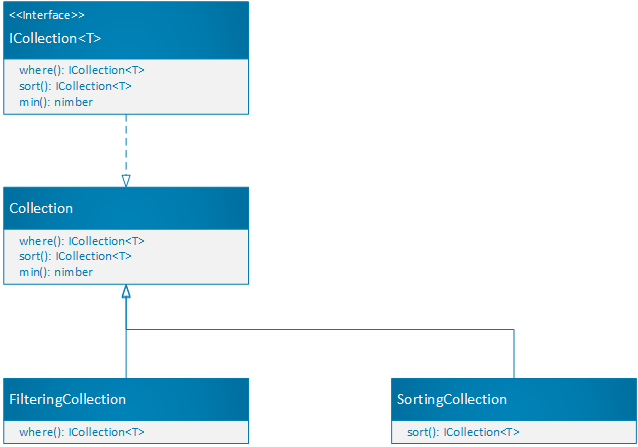
, , , .
export class Collection<T> implements ICollection<T> {
    protected inner: Collection<T>;
    private _computed: T[] | null = null; //          ,     ""

    public where(condition: FilterCondition<T>): ICollection<T> {
        return new FilteringCollection<T>(this, condition);
    }

    public sort(condition?: CompareCondition<T> | undefined): ICollection<T> {
        return new SortingCollection<T>(this, {
            compare: condition
        })
    }

    public min(predicate?: CompareCondition<T> | undefined): T {
        return new MinAggregator(this, predicate).aggregate();
    }

    public toArray(): T[] {
        return this.computed;
    }

    public [Symbol.iterator](): IterableIterator<T> {
        return this.getIterator();
    }

    public getIterator(): IterableIterator<T> {
        return this.computed[Symbol.iterator](); //  ,       for - of
    }

    private get computed(): T[] { //  :
        if (this._computed == null) {
            const result = this.materialize();

            Object.freeze(result);

            this._computed = result;
        }
        return this._computed
    }

    protected materialize(): T[] { //
        return this.inner.toArray();
    }
}
" ?" — , : " ".
:
const collection = new Collection([6, 5, 4, 3, 2, 1]);

const result = collection.where(item => item % 2).sort(); // [1, 3, 5]
, :
        const collection = new Collection([6, 5, 4, 3, 2, 1]);
/* 1) */const filtered = collection.where(item => item % 2);
/* 2) */const sorted = filtered.sort();
1) where Collection, inner.
2) sort FilteringCollection, inner.
, , :
1) materialize FilteringCollection [5, 3, 1].
2) materialize SortingCollection [1, 3, 5].
Where
export class FilteringCollection<T> extends Collection<T> {
    public constructor(iterable: Collection<T> | T[], private condition: FilterCondition<T>) {
        super(iterable);
    }

    public where(condition: FilterCondition<T>): ICollection<T> { //   where

        const result = new FilteringCollection<T>(this.inner, item => condition(item) && that.condition(item));

        return result;
    }

    protected materialize(): T[] { //
        return this.inner.toArray().filter(this.condition);
    }
}
. .
, where(). , ?
, where:
_(cats).where(cat => cat.age < 3).where(cat => cat.age > 1).toArray()
_(cats).where(cat => cat.age < 3 && (function(item){
    return item.age > 1;
}(cat))).toArray()
:
public where(condition: FilterCondition<T>): ICollection<T> { //   where
        const result = new FilteringCollection<T>(this.inner, item => condition(item) && this.condition(item)); // <--

        return result;
    }
"".
materialize filter. . , .
----------------------------------------------------
Filter for 1000000:

Where x 104 ops/sec ±14.73% (61 runs sampled)
Lodash filter x 609 ops/sec ±0.67% (88 runs sampled)
Native filter x 537 ops/sec ±1.69% (85 runs sampled)

Double where x 102 ops/sec ±11.51% (64 runs sampled)
Double lodash filter x 368 ops/sec ±1.00% (88 runs sampled)
Double native filter x 336 ops/sec ±1.08% (84 runs sampled)

10 where x 66.60 ops/sec ±9.15% (59 runs sampled)
10 lodash filter x 99.44 ops/sec ±1.20% (73 runs sampled)
10 native filter x 81.80 ops/sec ±1.33% (70 runs sampled)
----------------------------------------------------
Filter for 1000:

Where x 24,296 ops/sec ±0.90% (88 runs sampled)
Lodash filter x 60,927 ops/sec ±0.90% (89 runs sampled)
Native filter x 204,522 ops/sec ±6.76% (87 runs sampled)

Double where x 20,281 ops/sec ±0.86% (90 runs sampled)
Double lodash filter x 37,553 ops/sec ±0.97% (90 runs sampled)
Double native filter x 115,652 ops/sec ±6.12% (91 runs sampled)

10 where x 9,559 ops/sec ±1.09% (87 runs sampled)
10 lodash filter x 8,850 ops/sec ±0.80% (87 runs sampled)
10 native filter x 22,507 ops/sec ±9.22% (84 runs sampled)
----------------------------------------------------
Filter for 10:

Where x 1,788,009 ops/sec ±0.81% (87 runs sampled)
Lodash filter x 720,558 ops/sec ±0.80% (84 runs sampled)
Native filter x 14,917,151 ops/sec ±0.61% (85 runs sampled)

Double where x 1,257,163 ops/sec ±0.52% (95 runs sampled)
Double lodash filter x 456,365 ops/sec ±0.74% (76 runs sampled)
Double native filter x 8,262,940 ops/sec ±0.64% (90 runs sampled)

10 where x 489,733 ops/sec ±0.67% (94 runs sampled)
10 lodash filter x 135,275 ops/sec ±0.61% (94 runs sampled)
10 native filter x 1,350,316 ops/sec ±0.94% (90 runs sampled)
----------------------------------------------------
: , .
select ( ).
Sort
export class SortingCollection<T, V = T> extends Collection<T> implements ISortingCollection<T> {
    private sortSettings: SortSettings<T, V>[];

    public constructor(iterable: Collection<T>, ...sortSettings: SortSettings<T, V>[]) {
        super(iterable);
        this.sortSettings = _(sortSettings)
        .where(item => !!item.compare || !!item.mapping) //
        .toArray();
    }

    protected materialize(): T[] {
        const comparer = new Comparer(this.sortSettings, this.defaultCompare);

        return  Array.from(this.inner.toArray()).sort(this.sortSettings.length ? (first, second) => comparer.compare(first, second) : undefined);
    }

    private defaultCompare(first: V, second: V): number {
        if(first < second) {
            return -1
        } else if (second < first) {
            return 1
        } else {
            return 0;
        }
    }
}
. . Comparer.
Lodash, js .

----------------------------------------------------
Sort for 1000000:

Sort x 0.80 ops/sec ±3.59% (6 runs sampled)
Lodash sort x 0.97 ops/sec ±27.98% (7 runs sampled)
Native sort x 1.05 ops/sec ±14.71% (7 runs sampled)

SortBy x 0.19 ops/sec ±10.31% (5 runs sampled)
Lodash SortBy x 0.37 ops/sec ±7.21% (5 runs sampled)
Sort after map x 0.47 ops/sec ±8.67% (6 runs sampled)
----------------------------------------------------
Sort for 1000:

Sort x 1,121 ops/sec ±0.77% (85 runs sampled)
Lodash sort x 1,267 ops/sec ±0.77% (89 runs sampled)
Native sort x 1,274 ops/sec ±0.88% (86 runs sampled)

SortBy x 488 ops/sec ±1.45% (80 runs sampled)
Lodash SortBy x 549 ops/sec ±9.60% (70 runs sampled)
Sort after map x 954 ops/sec ±1.50% (83 runs sampled)
----------------------------------------------------
Sort for 10:

Sort x 171,700 ops/sec ±1.38% (85 runs sampled)
Lodash sort x 196,364 ops/sec ±2.01% (80 runs sampled)
Native sort x 250,820 ops/sec ±0.96% (85 runs sampled)

SortBy x 114,064 ops/sec ±0.90% (86 runs sampled)
Lodash SortBy x 86,370 ops/sec ±17.93% (67 runs sampled)
Sort after map x 221,034 ops/sec ±1.31% (87 runs sampled)
----------------------------------------------------
:
± .
Min
تنفيذ الحد الأدنى من مجمع البحث عن العناصر
export class MinAggregator<T> extends ReduceAggregator<T> {
    public constructor(collection: ICollection<T>, condition?: CompareCondition<T>) {
        super(collection, condition ? (first, second) => this.compare(first, second, condition) : (a, b) => a < b ? a : b)
    }

    private compare(first: T, second: T, func: CompareCondition<T>): T {
        return func(first, second) < 0 ? first : second;
    }
}

export class ReduceAggregator<T> extends Aggregator<T> {
    public constructor(private collection: ICollection<T>, protected predicate: ReduceCondition<T>){
        super();
    }

    public aggregate(): T {
        return this.collection.toArray().reduce((first, second) => this.predicate(first, second))
    }
}
لم يتوقعوا؟ ولن يكون هناك مصمم.
بدلاً من ذلك ، سيكون لدينا مجمع.
تفسير
لست متأكدًا مما إذا كنا بحاجة إليه على الإطلاق ، فنحن فقط نقوم بعمل التفاف.
----------------------------------------------------
Aggregate for 1000000:
Min x 43.69 ops/sec ±28.48% (65 runs sampled)
Lodash Min x 117 ops/sec ±0.58% (73 runs sampled)
----------------------------------------------------
Aggregate for 1000:
Min x 61,220 ops/sec ±5.10% (87 runs sampled)
Lodash Min x 111,452 ops/sec ±0.72% (90 runs sampled)
----------------------------------------------------
Aggregate for 10:
Min x 3,502,264 ops/sec ±1.36% (86 runs sampled)
Lodash Min x 4,181,189 ops/sec ±1.48% (86 runs sampled)
----------------------------------------------------
Aggregate By for 1000000 disp 50:
Min By x 23.81 ops/sec ±2.02% (42 runs sampled)
Lodash Min By x 42.66 ops/sec ±2.46% (55 runs sampled)
----------------------------------------------------
Aggregate By for 1000 disp 50:
Min By x 43,064 ops/sec ±0.71% (86 runs sampled)
Lodash Min By x 60,212 ops/sec ±0.89% (87 runs sampled)
----------------------------------------------------
Aggregate By for 100 disp 50:
Min By x 351,098 ops/sec ±1.03% (81 runs sampled)
Lodash Min By x 382,302 ops/sec ±1.39% (76 runs sampled)
----------------------------------------------------
فاز لوداش.
النتيجة
حظيت بوقت ممتع و ممتع
في رأيي ، اتضح أنها مكتبة جيدة أرغب في تطويرها.
إذا كان أي شخص يعرف كيفية تقليل تكلفة التكرار للتصفية ورسم الخرائط ، فهي هنا:
this.inner.toArray().filter(this.condition);
سأجد الجواب!
أنا منفتح على النقد ، أريد أن أجعل الكود أفضل.
شكرا لكم جميعا على اهتمامكم.