ماذا؟ لماذا؟
مرحبا!
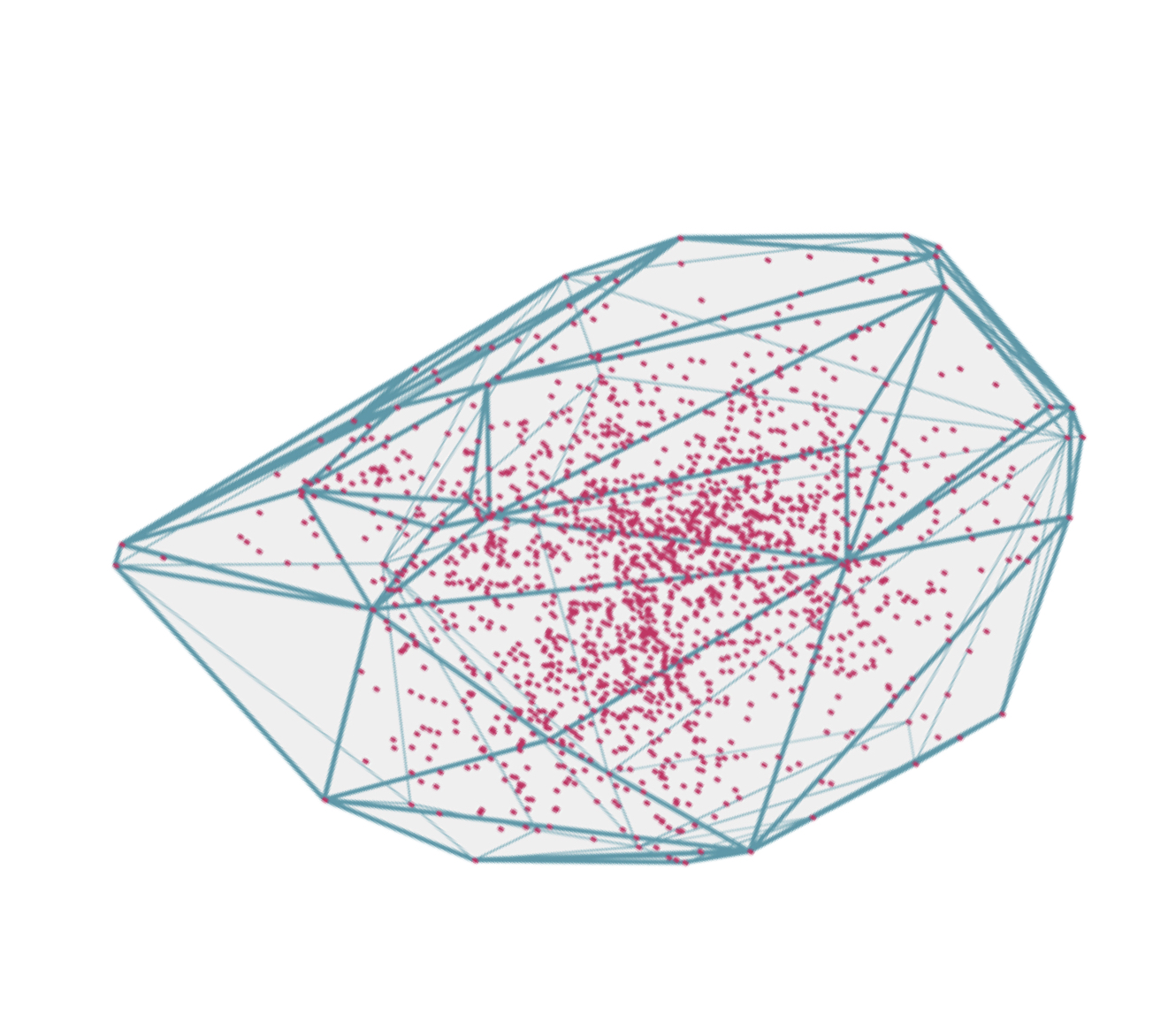
أود التفكير في مشكلة هندسة حسابية ، وهي بناء بدن محدب ثلاثي الأبعاد . كما يبدو لي ، هذه ليست الخوارزمية الأكثر تعقيدًا ولا أبسطها والتي ستكون مثيرة للاهتمام ومفيدة للغاية في التحليل.
إذا لم تكن قد واجهت مثل هذه المهمة من قبل ، أعتقد أنه سيكون من الممتع بالنسبة لك التعرف عليها ، ومعرفة ماهيتها.
إذا كنت قد سمعت للتو شيئًا عن الهياكل المحدبة ، فيمكنك معرفة المزيد عنها.
إذا كنت خبيرًا في الهياكل المحدبة ، فقد ترغب في الاستماع إلى حل مشكلة مثيرة للاهتمام مرة أخرى.
المحتوى
- ماذا؟ لماذا؟
- ما هو بدن محدب؟
- كلمات شائعة
- وصف الخوارزمية
- مقارب
- تنفيذ الخوارزمية
- التنفيذ الكامل
أعبر عن امتناني موجي 4ok للمساعدة في كتابة وتحرير المقال.
ما هو بدن محدب؟
البدن المحدب لمجموعة X هو أصغر مجموعة محدبة تحتوي على المجموعة X.
بشكل صارم ، لكن ليس واضحًا جدًا. سأحاول الآن أن أخبرك بمثال:
تخيل مجموعة من النقاط على مستوى ، ولنفترض أننا نريد أن نعرف ما هو الحد الأدنى لعدد النقاط التي يجب توصيلها بحيث تقع كل مجموعة النقاط المتبقية داخل السطح المحدد. هذه هي مشكلة العثور على الحد الأدنى من بدن محدب.

2D
,
, , , , , , "" , .
, , , 3D . , .
: , ?
— .
— . , , : .
, , .
, ( ) " ".
, 4 . 3 .
, , .
, , 3d , . , .
1.
, , , , .
, .
Z. , , "" Z . XY , . . , . P, , "" — f.
, . Q, f ( prQ). , () {P, Q} {Q, prQ} — — . , Q , . Q .

. R, , P, Q R (0, 0, 1) . , f — XY. , , . , , R .
, , , , ( - ).
, P, Q, R .
-! , .
2.
, , , . , .
: , . , , , , () ( ), , . , , , , .
: , . : .
1. ? , . . E. , , E — R. ( E) , E R. , , , — .
2. , , " ", E , , E .
3. , , . , , . , , , .
4. , . , . , "" , .
5. , "" , .
6. , . , .
, ( ), 3D .
, , . , . N, H , O(NH). H 2N, O(N^2).
, , , O(NlogN), , . 2D , O(NlogN), , , , .
, , : .
, , , , , . C++.
. . , , -. - . ( , ).
struct Point
{
    coordinate x;
    coordinate y;
    coordinate z;
    Point (coordinate x = 0, coordinate y = 0, coordinate z = 0) : x(x), y(y), z(z) {}
    Point operator- (const Point& other) const;
    Point operator+ (const Point& other) const;
    bool operator!= (const Point& other) const;
    bool operator== (const Point& other) const;
};
. 22 ( ).
coordinate Det2x2(coordinate a11, coordinate a12, coordinate a21, coordinate a22)
{
    return a11 * a22 - a12 * a21;
}
( A — — - - AB AC):
Point VectorProduct(const Point& A, const Point& B, const Point& C)
{
    Point a = B - A;
    Point b = C - A;
    return Point (Det2x2(a.y, a.z, b.y, b.z),
                  Det2x2(a.x, a.z, b.x, b.z),
                  Det2x2(a.x, a.y, b.x, b.y));
}
( ):
double GetLenghtVector(Point A, Point B = Point(0, 0, 0))
{
    Point vec = B - A;
    double lenght = std::sqrt(vec.x * vec.x + vec.y * vec.y + vec.z * vec.z);
    return lenght;
}
:
double GetAngle(const Point& n1, const Point& n2)
{
    double len_n1 = GetLenghtVector(n1);
    double len_n2 = GetLenghtVector(n2);
    double scalar_prod = n1.x * n2.x + n1.y * n2.y + n1.z * n2.z;
    if (scalar_prod == 0)
    {
        return 0;
    }
    return std::acos((scalar_prod) / (len_n1 * len_n2));
}
, .
. , . , , , , . , , .
struct Edge
{
    int first;
    int second;
    int flatness; //
    bool is_close = false; //    ,     ?
    Edge(int first, int second, int flatness = -1, Point normal = Point(0, 0 , 0)) :
                    first(first), second(second), flatness(flatness) {}
};
Flatness — . 3 , ( ). — Another, . ( — if — .)
struct Flatness
{
    int first;
    int second;
    int third;
    Point normal; //   ,
    Flatness(int first, int second, int third, Point normal) :
        first(first), second(second), third(third), normal(normal) {}
    int Another(int one, int two);
};
Class .
class ConvexHull
{
    struct Flatness;
    struct Edge;

    std::vector<Point> points_; //
    std::vector<Flatness> verge_; //
    std::vector<Edge> edges_; //

    int count_; //

    int findMinZ() const;
    void findFirstFlatness();
    int returnIsEdgeInHull(int a, int b) const;
    void makeHull();
public:
    ConvexHull(const std::vector<Point>& points): points_(points), count_(points.size()) { makeHull(); }
};
: Z ( , )
int ConvexHull::findMinZ() const
{
    int min_id = 0;
    for (int i = 1; i < count_; ++i)
    {
        if (points_[i].z < points_[min_id].z ||
            (points_[i].z == points_[min_id].z && points_[i].y < points_[min_id].y) ||
            (points_[i].z == points_[min_id].z && points_[i].y == points_[min_id].y &&
                points_[i].x < points_[min_id].x))
        {
            min_id = i;
        }
    }
    return min_id;
}
, :
int ConvexHull::returnIsEdgeInHull(int a, int b) const
{
    for (int i = 0; i < edges_.size(); ++i)
    {
        if ((edges_[i].first == a && edges_[i].second == b) ||
            (edges_[i].first == b && edges_[i].second == a))
        {
            return i;
        }
    }

    return -1;
}
. (-)
. , : . - , , .
:
void ConvexHull::findFirstFlatness()
{
    int first_point, second_point, third_point; //
    first_point = findMinZ();
, Z. "".
    double min_angle = 7; //         2pi,      7
    int min_id = -1;
    for (int i = 0; i < count_; ++i)
    {
        if (first_point == i) //
        {
            continue;
        }
        Point start = points_[first_point];
        Point next = points_[i];
        double angle = GetAngle(start - next, next - Point(next.x, next.y, start.z));
        if (min_angle > angle)
        {
            min_angle = angle;
            min_id = i;
        }
    }
    second_point = min_id;
, .
    min_angle = 7;
    min_id = -1;
    for (int i = 0; i < count_; ++i)
    {
        if (first_point == i || second_point == i)
        {
            continue;
        }
        Point normal = VectorProduct(points_[first_point], points_[second_point], points_[i]);
        double angle = GetAngle(Point(0, 0, 1), normal);
        if (min_angle > angle)
        {
            min_angle = angle;
            min_id = i;
        }
    }
    third_point = min_id;
, , XY, (0, 0, 1). .
( ), .
    if (VectorProduct(points_[first_point], points_[second_point], points_[third_point]).z > 0)
    {
        std::swap (second_point, third_point);
    }
    Point new_normal = VectorProduct(points_[first_point], points_[second_point], points_[third_point]);
    verge_.push_back(Flatness(first_point, second_point, third_point, new_normal)); //
    edges_.push_back(Edge(first_point, second_point, 0));
    edges_.push_back(Edge(second_point, third_point, 0));
    edges_.push_back(Edge(third_point, first_point, 0));
}
:
:
void ConvexHull::makeHull()
{
    findFirstFlatness();
    std::stack<int> stack;
    stack.push(0);
    stack.push(1);
    stack.push(2);
: , . , : .
    while (!stack.empty())
    {
        Point new_normal;
        Edge e = edges_[stack.top()]; //   ,
        stack.pop();
        if (e.is_close) //       ,
        {
            continue;
        }
        int min_id = -1;
        double min_angle = 7;

        for (int i = 0; i < count_; ++i)
        {
            int another = verge_[e.flatness].Another(e.first, e.second);
            if (i != another && e.first != i && e.second != i) // ,
            {
                //    ,    i-
                Point current_normal = VectorProduct(points_[e.second], points_[e.first], points_[i]);
                double angle = GetAngle(current_normal, verge_[e.flatness].normal);

                if (min_angle > angle)
                {
                    min_angle = angle;
                    min_id = i;
                    new_normal = current_normal;
                }
            }
        }
, , e , . , , is_closed = true, , , , — — , .
        if (min_id != -1) //    -     4
        {
            e.is_close = true; //     ,
            int count_flatness = verge_.size(); //
            int first_edge_in_hull = returnIsEdgeInHull(e.first, min_id); //  -1,
            int second_edge_in_hull = returnIsEdgeInHull(e.second, min_id);

            if (first_edge_in_hull == -1)
            {
                edges_.push_back(Edge(e.first, min_id, count_flatness));
                stack.push(edges_.size() - 1);
            }
            if (second_edge_in_hull == -1)
            {
                edges_.push_back(Edge(min_id, e.second, count_flatness));
                stack.push(edges_.size() - 1);
            }
            if (first_edge_in_hull != -1)
            {
                edges_[first_edge_in_hull].is_close = true;
            }
            if (second_edge_in_hull != -1)
            {
                edges_[second_edge_in_hull].is_close = true;
            }

            verge_.push_back(Flatness(e.first, e.second, min_id, new_normal));
        }

    } //  while
} // #include <iostream>
#include <vector>
#include <cmath>
#include <stack>
#include <iomanip>
using coordinate = int64_t;
struct Point;
coordinate Det2x2(coordinate a11, coordinate a12, coordinate a21, coordinate a22);
Point VectorProduct(const Point& A, const Point& B, const Point& C);
double GetLenghtVector(Point A, Point B);
double GetAngle(const Point& n1, const Point& n2);
struct Point
{
coordinate x;
coordinate y;
coordinate z;
Point(coordinate x = 0, coordinate y = 0, coordinate z = 0) : x(x), y(y), z(z) {}
Point operator-(const Point& other) const
{
return Point(x - other.x, y - other.y, z - other.z);
}
Point operator+(const Point& other) const
{
return Point(x + other.x, y + other.y, z + other.z);
}
bool operator!= (const Point& other) const
{
return (x != other.x || y != other.y || z != other.z);
}
bool operator== (const Point& other) const
{
return (x == other.x && y == other.y && z == other.z);
}
};
coordinate Det2x2(coordinate a11, coordinate a12, coordinate a21, coordinate a22)
{
return a11 * a22 - a12 * a21;
}
//[AB, AC]
Point VectorProduct(const Point& A, const Point& B, const Point& C)
{
Point a = B - A;
Point b = C - A;
return Point (Det2x2(a.y, a.z, b.y, b.z),
Det2x2(a.x, a.z, b.x, b.z),
Det2x2(a.x, a.y, b.x, b.y));
}
//vector AB
double GetLenghtVector(Point A, Point B = Point(0, 0, 0))
{
Point vec = B - A;
double lenght = std::sqrt(vec.x * vec.x + vec.y * vec.y + vec.z * vec.z);
return lenght;
}
double GetAngle(const Point& n1, const Point& n2)
{
double len_n1 = GetLenghtVector(n1);
double len_n2 = GetLenghtVector(n2);
double scalar_prod = n1.x * n2.x + n1.y * n2.y + n1.z * n2.z;
if (scalar_prod == 0)
{
return 0;
}
return std::acos((scalar_prod) / (len_n1 * len_n2));
}
class ConvexHull
{
struct Flatness
{
int first;
int second;
int third;
Point normal; // ,
Flatness(int first, int second, int third, Point normal) :
first(first), second(second), third(third), normal(normal) {}
int Another(int one, int two)
{
if ((one == first && two == second) || (one == second && two == first))
{
return third;
}
if ((one == first && two == third) || (one == third && two == first))
{
return second;
}
if ((one == third && two == second) || (one == second && two == third))
{
return first;
}
return -1; // error
}
};
struct Edge
{
int first;
int second;
int flatness; //
bool is_close = false;
Edge(int first, int second, int flatness = -1, Point normal = Point(0, 0 , 0)):
first(first), second(second), flatness(flatness) {}
};
std::vector<Point> points_;
std::vector<Flatness> verge_;
std::vector<Edge> edges_;
int count_; //
int findMinZ() const;
void findFirstFlatness();
int returnIsEdgeInHull(int a, int b) const;
void makeHull();
public:
ConvexHull(const std::vector<Point>& points): points_(points), count_(points.size()) { makeHull();}
};
void ConvexHull::makeHull()
{
findFirstFlatness();
std::stack<int> stack;
stack.push(0);
stack.push(1);
stack.push(2);
while (!stack.empty())
{
Point new_normal;
Edge e = edges_[stack.top()]; // ,
stack.pop();
if (e.is_close) // ,
{
continue;
}
int min_id = -1;
double min_angle = 7;
for (int i = 0; i < count_; ++i)
{
int another = verge_[e.flatness].Another(e.first, e.second);
if (i != another && e.first != i && e.second != i) // ,
{
// , i-
Point current_normal = VectorProduct(points_[e.second], points_[e.first], points_[i]);
double angle = GetAngle(current_normal, verge_[e.flatness].normal);
if (min_angle > angle)
{
min_angle = angle;
min_id = i;
new_normal = current_normal;
}
}
}
if (min_id != -1) // - 4
{
e.is_close = true; // ,
int count_flatness = verge_.size(); //
int first_edge_in_hull = returnIsEdgeInHull(e.first, min_id);
int second_edge_in_hull = returnIsEdgeInHull(e.second, min_id);
if (first_edge_in_hull == -1)
{
edges_.push_back(Edge(e.first, min_id, count_flatness));
stack.push(edges_.size() - 1);
}
if (second_edge_in_hull == -1)
{
edges_.push_back(Edge(min_id, e.second, count_flatness));
stack.push(edges_.size() - 1);
}
if (first_edge_in_hull != -1)
{
edges_[first_edge_in_hull].is_close = true;
}
if (second_edge_in_hull != -1)
{
edges_[second_edge_in_hull].is_close = true;
}
verge_.push_back(Flatness(e.first, e.second, min_id, new_normal));
}
} // while
} //
int ConvexHull::findMinZ() const
{
int min_id = 0;
for (int i = 1; i < count_; ++i)
{
if (points_[i].z < points_[min_id].z ||
(points_[i].z == points_[min_id].z && points_[i].y < points_[min_id].y) ||
(points_[i].z == points_[min_id].z && points_[i].y == points_[min_id].y &&
points_[i].x < points_[min_id].x))
{
min_id = i;
}
}
return min_id;
}
void ConvexHull::findFirstFlatness()
{
int first_point, second_point, third_point;
first_point = findMinZ();
double min_angle = 7;
int min_id = -1;
for (int i = 0; i < count_; ++i)
{
if (first_point == i)
{
continue;
}
Point start = points_[first_point];
Point next = points_[i];
double angle = GetAngle(start - next, next - Point(next.x, next.y, start.z));
if (min_angle > angle)
{
min_angle = angle;
min_id = i;
}
}
second_point = min_id;
min_angle = 7;
min_id = -1;
for (int i = 0; i < count_; ++i)
{
if (first_point == i || second_point == i)
{
continue;
}
Point normal = VectorProduct(points_[first_point], points_[second_point], points_[i]);
double angle = GetAngle(Point(0, 0, 1), normal);
if (min_angle > angle)
{
min_angle = angle;
min_id = i;
}
}
third_point = min_id;
//
if (VectorProduct(points_[first_point], points_[second_point], points_[third_point]).z > 0)
{
std::swap (second_point, third_point);
}
Point new_normal = VectorProduct(points_[first_point], points_[second_point], points_[third_point]);
verge_.push_back(Flatness(first_point, second_point, third_point, new_normal)); //
edges_.push_back(Edge(first_point, second_point, 0));
edges_.push_back(Edge(second_point, third_point, 0));
edges_.push_back(Edge(third_point, first_point, 0));
}
int ConvexHull::returnIsEdgeInHull(int a, int b) const
{
for (int i = 0; i < edges_.size(); ++i)
{
if ((edges_[i].first == a && edges_[i].second == b) ||
(edges_[i].first == b && edges_[i].second == a))
{
return i;
}
}
return -1;
}.