- كيف شاركت في IOCCC-'19 (وخسرت). الجزء 1: "تيك تاك تو"
- كيف شاركت في IOCCC-'19 (وخسرت). الجزء 2: "NOR Simulator"
آمل أن تساعدك هذه المقالة عند تحليل كود أو رمز شخص آخر بعد برنامج فك التحويل البرمجي أو التعتيم.
إذا كنت لا تزال لا تعرف ماهية IOCCC أو إذا كنت تريد التعرف على نسخة أبسط من الشفرة المبهمة ، فأنا أوصي بالانتقال إلى الجزء الأول.
للجميع ، أتمنى لكم قراءة ممتعة.
يتم وضع جميع المصادر على جيثب ، حيث يمكنك تنزيلها ومحاولة تجميعها.
بيانات أولية
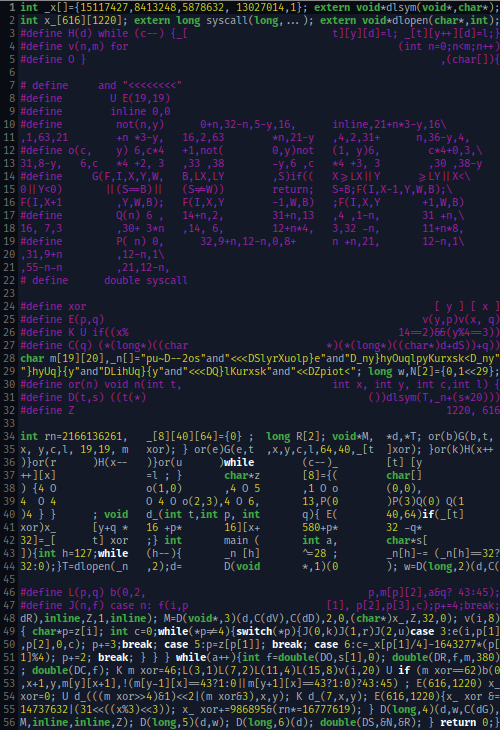
نظرًا لأنه يمكن العثور على الكود المصدري في شكل نصي على الرابط ، فسأوضح كيف يبدو الرمز بيانياً: تقليديًا ، يتم إعطاء "نقاط إضافية" إذا تم تنسيق الكود بشكل غير قياسي أو يبدو وكأنه نوع من الصور. حسنًا ، لنفترض أن هذا لا بأس به هنا.
لكن ماذا يفعل البرنامج؟
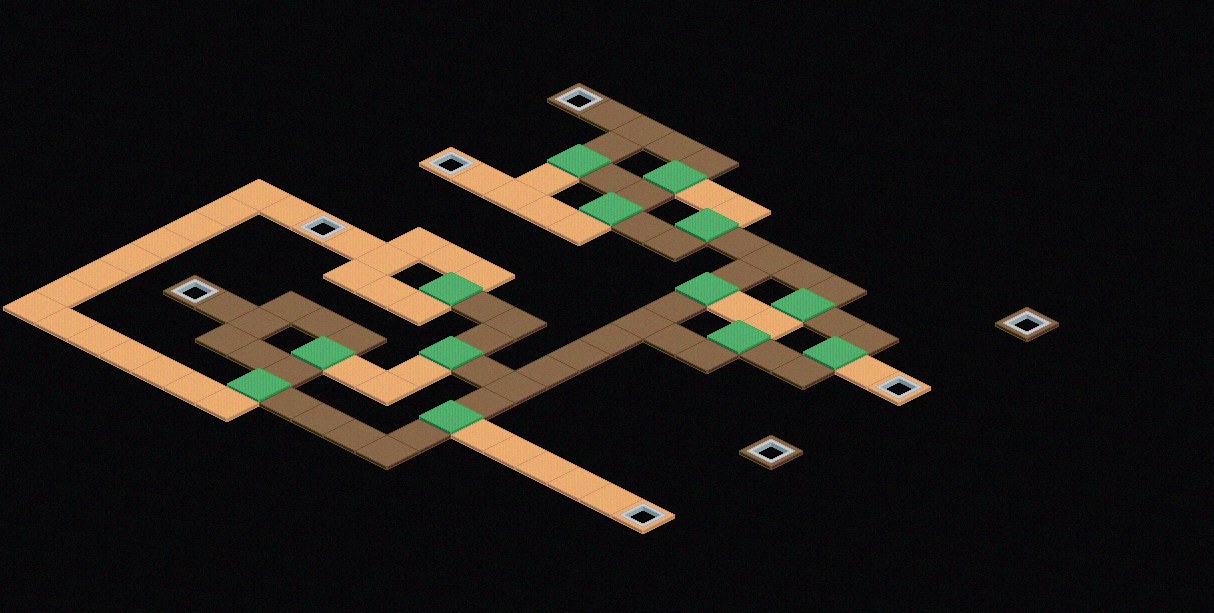
يقوم بتهيئة مكدس رسومات X-server ، ومسح ملف التكوين المقدم ، ورسم دائرة كهربائية وفقًا للملف وبدء المحاكاة ، وتغيير القطبية بالتناوب على دبابيس الإدخال الأربعة ، باستخدام عناصر NOR (Not-OR) فقط. يتم التقديم باستخدام تظليل شاشة LCD القديم.
ياتي البرنامج بعدة ملفات تكوين وهي:
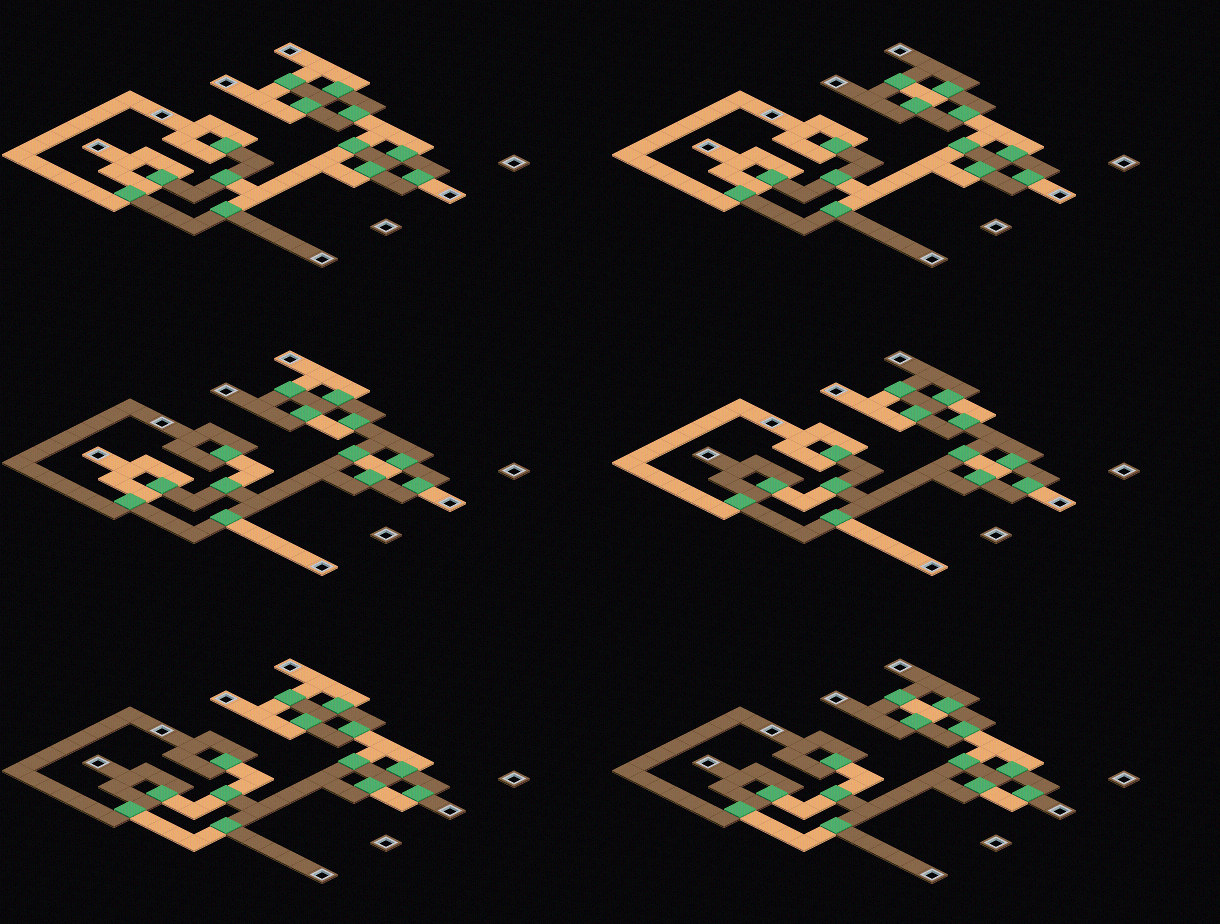
DIP8-4packnot.txt - نظير تقريبي لـ CMOS 4041 / عاكس رباعي القنوات
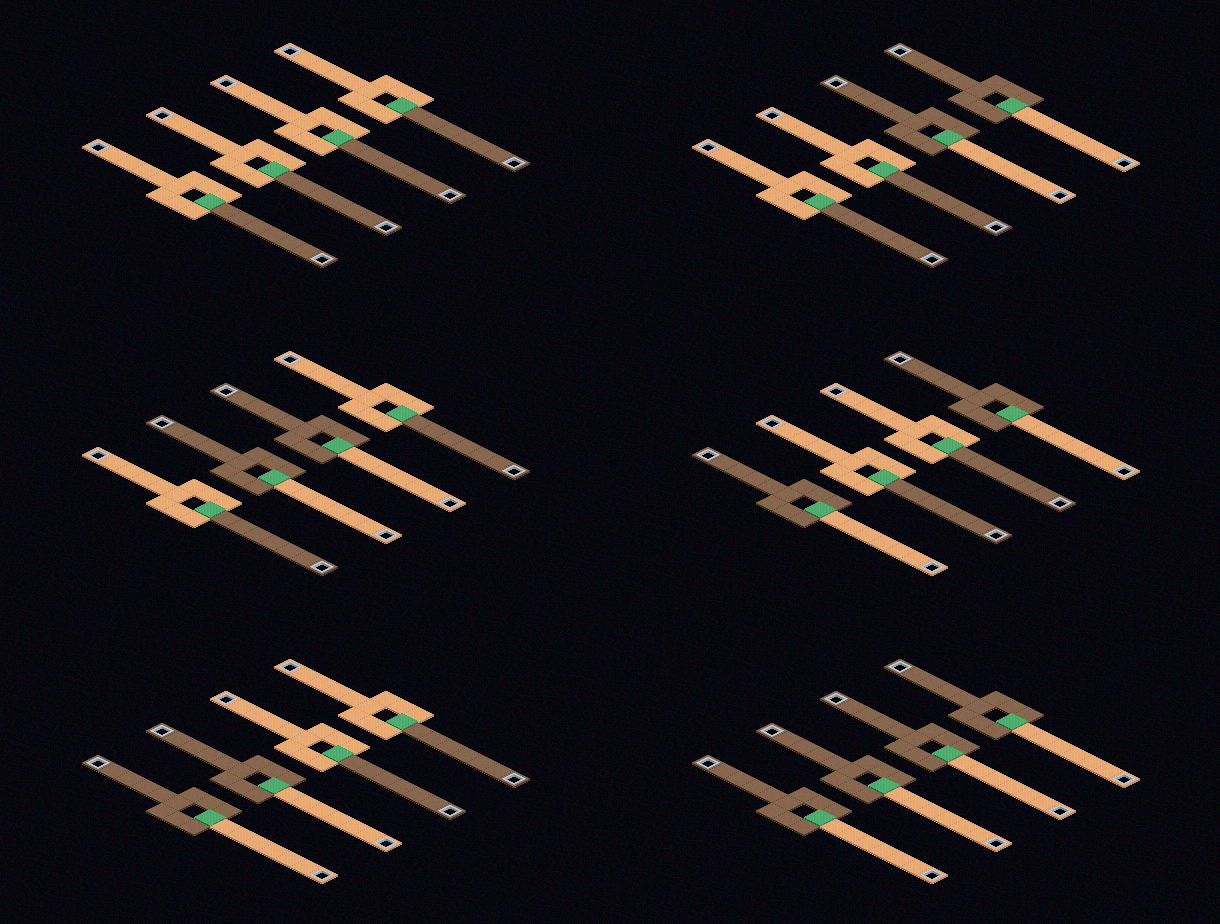
(الصورة مضغوطة مرتين لتلائم حدود اللياقة. من المضحك في الواقع أن البرنامج ، الذي يزن 3.5 كيلوبايت ، يولد سلسلة من الصور ، والتي في أقصى ضغط تشغل 10.5 + ميجابايت)
DIP8-triplexor.txt - نظير تقريبي لـ CMOS 4030 مع مدخلات مدمجة وثلاث قنوات / بوابة XOR ثلاثية القنوات مع مدخلات مدمجة
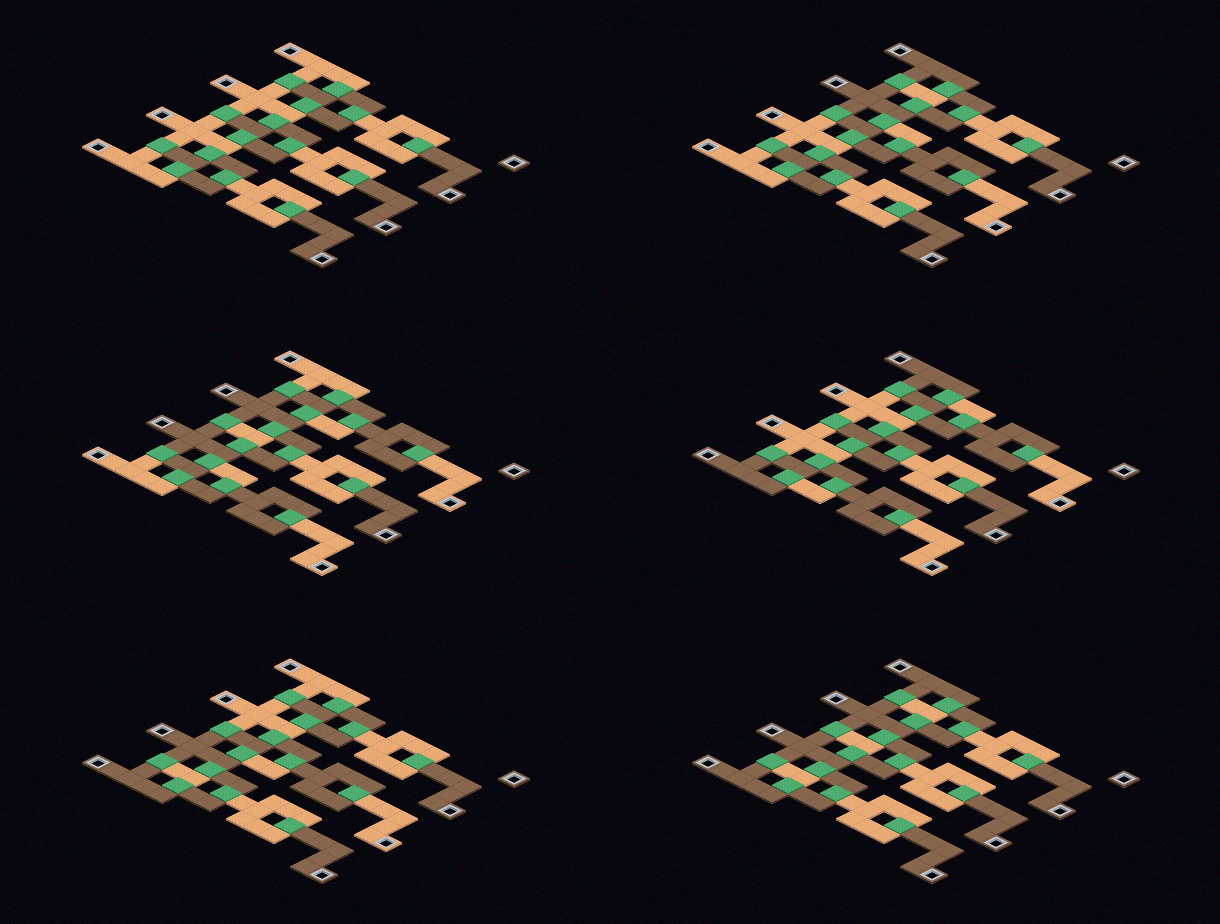
DIP8-fulladder.txt - نظير تقريبي لـ CMOS 4008 ، ولكن لبتتين / أفعى لـ 2 بت مع إخراج بت حمل
تحليل الكود
كانت أصعب مهمة هذه المرة هي التوافق مع الحد الأقصى لحجم العمل المقدم. ليس حجم الملف محدودًا فحسب ، بل أيضًا عدد "الرموز المميزة" المشروطة - رموز العملية والكلمات الأساسية اللغوية وأزواج الأقواس. من أجل "استغلال" هذه الميزة الخاصة بمدقق محلل الحجم في البرنامج تم الإعلان عن عدد كبير من التعريفات ، مما يقلل من كتل التعليمات البرمجية إلى كلمة رئيسية C واحدة.
أولاً ، دعنا ننظر إلى Makefile لفهم كيفية تجميع الكود:
#!/usr/bin/env make
PROJECT=prog
CC= gcc
SRC=prog.c
CWARN=-Wall -Wextra -Wno-char-subscripts

CSTD= -std=c99
# Syscalls table
# DS - syscall nanosleep
# DO - syscall open
# DR - syscall read
# DC - syscall close

# X11 structures offsets
# dS - offset of screens in Display
# dR - offset of root in Screen
# dD - offset of root_depth in Screen
# dV - offset of root_visual in Screen
# dG - offset of default_gc in Screen

BITS := $(shell uname -p)

ifeq ($(BITS), x86_64)
    ARCH= -m64
    CDEFINE= -DDS=35 -DDO=2 -DDR=0 -DDC=3 -DdS=232 -DdR=16 -DdD=56 -DdV=64 -DdG=72
else
    ARCH= -m32
    CDEFINE= -DDS=162 -DDO=5 -DDR=3 -DDC=6 -DdS=140 -DdR=8 -DdD=36 -DdV=40 -DdG=44
endif


OPT= -g

CFLAGS= ${CWARN} ${CSTD} ${ARCH} ${CDEFINE} ${OPT}
LDFLAGS= -ldl

RM= rm

all:  ${PROJECT}

${PROJECT}:
	${CC} ${CFLAGS} ${SRC} -o $@ ${LDFLAGS}
clean:
	${RM} -f ${PROJECT}
كما ترى ، هذا العمل ، تمامًا مثل السابق ، يستخدم بنشاط استدعاءات النظام لتجنب "# تضمين" القبيح الذي يكسر نمط الصورة. دعونا نتذكر هذه الحقيقة ونجهز سطرًا للمعالج الأولي والليتر:
بعد المعالج
gcc -DDS=35 -DDO=2 -DDR=0 -DDC=3 -DdS=232 -DdR=16 -DdD=56 -DdV=64 -DdG=72 prog.c -ldl -E | indent -kr -brf > /tmp/fmt.cint _x[] = { 15117427, 8413248, 5878632, 13027014, 1 };
extern void *dlsym(void *, char *);
int x_[616][1220];
extern long syscall(long, ...);
extern void *dlopen(char *, int);
char m[19][20], _n[] =
"pu~D--2os" "<<<<<<<<" "<<<DSlyrXuolp}e" "<<<<<<<<"
"D_ny}hyOuqlpyKurxsk<D_ny" "}hyUq}{y" "<<<<<<<<" "DLihUq}{y" "<<<<<<<<"
"<<<DQ}lKurxsk" "<<<<<<<<" "<<DZpiot<";
long w, N[2] = { 0, 1 << 29 };
int rn = 2166136261, _[8][40][64] = { 0 };
long R[2];
void *M, *d, *T;
void b(int t, int x, int y, int c, int l) {
if ((x >= 19 || y >= 19 || x < 0 || y < 0) || (m[y][x] == l)
|| (m[y][x] != c))
return;
m[y][x] = l;
b(t, x - 1, y, c, l);
b(t, x + 1, y, c, l);
b(t, x, y - 1, c, l);
b(t, x, y + 1, c, l);
}
void e(int t, int x, int y, int c, int l) {
if ((x >= 64 || y >= 40 || x < 0 || y < 0) || (_[t][y][x] == l)
|| (_[t][y][x] != c))
return;
_[t][y][x] = l;
e(t, x - 1, y, c, l);
e(t, x + 1, y, c, l);
e(t, x, y - 1, c, l);
e(t, x, y + 1, c, l);
}
void k(int t, int x, int y, int c, int l) {
while (c--) {
_[t][y][x++] = l;
_[t][y++][x++] = l;
}
}
void r(int t, int x, int y, int c, int l) {
while (c--) {
_[t][y][x--] = l;
_[t][y++][x--] = l;
}
}
void u(int t, int x, int y, int c, int l) {
while (c--)
_[t][y++][x] = l;
}
char *z[8] = {
(char[]) {4},
(char[]) {6, 1 * 4 + 1, 0 + 0, 32 - 0, 5 - 0, 16, 0, 0,
21 + 0 * 3 - 0, 16, 1, 63, 21 + 0 * 3 - 0, 16, 2,
63 * 0, 21 - 0, 4, 2, 31 + 0, 36 - 0, 4, 0 + 1,
32 - 1, 5 - 0, 16, 0, 0, 21 + 1 * 3 - 0, 16, 1, 63,
21 + 1 * 3 - 0, 16, 2, 63 * 1, 21 - 0, 4, 2, 31 + 1,
36 - 0, 4, 6, 1 * 4 + 0, 3, 31, 8 - 0, 6, 1 * 4 + 2,
3, 33, 38 - 0, 6, 1 * 4 + 3, 3, 30, 38 - 0, 4},
(char[]) {5, 1},
(char[]) {6, 0 * 4 + 1, 0 + 0, 32 - 0, 5 - 0, 16,
0, 0, 21 + 0 * 3 - 0, 16, 1, 63,
21 + 0 * 3 - 0, 16, 2, 63 * 0, 21 - 0,
4, 2, 31 + 0, 36 - 0, 4, 0 + 1, 32 - 1,
5 - 0, 16, 0, 0, 21 + 1 * 3 - 0, 16, 1,
63, 21 + 1 * 3 - 0, 16, 2, 63 * 1,
21 - 0, 4, 2, 31 + 1, 36 - 0, 4, 6,
0 * 4 + 0, 3, 31, 8 - 0, 6, 0 * 4 + 2,
3, 33, 38 - 0, 6, 0 * 4 + 3, 3, 30,
38 - 0,
4},
(char[]) {4}, (char[]) {4},
(char[]) {6, 2 * 4 + 1, 0 + 0, 32 - 0, 5 - 3, 16, 0, 0,
21 + 0 * 3 - 3, 16, 1, 63, 21 + 0 * 3 - 3, 16, 2, 63 * 0,
21 - 3, 4, 2, 31 + 0, 36 - 3, 4, 0 + 1, 32 - 1, 5 - 3,
16, 0, 0, 21 + 1 * 3 - 3, 16, 1, 63, 21 + 1 * 3 - 3, 16,
2, 63 * 1, 21 - 3, 4, 2, 31 + 1, 36 - 3, 4, 6, 2 * 4 + 0,
3, 31, 8 - 3, 6, 2 * 4 + 2, 3, 33, 38 - 3, 6, 2 * 4 + 3,
3, 30, 38 - 3, 4},
(char[]) {6, 13, 0, 32, 9 + 0, 12 - 0,
0, 8 + 0 + 0, 21, 12 - 0, 1,
31, 9 + 0, 12 - 0, 1,
55 - 0 - 0, 21, 12 - 0, 0,
32, 9 + 3, 12 - 3, 0,
8 + 3 + 3, 21, 12 - 3, 1,
31, 9 + 3, 12 - 3, 1,
55 - 3 - 3, 21, 12 - 3, 6,
14 + 0, 2, 31 + 0, 13, 4,
1 - 0, 31 + 0, 16, 7, 3,
30 + 3 * 0, 14, 6,
12 + 0 * 4, 3, 32 - 0,
11 + 0 * 8, 6, 14 + 1, 2,
31 + 1, 13, 4, 1 - 1,
31 + 1, 16, 7, 3,
30 + 3 * 1, 14, 6,
12 + 1 * 4, 3, 32 - 1,
11 + 1 * 8,
4}
};
void d_(int t, int p, int q) {
for (int y = 0; y < 40; y++)
for (int x = 0; x < 64; x++)
if (_[t]
[y][x])
x_[y + q * 16 + p * 16][x + 580 + p * 32 - q *
32] = _[t][y][x];
}
int main(int a, char *s[]) {
int h = 127;
while (h--) {
_n[h] ^= 28;
_n[h] -= (_n[h] == 32 ? 32 : 0);
}
T = dlopen(_n, 2);
d = ((void *(*)()) dlsym(T, _n + (1 * 20))) (0);
w = ((long (*)()) dlsym(T, _n + (2 * 20))) (d,
(*(long *)
((char
*) (*(long *) ((char *)
d +
232)) +
16))
, 0, 0, 1220, 616, 1, 0,
0);
M = ((void *(*)()) dlsym(T, _n + (3 * 20))) (d,
(*(long *)
((char
*) (*(long *) ((char *)
d +
232)) +
64)),
(*(long *)
((char
*) (*(long *) ((char *)
d +
232)) +
56)), 2, 0, (char *) x_,
1220, 616, 32, 0);
for (int i = 0; i < 8; i++) {
char *p = z[i];
int c = 0;
while (*p != 4) {
switch (*p) {
case 0:
k(i, p[1], p[2], p[3], c);
p += 4;
break;
case 1:
r(i, p[1], p[2], p[3], c);
p += 4;
break;
case 2:
u(i, p[1], p[2], p[3], c);
p += 4;
break;
case 3:
e(i, p[1]
, p[2], 0, c);
p += 3;
break;
case 5:
p = z[p[1]];
break;
case 6:
c = _x[p[1] / 4] - 1643277 * (p[1] % 4);
p += 2;
break;
}
}
}
while (a++) {
int f = syscall(2, s[1], 0);
syscall(0, f, m, 380);
syscall(3, f);
for (int y = 0; y < 19; y++)
for (int x = 0; x < 19; x++)
if ((x % 14 == 2) && (y % 4 == 3))
m[y][x] = 46;
b(0, 2, 3, m[3][2], a & 1 ? 43 : 45);
b(0, 2, 7, m[7][2], a & 2 ? 43 : 45);
b(0, 2, 11, m[11][2], a & 4 ? 43 : 45);
b(0, 2, 15, m[15][2], a & 8 ? 43 : 45);
for (int i = 0; i < 20; i++)
for (int y = 0; y < 19; y++)
for (int x = 0; x < 19; x++)
if (m[y][x] == 62)
b(0, x + 1, y, m[y][x + 1],
!(m[y - 1][x] == 43 ? 1 : 0
|| m[y + 1][x] == 43 ? 1 : 0) ? 43 : 45);
for (int y = 0; y < 616; y++)
for (int x = 0; x < 1220; x++)
x_[y][x] = 0;
for (int y = 0; y < 19; y++)
for (int x = 0; x < 19; x++)
d_(((m[y][x] >> 4) & 1) << 2 | (m[y][x] & 3), x, y);
for (int y = 0; y < 19; y++)
for (int x = 0; x < 19; x++)
if ((x % 14 == 2) && (y % 4 == 3))
d_(7, x, y);
for (int y = 0; y < 616; y++)
for (int x = 0; x < 1220; x++) {
x_[y][x] &= 14737632 | (31 << ((x % 3) << 3));
x_[y][x] += 986895 & (rn *= 16777619);
} ((long (*)()) dlsym(T, _n + (4 * 20))) (d, w,
(*(long *)
((char
*) (*(long
*) ((char *)
d +
232)) +
72)), M, 0, 0, 0,
0, 1220, 616);
((long (*)()) dlsym(T, _n + (5 * 20))) (d, w);
((long (*)()) dlsym(T, _n + (6 * 20))) (d);
syscall(35, &N, &R);
} return 0;
}
حسنًا ، لقد استوفينا واحدًا على الأقل من شروط المنافسة ، لم يصبح الرمز بعد المعالج المسبق أكثر وضوحًا.
لنبدأ بما يمكنك التقاطه في لمحة ونحاول إعادة بناء سلسلة الأحداث.
dlsym \ dlopen
من الواضح ، من أجل استخدام وظائف خادم X وإنشاء نافذة ، ثم رسم شيء ما فيها ، يجب أن يتحول الرمز إلى مكتبة XLib. يحتوي الكود على وظائف dlopen / dlsym التي تسمح لك بتحميل المكتبة ديناميكيًا ، ولكن يتم تغذيتها ببعض الفوضى الصعبة عند الإدخال:
char _n[] =
    "pu~D--2os" "<<<<<<<<" "<<<DSlyrXuolp}e" "<<<<<<<<"
    "D_ny}hyOuqlpyKurxsk<D_ny" "}hyUq}{y" "<<<<<<<<" "DLihUq}{y" "<<<<<<<<"
    "<<<DQ}lKurxsk" "<<<<<<<<" "<<DZpiot<";
...
T = dlopen(_n, 2);
لنعد خطوة إلى الوراء ونفحص الكود التالي:
int h = 127;
    while (h--) {
	_n[h] ^= 28;
	_n[h] -= (_n[h] == 32 ? 32 : 0);
    }
على ما يبدو ، فإنه يحول المصفوفة الأصلية بطريقة ما ، مما يسمح لنا بالحصول على خطوط قابلة للقراءة. دعنا ننفذها بشكل منفصل:
https://onlinegdb.com/SJNM9Og7v :
libX11.so
XOpenDisplay
XCreateSimpleWindow
XCreateImage
XPutImage
XMapWindow
XFlush
من أجل استدعاء وظائف مختلفة جدًا في التنسيق في سطر واحد ، يستغل الكود حقيقة أنه في معيار اللغة C (الفراغ) لا يعني أي معلمات ، و () يعني أي عدد من المعلمات. يبقى فقط إلقاء الفراغ الناتج * إلى النوع المقابل ((طويل (*) ()) وفويلا:
w = ((long (*)()) dlsym(T, _n + (2 * 20))) (d, (*(long *)((char *) (*(long *)((char *) d + 232)) + 16))بمعرفة ما تعنيه هذه التحويلات ، يمكننا الآن استبدال هذا الاستخدام غير المعتاد لـ dlsym بالسلاسل أولاً:
بعد استبدال الخطوط:
int _x[] = { 15117427, 8413248, 5878632, 13027014, 1 };

extern void *dlsym(void *, char *);
int x_[616][1220];
extern long syscall(long, ...);
extern void *dlopen(char *, int);
char m[19][20];
long w, N[2] = { 0, 1 << 29 };
int rn = 2166136261, _[8][40][64] = { 0 };
long R[2];
void *M, *d, *T;

void b(int t, int x, int y, int c, int l) {
    if ((x >= 19 || y >= 19 || x < 0 || y < 0) || (m[y][x] == l)
	|| (m[y][x] != c))
	return;
    m[y][x] = l;
    b(t, x - 1, y, c, l);
    b(t, x + 1, y, c, l);
    b(t, x, y - 1, c, l);
    b(t, x, y + 1, c, l);
}

void e(int t, int x, int y, int c, int l) {
    if ((x >= 64 || y >= 40 || x < 0 || y < 0) || (_[t][y][x] == l)
	|| (_[t][y][x] != c))
	return;
    _[t][y][x] = l;
    e(t, x - 1, y, c, l);
    e(t, x + 1, y, c, l);
    e(t, x, y - 1, c, l);
    e(t, x, y + 1, c, l);
}

void k(int t, int x, int y, int c, int l) {
    while (c--) {
	_[t][y][x++] = l;
	_[t][y++][x++] = l;
    }
}

void r(int t, int x, int y, int c, int l) {
    while (c--) {
	_[t][y][x--] = l;
	_[t][y++][x--] = l;
    }
}

void u(int t, int x, int y, int c, int l) {
    while (c--)
	_[t][y++][x] = l;
}

char *z[8] = {
    (char[]) {4},
    (char[]) {6, 1 * 4 + 1, 0 + 0, 32 - 0, 5 - 0, 16, 0, 0,
		     21 + 0 * 3 - 0, 16, 1, 63, 21 + 0 * 3 - 0, 16, 2,
		     63 * 0, 21 - 0, 4, 2, 31 + 0, 36 - 0, 4, 0 + 1,
		     32 - 1, 5 - 0, 16, 0, 0, 21 + 1 * 3 - 0, 16, 1, 63,
		     21 + 1 * 3 - 0, 16, 2, 63 * 1, 21 - 0, 4, 2, 31 + 1,
		     36 - 0, 4, 6, 1 * 4 + 0, 3, 31, 8 - 0, 6, 1 * 4 + 2,
		     3, 33, 38 - 0, 6, 1 * 4 + 3, 3, 30, 38 - 0, 4},
	(char[]) {5, 1},
	(char[]) {6, 0 * 4 + 1, 0 + 0, 32 - 0, 5 - 0, 16,
				   0, 0, 21 + 0 * 3 - 0, 16, 1, 63,
				   21 + 0 * 3 - 0, 16, 2, 63 * 0, 21 - 0,
				   4, 2, 31 + 0, 36 - 0, 4, 0 + 1, 32 - 1,
				   5 - 0, 16, 0, 0, 21 + 1 * 3 - 0, 16, 1,
				   63, 21 + 1 * 3 - 0, 16, 2, 63 * 1,
				   21 - 0, 4, 2, 31 + 1, 36 - 0, 4, 6,
				   0 * 4 + 0, 3, 31, 8 - 0, 6, 0 * 4 + 2,
				   3, 33, 38 - 0, 6, 0 * 4 + 3, 3, 30,
				   38 - 0,
				   4},
	(char[]) {4}, (char[]) {4},
	(char[]) {6, 2 * 4 + 1, 0 + 0, 32 - 0, 5 - 3, 16, 0, 0,
		  21 + 0 * 3 - 3, 16, 1, 63, 21 + 0 * 3 - 3, 16, 2, 63 * 0,
		  21 - 3, 4, 2, 31 + 0, 36 - 3, 4, 0 + 1, 32 - 1, 5 - 3,
		  16, 0, 0, 21 + 1 * 3 - 3, 16, 1, 63, 21 + 1 * 3 - 3, 16,
		  2, 63 * 1, 21 - 3, 4, 2, 31 + 1, 36 - 3, 4, 6, 2 * 4 + 0,
		  3, 31, 8 - 3, 6, 2 * 4 + 2, 3, 33, 38 - 3, 6, 2 * 4 + 3,
		  3, 30, 38 - 3, 4},
    (char[]) {6, 13, 0, 32, 9 + 0, 12 - 0,
					       0, 8 + 0 + 0, 21, 12 - 0, 1,
					       31, 9 + 0, 12 - 0, 1,
					       55 - 0 - 0, 21, 12 - 0, 0,
					       32, 9 + 3, 12 - 3, 0,
					       8 + 3 + 3, 21, 12 - 3, 1,
					       31, 9 + 3, 12 - 3, 1,
					       55 - 3 - 3, 21, 12 - 3, 6,
					       14 + 0, 2, 31 + 0, 13, 4,
					       1 - 0, 31 + 0, 16, 7, 3,
					       30 + 3 * 0, 14, 6,
					       12 + 0 * 4, 3, 32 - 0,
					       11 + 0 * 8, 6, 14 + 1, 2,
					       31 + 1, 13, 4, 1 - 1,
					       31 + 1, 16, 7, 3,
					       30 + 3 * 1, 14, 6,
					       12 + 1 * 4, 3, 32 - 1,
					       11 + 1 * 8,
					       4}
};

void d_(int t, int p, int q) {
    for (int y = 0; y < 40; y++)
	for (int x = 0; x < 64; x++)
	    if (_[t]
		[y][x])
		x_[y + q * 16 + p * 16][x + 580 + p * 32 - q *
					32] = _[t][y][x];
}

int main(int a, char *s[]) {
    T = dlopen("libX11.so", 2);
    d = ((void *(*)()) dlsym(T, "XOpenDisplay") (0);
    w = ((long (*)()) dlsym(T, "XCreateSimpleWindow")) (d,
						(*(long *)
						 ((char
						   *) (*(long *) ((char *)
								  d +
								  232)) +
						  16))


						, 0, 0, 1220, 616, 1, 0,
						0);
    M = ((void *(*)()) dlsym(T, "XCreateImage")) (d,
						 (*(long *)
						  ((char
						    *) (*(long *) ((char *)
								   d +
								   232)) +
						   64)),
						 (*(long *)
						  ((char
						    *) (*(long *) ((char *)
								   d +
								   232)) +
						   56)), 2, 0, (char *) x_,
						 1220, 616, 32, 0);
    for (int i = 0; i < 8; i++) {
	char *p = z[i];
	int c = 0;
	while (*p != 4) {
	    switch (*p) {
	    case 0:
		k(i, p[1], p[2], p[3], c);
		p += 4;
		break;
	    case 1:
		r(i, p[1], p[2], p[3], c);
		p += 4;
		break;
	    case 2:
		u(i, p[1], p[2], p[3], c);
		p += 4;
		break;
	    case 3:
		e(i, p[1]
		  , p[2], 0, c);
		p += 3;
		break;
	    case 5:
		p = z[p[1]];
		break;
	    case 6:
		c = _x[p[1] / 4] - 1643277 * (p[1] % 4);
		p += 2;
		break;
	    }
	}
    }
    while (a++) {
	int f = syscall(2, s[1], 0);
	syscall(0, f, m, 380);
	syscall(3, f);
	for (int y = 0; y < 19; y++)
	    for (int x = 0; x < 19; x++)
		if ((x % 14 == 2) && (y % 4 == 3))
		    m[y][x] = 46;
	b(0, 2, 3, m[3][2], a & 1 ? 43 : 45);
	b(0, 2, 7, m[7][2], a & 2 ? 43 : 45);
	b(0, 2, 11, m[11][2], a & 4 ? 43 : 45);
	b(0, 2, 15, m[15][2], a & 8 ? 43 : 45);
	for (int i = 0; i < 20; i++)
	    for (int y = 0; y < 19; y++)
		for (int x = 0; x < 19; x++)
		    if (m[y][x] == 62)
			b(0, x + 1, y, m[y][x + 1],
			  !(m[y - 1][x] == 43 ? 1 : 0
			    || m[y + 1][x] == 43 ? 1 : 0) ? 43 : 45);
	for (int y = 0; y < 616; y++)
	    for (int x = 0; x < 1220; x++)
		x_[y][x] = 0;
	for (int y = 0; y < 19; y++)
	    for (int x = 0; x < 19; x++)
		d_(((m[y][x] >> 4) & 1) << 2 | (m[y][x] & 3), x, y);
	for (int y = 0; y < 19; y++)
	    for (int x = 0; x < 19; x++)
		if ((x % 14 == 2) && (y % 4 == 3))
		    d_(7, x, y);
	for (int y = 0; y < 616; y++)
	    for (int x = 0; x < 1220; x++) {
		x_[y][x] &= 14737632 | (31 << ((x % 3) << 3));
		x_[y][x] += 986895 & (rn *= 16777619);
	    } ((long (*)()) dlsym(T, "XPutImage")) (d, w,
						      (*(long *)
						       ((char
							 *) (*(long
							       *) ((char *)
								   d +
								   232)) +
							72)), M, 0, 0, 0,
						      0, 1220, 616);
	((long (*)()) dlsym(T, "XMapWindow")) (d, w);
	((long (*)()) dlsym(T, "XFlush")) (d);
	syscall(35, &N, &R);
    } return 0;
}
ثم إلى الوظائف الأصلية:
بعد الاستبدال بوظائف `` أصلية '':
#include <X11/Xlib.h>

int _x[] = { 15117427, 8413248, 5878632, 13027014, 1 };

int x_[616][1220];
extern long syscall(long, ...);
char m[19][20];
long w, N[2] = { 0, 1 << 29 };
int rn = 2166136261, _[8][40][64] = { 0 };
long R[2];
void *M, *d, *T;

void b(int t, int x, int y, int c, int l) {
    if ((x >= 19 || y >= 19 || x < 0 || y < 0) || (m[y][x] == l)
	|| (m[y][x] != c))
	return;
    m[y][x] = l;
    b(t, x - 1, y, c, l);
    b(t, x + 1, y, c, l);
    b(t, x, y - 1, c, l);
    b(t, x, y + 1, c, l);
}

void e(int t, int x, int y, int c, int l) {
    if ((x >= 64 || y >= 40 || x < 0 || y < 0) || (_[t][y][x] == l)
	|| (_[t][y][x] != c))
	return;
    _[t][y][x] = l;
    e(t, x - 1, y, c, l);
    e(t, x + 1, y, c, l);
    e(t, x, y - 1, c, l);
    e(t, x, y + 1, c, l);
}

void k(int t, int x, int y, int c, int l) {
    while (c--) {
	_[t][y][x++] = l;
	_[t][y++][x++] = l;
    }
}

void r(int t, int x, int y, int c, int l) {
    while (c--) {
	_[t][y][x--] = l;
	_[t][y++][x--] = l;
    }
}

void u(int t, int x, int y, int c, int l) {
    while (c--)
	_[t][y++][x] = l;
}

char *z[8] = {
    (char[]) {4},
    (char[]) {6, 1 * 4 + 1, 0 + 0, 32 - 0, 5 - 0, 16, 0, 0,
		     21 + 0 * 3 - 0, 16, 1, 63, 21 + 0 * 3 - 0, 16, 2,
		     63 * 0, 21 - 0, 4, 2, 31 + 0, 36 - 0, 4, 0 + 1,
		     32 - 1, 5 - 0, 16, 0, 0, 21 + 1 * 3 - 0, 16, 1, 63,
		     21 + 1 * 3 - 0, 16, 2, 63 * 1, 21 - 0, 4, 2, 31 + 1,
		     36 - 0, 4, 6, 1 * 4 + 0, 3, 31, 8 - 0, 6, 1 * 4 + 2,
		     3, 33, 38 - 0, 6, 1 * 4 + 3, 3, 30, 38 - 0, 4},
	(char[]) {5, 1},
	(char[]) {6, 0 * 4 + 1, 0 + 0, 32 - 0, 5 - 0, 16,
				   0, 0, 21 + 0 * 3 - 0, 16, 1, 63,
				   21 + 0 * 3 - 0, 16, 2, 63 * 0, 21 - 0,
				   4, 2, 31 + 0, 36 - 0, 4, 0 + 1, 32 - 1,
				   5 - 0, 16, 0, 0, 21 + 1 * 3 - 0, 16, 1,
				   63, 21 + 1 * 3 - 0, 16, 2, 63 * 1,
				   21 - 0, 4, 2, 31 + 1, 36 - 0, 4, 6,
				   0 * 4 + 0, 3, 31, 8 - 0, 6, 0 * 4 + 2,
				   3, 33, 38 - 0, 6, 0 * 4 + 3, 3, 30,
				   38 - 0,
				   4},
	(char[]) {4}, (char[]) {4},
	(char[]) {6, 2 * 4 + 1, 0 + 0, 32 - 0, 5 - 3, 16, 0, 0,
		  21 + 0 * 3 - 3, 16, 1, 63, 21 + 0 * 3 - 3, 16, 2, 63 * 0,
		  21 - 3, 4, 2, 31 + 0, 36 - 3, 4, 0 + 1, 32 - 1, 5 - 3,
		  16, 0, 0, 21 + 1 * 3 - 3, 16, 1, 63, 21 + 1 * 3 - 3, 16,
		  2, 63 * 1, 21 - 3, 4, 2, 31 + 1, 36 - 3, 4, 6, 2 * 4 + 0,
		  3, 31, 8 - 3, 6, 2 * 4 + 2, 3, 33, 38 - 3, 6, 2 * 4 + 3,
		  3, 30, 38 - 3, 4},
    (char[]) {6, 13, 0, 32, 9 + 0, 12 - 0,
					       0, 8 + 0 + 0, 21, 12 - 0, 1,
					       31, 9 + 0, 12 - 0, 1,
					       55 - 0 - 0, 21, 12 - 0, 0,
					       32, 9 + 3, 12 - 3, 0,
					       8 + 3 + 3, 21, 12 - 3, 1,
					       31, 9 + 3, 12 - 3, 1,
					       55 - 3 - 3, 21, 12 - 3, 6,
					       14 + 0, 2, 31 + 0, 13, 4,
					       1 - 0, 31 + 0, 16, 7, 3,
					       30 + 3 * 0, 14, 6,
					       12 + 0 * 4, 3, 32 - 0,
					       11 + 0 * 8, 6, 14 + 1, 2,
					       31 + 1, 13, 4, 1 - 1,
					       31 + 1, 16, 7, 3,
					       30 + 3 * 1, 14, 6,
					       12 + 1 * 4, 3, 32 - 1,
					       11 + 1 * 8,
					       4}
};

void d_(int t, int p, int q) {
    for (int y = 0; y < 40; y++)
	for (int x = 0; x < 64; x++)
	    if (_[t]
		[y][x])
		x_[y + q * 16 + p * 16][x + 580 + p * 32 - q *
					32] = _[t][y][x];
}

int main(int a, char *s[]) {
    d = XOpenDisplay(0);
    w = XCreateSimpleWindow(d, (*(long *) ((char *) (*(long *) ((char *)d + 232)) + 16)), 0, 0, 1220, 616, 1, 0, 0);
    M = XCreateImage(d, (*(long *)((char *) (*(long *) ((char *)d + 232)) + 64)), (*(long *)((char *) (*(long *) ((char *)d + 232)) + 56)), 2, 0, (char *) x_, 1220, 616, 32, 0);
    for (int i = 0; i < 8; i++) {
	    char *p = z[i];
	    int c = 0;
	    while (*p != 4) {
	        switch (*p) {
	        case 0:
	    	    k(i, p[1], p[2], p[3], c);
	    	    p += 4;
	    	    break;
	        case 1:
	    	    r(i, p[1], p[2], p[3], c);
	    	    p += 4;
	    	    break;
	        case 2:
	    	    u(i, p[1], p[2], p[3], c);
	    	    p += 4;
	    	    break;
	        case 3:
	    	    e(i, p[1]
	    	      , p[2], 0, c);
	    	    p += 3;
	    	    break;
	        case 5:
	    	    p = z[p[1]];
	    	    break;
	        case 6:
	    	    c = _x[p[1] / 4] - 1643277 * (p[1] % 4);
	    	    p += 2;
	    	    break;
	        }
	    }
    }
    while (a++) {
	    int f = syscall(2, s[1], 0);
	    syscall(0, f, m, 380);
	    syscall(3, f);
	    for (int y = 0; y < 19; y++)
	        for (int x = 0; x < 19; x++)
		    if ((x % 14 == 2) && (y % 4 == 3))
		        m[y][x] = 46;
	    b(0, 2, 3, m[3][2], a & 1 ? 43 : 45);
	    b(0, 2, 7, m[7][2], a & 2 ? 43 : 45);
	    b(0, 2, 11, m[11][2], a & 4 ? 43 : 45);
	    b(0, 2, 15, m[15][2], a & 8 ? 43 : 45);
	    for (int i = 0; i < 20; i++)
	        for (int y = 0; y < 19; y++)
		    for (int x = 0; x < 19; x++)
		        if (m[y][x] == 62)
			    b(0, x + 1, y, m[y][x + 1],
			    !(m[y - 1][x] == 43 ? 1 : 0
			        || m[y + 1][x] == 43 ? 1 : 0) ? 43 : 45);
	    for (int y = 0; y < 616; y++)
	        for (int x = 0; x < 1220; x++)
		    x_[y][x] = 0;
	    for (int y = 0; y < 19; y++)
	        for (int x = 0; x < 19; x++)
		    d_(((m[y][x] >> 4) & 1) << 2 | (m[y][x] & 3), x, y);
	    for (int y = 0; y < 19; y++)
	        for (int x = 0; x < 19; x++)
    		if ((x % 14 == 2) && (y % 4 == 3))
	    	    d_(7, x, y);
    	for (int y = 0; y < 616; y++)
	        for (int x = 0; x < 1220; x++) {
	    	    x_[y][x] &= 14737632 | (31 << ((x % 3) << 3));
	    	    x_[y][x] += 986895 & (rn *= 16777619);
	        }
	    XPutImage(d, w, (*(long *)((char *) (*(long *) ((char *)d + 232)) +	72)), M, 0, 0, 0, 0, 1220, 616);
	    XMapWindow(d, w);
	    XFlush(d);
	    syscall(35, &N, &R);
    }
    return 0;
}
Syscalls
دعنا نستبدل استدعاءات النظام بنفس الطريقة التي اتبعناها في الجزء الأول:
كود بدون استدعاءات النظام:
#include <X11/Xlib.h>
#include <sys/types.h>
#include <sys/stat.h>
#include <fcntl.h>
#include <unistd.h>

int _x[] = { 15117427, 8413248, 5878632, 13027014, 1 };

int x_[616][1220];
char m[19][20];
long w;
int rn = 2166136261, _[8][40][64] = { 0 };

void *M, *d, *T;

void b(int t, int x, int y, int c, int l) {
    if ((x >= 19 || y >= 19 || x < 0 || y < 0) || (m[y][x] == l)
	|| (m[y][x] != c))
	return;
    m[y][x] = l;
    b(t, x - 1, y, c, l);
    b(t, x + 1, y, c, l);
    b(t, x, y - 1, c, l);
    b(t, x, y + 1, c, l);
}

void e(int t, int x, int y, int c, int l) {
    if ((x >= 64 || y >= 40 || x < 0 || y < 0) || (_[t][y][x] == l)
	|| (_[t][y][x] != c))
	return;
    _[t][y][x] = l;
    e(t, x - 1, y, c, l);
    e(t, x + 1, y, c, l);
    e(t, x, y - 1, c, l);
    e(t, x, y + 1, c, l);
}

void k(int t, int x, int y, int c, int l) {
    while (c--) {
	_[t][y][x++] = l;
	_[t][y++][x++] = l;
    }
}

void r(int t, int x, int y, int c, int l) {
    while (c--) {
	_[t][y][x--] = l;
	_[t][y++][x--] = l;
    }
}

void u(int t, int x, int y, int c, int l) {
    while (c--)
	_[t][y++][x] = l;
}

char *z[8] = {
    (char[]) {4},
    (char[]) {6, 1 * 4 + 1, 0 + 0, 32 - 0, 5 - 0, 16, 0, 0,
		     21 + 0 * 3 - 0, 16, 1, 63, 21 + 0 * 3 - 0, 16, 2,
		     63 * 0, 21 - 0, 4, 2, 31 + 0, 36 - 0, 4, 0 + 1,
		     32 - 1, 5 - 0, 16, 0, 0, 21 + 1 * 3 - 0, 16, 1, 63,
		     21 + 1 * 3 - 0, 16, 2, 63 * 1, 21 - 0, 4, 2, 31 + 1,
		     36 - 0, 4, 6, 1 * 4 + 0, 3, 31, 8 - 0, 6, 1 * 4 + 2,
		     3, 33, 38 - 0, 6, 1 * 4 + 3, 3, 30, 38 - 0, 4},
	(char[]) {5, 1},
	(char[]) {6, 0 * 4 + 1, 0 + 0, 32 - 0, 5 - 0, 16,
				   0, 0, 21 + 0 * 3 - 0, 16, 1, 63,
				   21 + 0 * 3 - 0, 16, 2, 63 * 0, 21 - 0,
				   4, 2, 31 + 0, 36 - 0, 4, 0 + 1, 32 - 1,
				   5 - 0, 16, 0, 0, 21 + 1 * 3 - 0, 16, 1,
				   63, 21 + 1 * 3 - 0, 16, 2, 63 * 1,
				   21 - 0, 4, 2, 31 + 1, 36 - 0, 4, 6,
				   0 * 4 + 0, 3, 31, 8 - 0, 6, 0 * 4 + 2,
				   3, 33, 38 - 0, 6, 0 * 4 + 3, 3, 30,
				   38 - 0,
				   4},
	(char[]) {4}, (char[]) {4},
	(char[]) {6, 2 * 4 + 1, 0 + 0, 32 - 0, 5 - 3, 16, 0, 0,
		  21 + 0 * 3 - 3, 16, 1, 63, 21 + 0 * 3 - 3, 16, 2, 63 * 0,
		  21 - 3, 4, 2, 31 + 0, 36 - 3, 4, 0 + 1, 32 - 1, 5 - 3,
		  16, 0, 0, 21 + 1 * 3 - 3, 16, 1, 63, 21 + 1 * 3 - 3, 16,
		  2, 63 * 1, 21 - 3, 4, 2, 31 + 1, 36 - 3, 4, 6, 2 * 4 + 0,
		  3, 31, 8 - 3, 6, 2 * 4 + 2, 3, 33, 38 - 3, 6, 2 * 4 + 3,
		  3, 30, 38 - 3, 4},
    (char[]) {6, 13, 0, 32, 9 + 0, 12 - 0,
					       0, 8 + 0 + 0, 21, 12 - 0, 1,
					       31, 9 + 0, 12 - 0, 1,
					       55 - 0 - 0, 21, 12 - 0, 0,
					       32, 9 + 3, 12 - 3, 0,
					       8 + 3 + 3, 21, 12 - 3, 1,
					       31, 9 + 3, 12 - 3, 1,
					       55 - 3 - 3, 21, 12 - 3, 6,
					       14 + 0, 2, 31 + 0, 13, 4,
					       1 - 0, 31 + 0, 16, 7, 3,
					       30 + 3 * 0, 14, 6,
					       12 + 0 * 4, 3, 32 - 0,
					       11 + 0 * 8, 6, 14 + 1, 2,
					       31 + 1, 13, 4, 1 - 1,
					       31 + 1, 16, 7, 3,
					       30 + 3 * 1, 14, 6,
					       12 + 1 * 4, 3, 32 - 1,
					       11 + 1 * 8,
					       4}
};

void d_(int t, int p, int q) {
    for (int y = 0; y < 40; y++)
	for (int x = 0; x < 64; x++)
	    if (_[t]
		[y][x])
		x_[y + q * 16 + p * 16][x + 580 + p * 32 - q *
					32] = _[t][y][x];
}

int main(int a, char *s[]) {
    d = XOpenDisplay(0);
    w = XCreateSimpleWindow(d, (*(long *) ((char *) (*(long *) ((char *)d + 232)) + 16)), 0, 0, 1220, 616, 1, 0, 0);
    M = XCreateImage(d, (*(long *)((char *) (*(long *) ((char *)d + 232)) + 64)), (*(long *)((char *) (*(long *) ((char *)d + 232)) + 56)), 2, 0, (char *) x_, 1220, 616, 32, 0);
    for (int i = 0; i < 8; i++) {
	    char *p = z[i];
	    int c = 0;
	    while (*p != 4) {
	        switch (*p) {
	        case 0:
	    	    k(i, p[1], p[2], p[3], c);
	    	    p += 4;
	    	    break;
	        case 1:
	    	    r(i, p[1], p[2], p[3], c);
	    	    p += 4;
	    	    break;
	        case 2:
	    	    u(i, p[1], p[2], p[3], c);
	    	    p += 4;
	    	    break;
	        case 3:
	    	    e(i, p[1]
	    	      , p[2], 0, c);
	    	    p += 3;
	    	    break;
	        case 5:
	    	    p = z[p[1]];
	    	    break;
	        case 6:
	    	    c = _x[p[1] / 4] - 1643277 * (p[1] % 4);
	    	    p += 2;
	    	    break;
	        }
	    }
    }
    while (a++) {
	    int f = open(s[1], 0);
	    read(f, m, 380);
	    close(f);


	    for (int y = 0; y < 19; y++)
	        for (int x = 0; x < 19; x++)
		    if ((x % 14 == 2) && (y % 4 == 3))
		        m[y][x] = 46;
	    b(0, 2, 3, m[3][2], a & 1 ? 43 : 45);
	    b(0, 2, 7, m[7][2], a & 2 ? 43 : 45);
	    b(0, 2, 11, m[11][2], a & 4 ? 43 : 45);
	    b(0, 2, 15, m[15][2], a & 8 ? 43 : 45);
	    for (int i = 0; i < 20; i++)
	        for (int y = 0; y < 19; y++)
		    for (int x = 0; x < 19; x++)
		        if (m[y][x] == 62)
			    b(0, x + 1, y, m[y][x + 1],
			    !(m[y - 1][x] == 43 ? 1 : 0
			        || m[y + 1][x] == 43 ? 1 : 0) ? 43 : 45);
	    for (int y = 0; y < 616; y++)
	        for (int x = 0; x < 1220; x++)
		    x_[y][x] = 0;
	    for (int y = 0; y < 19; y++)
	        for (int x = 0; x < 19; x++)
		    d_(((m[y][x] >> 4) & 1) << 2 | (m[y][x] & 3), x, y);
	    for (int y = 0; y < 19; y++)
	        for (int x = 0; x < 19; x++)
    		if ((x % 14 == 2) && (y % 4 == 3))
	    	    d_(7, x, y);
    	for (int y = 0; y < 616; y++)
	        for (int x = 0; x < 1220; x++) {
	    	    x_[y][x] &= 14737632 | (31 << ((x % 3) << 3));
	    	    x_[y][x] += 986895 & (rn *= 16777619);
	        }
	    XPutImage(d, w, (*(long *)((char *) (*(long *) ((char *)d + 232)) +	72)), M, 0, 0, 0, 0, 1220, 616);
	    XMapWindow(d, w);
	    XFlush(d);

	    sleep(1);
    }
    return 0;
}
XCreateSimpleWindow والإزاحات
دعنا نحاول تفكيك البناء التالي:
w = XCreateSimpleWindow(d, (*(long *) ((char *) (*(long *) ((char *)d + 232)) + 16)), 0, 0, 1220, 616, 1, 0, 0);مجموعة من تحويلات النوع ، والتي ، للوهلة الأولى ، ضرورية فقط لإرباك القارئ ، ولكن كل تحويل هنا له غرضه الخاص ، وهو:
d هو مؤشر إلى بنية العرض في سياق Xlib. يحتوي على حقل مصفوفة يسمى الشاشات ومن أجل الحصول على مؤشر للعنصر الأول من هذه المصفوفة ، يجب أن نحسب عددًا معينًا من البايتات (x64 - 232) من مؤشر العرض إلى الأمام. نظرًا لأن العرض ليس حرفًا * ، فباستخدام القراءة المباشرة ، كنا سنحسب في sizeof (طويلة *) بايت. لذلك قمنا بإلقاء d على الحرف * ونقلنا 232 بايت:
((char *)d + 232)حصلنا على موضع عنصر الشاشات الأول في الذاكرة. دعنا نحوله إلى مؤشر كامل ونرجعه:
(*(long *) ((char *)d + 232))الآن ، داخل هيكل الشاشات ، نحتاج إلى الحصول على مؤشر إلى نافذة الجذر ، الجذر. للقيام بذلك ، دعنا نبتعد عن الشاشات بمقدار 16 بايت ونرجع إلى البناء:
(*(long *) ((char *) (*(long *) ((char *)d + 232)) + 16))يتم استخدام هذا البناء في الواقع كل يوم من قبل مبرمجي Xlib ، حيث أن مكافئته شائعة الاستخدام
RootWindow(Display, DefaultScreen(Display))بطريقة مماثلة ، سنقوم باستبدال الإزاحات المقابلة في أماكن أخرى من أجل الحصول على وحدات ماكرو أكثر شيوعًا (في نفس الوقت سنقوم بتصحيح عضادات المسافة البادئة):
الكود بعد استبدال التعويضات:
#include <X11/Xlib.h>
#include <sys/types.h>
#include <sys/stat.h>
#include <fcntl.h>
#include <unistd.h>

int _x[] = { 15117427, 8413248, 5878632, 13027014, 1 };

int x_[616][1220];
char m[19][20];
int rn = 2166136261, _[8][40][64] = { 0 };

void *T;

Display * display;
Window window;
XImage * image;

void b(int t, int x, int y, int c, int l) {
    if ((x >= 19 || y >= 19 || x < 0 || y < 0) || (m[y][x] == l)
    || (m[y][x] != c))
    return;
    m[y][x] = l;
    b(t, x - 1, y, c, l);
    b(t, x + 1, y, c, l);
    b(t, x, y - 1, c, l);
    b(t, x, y + 1, c, l);
}

void e(int t, int x, int y, int c, int l) {
    if ((x >= 64 || y >= 40 || x < 0 || y < 0) || (_[t][y][x] == l)
        || (_[t][y][x] != c))
        return;
    _[t][y][x] = l;
    e(t, x - 1, y, c, l);
    e(t, x + 1, y, c, l);
    e(t, x, y - 1, c, l);
    e(t, x, y + 1, c, l);
}

void k(int t, int x, int y, int c, int l) {
    while (c--) {
        _[t][y][x++] = l;
        _[t][y++][x++] = l;
    }
}

void r(int t, int x, int y, int c, int l) {
    while (c--) {
        _[t][y][x--] = l;
        _[t][y++][x--] = l;
    }
}

void u(int t, int x, int y, int c, int l) {
    while (c--)
        _[t][y++][x] = l;
}

char *z[8] = {
    (char[]) {4},
    (char[]) {6, 1 * 4 + 1, 0 + 0, 32 - 0, 5 - 0, 16, 0, 0,
              21 + 0 * 3 - 0, 16, 1, 63, 21 + 0 * 3 - 0, 16, 2,
              63 * 0, 21 - 0, 4, 2, 31 + 0, 36 - 0, 4, 0 + 1,
              32 - 1, 5 - 0, 16, 0, 0, 21 + 1 * 3 - 0, 16, 1, 63,
              21 + 1 * 3 - 0, 16, 2, 63 * 1, 21 - 0, 4, 2, 31 + 1,
              36 - 0, 4, 6, 1 * 4 + 0, 3, 31, 8 - 0, 6, 1 * 4 + 2,
              3, 33, 38 - 0, 6, 1 * 4 + 3, 3, 30, 38 - 0, 4},
    (char[]) {5, 1},
    (char[]) {6, 0 * 4 + 1, 0 + 0, 32 - 0, 5 - 0, 16,
              0, 0, 21 + 0 * 3 - 0, 16, 1, 63,
              21 + 0 * 3 - 0, 16, 2, 63 * 0, 21 - 0,
              4, 2, 31 + 0, 36 - 0, 4, 0 + 1, 32 - 1,
              5 - 0, 16, 0, 0, 21 + 1 * 3 - 0, 16, 1,
              63, 21 + 1 * 3 - 0, 16, 2, 63 * 1,
              21 - 0, 4, 2, 31 + 1, 36 - 0, 4, 6,
              0 * 4 + 0, 3, 31, 8 - 0, 6, 0 * 4 + 2,
              3, 33, 38 - 0, 6, 0 * 4 + 3, 3, 30,
              38 - 0,
              4},
    (char[]) {4},
    (char[]) {4},
    (char[]) {6, 2 * 4 + 1, 0 + 0, 32 - 0, 5 - 3, 16, 0, 0,
              21 + 0 * 3 - 3, 16, 1, 63, 21 + 0 * 3 - 3, 16, 2, 63 * 0,
              21 - 3, 4, 2, 31 + 0, 36 - 3, 4, 0 + 1, 32 - 1, 5 - 3,
              16, 0, 0, 21 + 1 * 3 - 3, 16, 1, 63, 21 + 1 * 3 - 3, 16,
              2, 63 * 1, 21 - 3, 4, 2, 31 + 1, 36 - 3, 4, 6, 2 * 4 + 0,
              3, 31, 8 - 3, 6, 2 * 4 + 2, 3, 33, 38 - 3, 6, 2 * 4 + 3,
              3, 30, 38 - 3, 4},
    (char[]) {6, 13, 0, 32, 9 + 0, 12 - 0,
              0, 8 + 0 + 0, 21, 12 - 0, 1,
              31, 9 + 0, 12 - 0, 1,
              55 - 0 - 0, 21, 12 - 0, 0,
              32, 9 + 3, 12 - 3, 0,
              8 + 3 + 3, 21, 12 - 3, 1,
              31, 9 + 3, 12 - 3, 1,
              55 - 3 - 3, 21, 12 - 3, 6,
              14 + 0, 2, 31 + 0, 13, 4,
              1 - 0, 31 + 0, 16, 7, 3,
              30 + 3 * 0, 14, 6,
              12 + 0 * 4, 3, 32 - 0,
              11 + 0 * 8, 6, 14 + 1, 2,
              31 + 1, 13, 4, 1 - 1,
              31 + 1, 16, 7, 3,
              30 + 3 * 1, 14, 6,
              12 + 1 * 4, 3, 32 - 1,
              11 + 1 * 8,
              4}
};

void d_(int t, int p, int q) {
    for (int y = 0; y < 40; y++)
    for (int x = 0; x < 64; x++)
        if (_[t][y][x])
            x_[y + q * 16 + p * 16][x + 580 + p * 32 - q * 32] = _[t][y][x];
}

int main(int a, char *s[]) {
    display = XOpenDisplay(0);
    window = XCreateSimpleWindow(display,
                                 RootWindow(display, DefaultScreen(display)),
                                 0, 0, 1220, 616, 1, 0, 0);
    image = XCreateImage(display,
                     DefaultVisual(display, DefaultScreen(display)),
                     DefaultDepth(display, DefaultScreen(display)),
                     2, 0, (char *) x_, 1220, 616, 32, 0);
    for (int i = 0; i < 8; i++) {
        char *p = z[i];
        int c = 0;
        while (*p != 4) {
            switch (*p) {
            case 0:
                k(i, p[1], p[2], p[3], c);
                p += 4;
                break;
            case 1:
                r(i, p[1], p[2], p[3], c);
                p += 4;
                break;
            case 2:
                u(i, p[1], p[2], p[3], c);
                p += 4;
                break;
            case 3:
                e(i, p[1]
                  , p[2], 0, c);
                p += 3;
                break;
            case 5:
                p = z[p[1]];
                break;
            case 6:
                c = _x[p[1] / 4] - 1643277 * (p[1] % 4);
                p += 2;
                break;
            }
        }
    }
    while (a++) {
        int f = open(s[1], 0);
        read(f, m, 380);
        close(f);


        for (int y = 0; y < 19; y++)
            for (int x = 0; x < 19; x++)
                if ((x % 14 == 2) && (y % 4 == 3))
                    m[y][x] = 46;
        b(0, 2, 3, m[3][2], a & 1 ? 43 : 45);
        b(0, 2, 7, m[7][2], a & 2 ? 43 : 45);
        b(0, 2, 11, m[11][2], a & 4 ? 43 : 45);
        b(0, 2, 15, m[15][2], a & 8 ? 43 : 45);
        for (int i = 0; i < 20; i++)
            for (int y = 0; y < 19; y++)
                for (int x = 0; x < 19; x++)
                    if (m[y][x] == 62)
                        b(0, x + 1, y, m[y][x + 1],
                            !(m[y - 1][x] == 43 ? 1 : 0
                            || m[y + 1][x] == 43 ? 1 : 0) ? 43 : 45);
        for (int y = 0; y < 616; y++)
            for (int x = 0; x < 1220; x++)
                x_[y][x] = 0;
        for (int y = 0; y < 19; y++)
            for (int x = 0; x < 19; x++)
                d_(((m[y][x] >> 4) & 1) << 2 | (m[y][x] & 3), x, y);
        for (int y = 0; y < 19; y++)
            for (int x = 0; x < 19; x++)
                if ((x % 14 == 2) && (y % 4 == 3))
                    d_(7, x, y);
        for (int y = 0; y < 616; y++)
            for (int x = 0; x < 1220; x++) {
                x_[y][x] &= 14737632 | (31 << ((x % 3) << 3));
                x_[y][x] += 986895 & (rn *= 16777619);
            }
        XPutImage(display, window,
                  DefaultGC(display, DefaultScreen(display)),
                  image, 0, 0, 0, 0, 1220, 616);
        XMapWindow(display, window);
        XFlush(display);

        sleep(1);
    }
    return 0;
}
بيانات الصورة
لاحظ أن XCreateImage يتطلب مؤشرًا لمنطقة الذاكرة حيث سيتم تخزين بيانات البكسل. لاستدعاء الوظيفة لدينا ، هذا هو المتغير "x_". أعد تسميتها pixdata وابحث عن جميع الأماكن التي يتم استخدامها فيها:
void d_(int t, int p, int q) {
    for (int y = 0; y < 40; y++)
    for (int x = 0; x < 64; x++)
        if (_[t][y][x])
            pixdata[y + q * 16 + p * 16][x + 580 + p * 32 - q * 32] = _[t][y][x]; // ,      -
}
image = XCreateImage(display,
DefaultVisual(display, DefaultScreen(display)),
DefaultDepth(display, DefaultScreen(display)),
2, 0, (char *) pixdata, 1220, 616, 32, 0); // for (int y = 0; y < 616; y++)
for (int x = 0; x < 1220; x++)
pixdata[y][x] = 0; // "" , for (int y = 0; y < 616; y++)
for (int x = 0; x < 1220; x++) { // - , .
pixdata[y][x] &= 14737632 | (31 << ((x % 3) << 3));
pixdata[y][x] += 986895 & (rn *= 16777619);
}دعنا نعزل pixdata [..] = 0 كتلة في دالة منفصلة ونحاول معرفة ما يفعله التكرار الأول:
    for (int y = 0; y < 40; y++)
    for (int x = 0; x < 64; x++)
        if (_[t][y][x])
            pixdata[y + q * 16 + p * 16][x + 580 + p * 32 - q * 32] = _[t][y][x];
إذا نظرت عن كثب إلى الصورة النهائية التي تم إنشاؤها أثناء تشغيل البرنامج ، ستلاحظ بسهولة أن 40 و 64 هما أبعاد "كتلة" منفصلة تم بناء الدائرة منها.
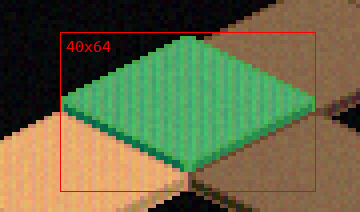
لذلك ، ترسم هذه الوظيفة "تجانبًا" منفصلًا على اللوحة القماشية للصورة الرئيسية ، واستناداً إلى فهرسة المصفوفة "_" ، يكون المتغير "t" مسؤولاً عن فهرس الصورة ، و p و q - لإحداثيات x و y. يمكنك أيضًا إعادة تسمية "_" إلى الزخارف:
الكود حاليا:
#include <X11/Xlib.h>
#include <sys/types.h>
#include <sys/stat.h>
#include <fcntl.h>
#include <unistd.h>

/*    */

/*! \brief     */
#define IMAGE_WIDTH *1220)
/*! \brief     */
#define IMAGE_HEIGHT (616)

/*! \brief   */
#define TEXTURE_COUNT (8)
/*! \brief     */
#define TEXTURE_WIDTH (64)
/*! \brief     */
#define TEXTURE_HEIGHT (40)

/*! \brief    .
 *   int      */
int pixdata[IMAGE_HEIGHT][IMAGE_WIDTH];
int textures[TEXTURE_COUNT][TEXTURE_HEIGHT][TEXTURE_WIDTH] = { 0 };

/*! \brief   Xlib */
Display * display;
/*! \brief    Xlib */
Window window;
/*! \brief      */
XImage * image;

/* \brief  ,     */
static void _image_reset(void) {
    for (int y = 0; y < IMAGE_HEIGHT; y++)
        for (int x = 0; x < IMAGE_WIDTH; x++)
            pixdata[y][x] = 0;
}

/*! \brief
 * \param[in] t
 * \param[in] x X
 * \param[in] y Y   */
void _texture_draw(int t, int x, int y) {
    for (int ty = 0; ty < TEXTURE_HEIGHT; ty++)
        for (int tx = 0; tx < TEXTURE_WIDTH; tx++)
            if (textures[t][ty][tx])
                pixdata[ty + y * 16 + x * 16]
                       [tx + 580 + x * 32 - y * 32] = textures[t][ty][tx];
}

/*    */

int _x[] = { 15117427, 8413248, 5878632, 13027014, 1 };

char m[19][20];
int rn = 2166136261;

void *T;

void b(int t, int x, int y, int c, int l) {
    if ((x >= 19 || y >= 19 || x < 0 || y < 0) || (m[y][x] == l)
    || (m[y][x] != c))
    return;
    m[y][x] = l;
    b(t, x - 1, y, c, l);
    b(t, x + 1, y, c, l);
    b(t, x, y - 1, c, l);
    b(t, x, y + 1, c, l);
}

void e(int t, int x, int y, int c, int l) {
    if ((x >= TEXTURE_WIDTH || y >= TEXTURE_HEIGHT ||
         x < 0 || y < 0) ||
         (textures[t][y][x] == l) ||
         (textures[t][y][x] != c))
        return;
    textures[t][y][x] = l;
    e(t, x - 1, y, c, l);
    e(t, x + 1, y, c, l);
    e(t, x, y - 1, c, l);
    e(t, x, y + 1, c, l);
}

void k(int t, int x, int y, int c, int l) {
    while (c--) {
        textures[t][y][x++] = l;
        textures[t][y++][x++] = l;
    }
}

void r(int t, int x, int y, int c, int l) {
    while (c--) {
        textures[t][y][x--] = l;
        textures[t][y++][x--] = l;
    }
}

void u(int t, int x, int y, int c, int l) {
    while (c--)
        textures[t][y++][x] = l;
}

char *z[8] = {
    (char[]) {4},
    (char[]) {6, 1 * 4 + 1, 0 + 0, 32 - 0, 5 - 0, 16, 0, 0,
              21 + 0 * 3 - 0, 16, 1, 63, 21 + 0 * 3 - 0, 16, 2,
              63 * 0, 21 - 0, 4, 2, 31 + 0, 36 - 0, 4, 0 + 1,
              32 - 1, 5 - 0, 16, 0, 0, 21 + 1 * 3 - 0, 16, 1, 63,
              21 + 1 * 3 - 0, 16, 2, 63 * 1, 21 - 0, 4, 2, 31 + 1,
              36 - 0, 4, 6, 1 * 4 + 0, 3, 31, 8 - 0, 6, 1 * 4 + 2,
              3, 33, 38 - 0, 6, 1 * 4 + 3, 3, 30, 38 - 0, 4},
    (char[]) {5, 1},
    (char[]) {6, 0 * 4 + 1, 0 + 0, 32 - 0, 5 - 0, 16,
              0, 0, 21 + 0 * 3 - 0, 16, 1, 63,
              21 + 0 * 3 - 0, 16, 2, 63 * 0, 21 - 0,
              4, 2, 31 + 0, 36 - 0, 4, 0 + 1, 32 - 1,
              5 - 0, 16, 0, 0, 21 + 1 * 3 - 0, 16, 1,
              63, 21 + 1 * 3 - 0, 16, 2, 63 * 1,
              21 - 0, 4, 2, 31 + 1, 36 - 0, 4, 6,
              0 * 4 + 0, 3, 31, 8 - 0, 6, 0 * 4 + 2,
              3, 33, 38 - 0, 6, 0 * 4 + 3, 3, 30,
              38 - 0,
              4},
    (char[]) {4},
    (char[]) {4},
    (char[]) {6, 2 * 4 + 1, 0 + 0, 32 - 0, 5 - 3, 16, 0, 0,
              21 + 0 * 3 - 3, 16, 1, 63, 21 + 0 * 3 - 3, 16, 2, 63 * 0,
              21 - 3, 4, 2, 31 + 0, 36 - 3, 4, 0 + 1, 32 - 1, 5 - 3,
              16, 0, 0, 21 + 1 * 3 - 3, 16, 1, 63, 21 + 1 * 3 - 3, 16,
              2, 63 * 1, 21 - 3, 4, 2, 31 + 1, 36 - 3, 4, 6, 2 * 4 + 0,
              3, 31, 8 - 3, 6, 2 * 4 + 2, 3, 33, 38 - 3, 6, 2 * 4 + 3,
              3, 30, 38 - 3, 4},
    (char[]) {6, 13, 0, 32, 9 + 0, 12 - 0,
              0, 8 + 0 + 0, 21, 12 - 0, 1,
              31, 9 + 0, 12 - 0, 1,
              55 - 0 - 0, 21, 12 - 0, 0,
              32, 9 + 3, 12 - 3, 0,
              8 + 3 + 3, 21, 12 - 3, 1,
              31, 9 + 3, 12 - 3, 1,
              55 - 3 - 3, 21, 12 - 3, 6,
              14 + 0, 2, 31 + 0, 13, 4,
              1 - 0, 31 + 0, 16, 7, 3,
              30 + 3 * 0, 14, 6,
              12 + 0 * 4, 3, 32 - 0,
              11 + 0 * 8, 6, 14 + 1, 2,
              31 + 1, 13, 4, 1 - 1,
              31 + 1, 16, 7, 3,
              30 + 3 * 1, 14, 6,
              12 + 1 * 4, 3, 32 - 1,
              11 + 1 * 8,
              4}
};

int main(int a, char *s[]) {
    display = XOpenDisplay(0);
    window = XCreateSimpleWindow(display,
                                 RootWindow(display, DefaultScreen(display)),
                                 0, 0, IMAGE_WIDTH, IMAGE_HEIGHT, 1, 0, 0);
    image = XCreateImage(display,
                     DefaultVisual(display, DefaultScreen(display)),
                     DefaultDepth(display, DefaultScreen(display)),
                     2, 0, (char *) pixdata, IMAGE_WIDTH, IMAGE_HEIGHT, 32, 0);
    for (int i = 0; i < 8; i++) {
        char *p = z[i];
        int c = 0;
        while (*p != 4) {
            switch (*p) {
            case 0:
                k(i, p[1], p[2], p[3], c);
                p += 4;
                break;
            case 1:
                r(i, p[1], p[2], p[3], c);
                p += 4;
                break;
            case 2:
                u(i, p[1], p[2], p[3], c);
                p += 4;
                break;
            case 3:
                e(i, p[1]
                  , p[2], 0, c);
                p += 3;
                break;
            case 5:
                p = z[p[1]];
                break;
            case 6:
                c = _x[p[1] / 4] - 1643277 * (p[1] % 4);
                p += 2;
                break;
            }
        }
    }
    while (a++) {
        int f = open(s[1], 0);
        read(f, m, 380);
        close(f);

        for (int y = 0; y < 19; y++)
            for (int x = 0; x < 19; x++)
                if ((x % 14 == 2) && (y % 4 == 3))
                    m[y][x] = 46;
        b(0, 2, 3, m[3][2], a & 1 ? 43 : 45);
        b(0, 2, 7, m[7][2], a & 2 ? 43 : 45);
        b(0, 2, 11, m[11][2], a & 4 ? 43 : 45);
        b(0, 2, 15, m[15][2], a & 8 ? 43 : 45);
        for (int i = 0; i < 20; i++)
            for (int y = 0; y < 19; y++)
                for (int x = 0; x < 19; x++)
                    if (m[y][x] == 62)
                        b(0, x + 1, y, m[y][x + 1],
                            !(m[y - 1][x] == 43 ? 1 : 0
                            || m[y + 1][x] == 43 ? 1 : 0) ? 43 : 45);

        _image_reset();

        for (int y = 0; y < 19; y++)
            for (int x = 0; x < 19; x++)
                _texture_draw(((m[y][x] >> 4) & 1) << 2 | (m[y][x] & 3), x, y);

        for (int y = 0; y < 19; y++)
            for (int x = 0; x < 19; x++)
                if ((x % 14 == 2) && (y % 4 == 3))
                    _texture_draw(7, x, y);
        for (int y = 0; y < IMAGE_HEIGHT; y++)
            for (int x = 0; x < IMAGE_WIDTH; x++) {
                pixdata[y][x] &= 14737632 | (31 << ((x % 3) << 3));
                pixdata[y][x] += 986895 & (rn *= 16777619);
            }
        XPutImage(display, window,
                  DefaultGC(display, DefaultScreen(display)),
                  image, 0, 0, 0, 0, IMAGE_WIDTH, IMAGE_HEIGHT);
        XMapWindow(display, window);
        XFlush(display);

        sleep(1);
    }
    return 0;
}
قراءة الخريطة
لنفصل الأسطر مفتوحة..انغلق في وظيفة منفصلة ، حيث تتم قراءة محتويات الملف المحدد في المتغير m (الذي سنعيد تسميته إلى بيانات الخريطة).
لماذا يتم احتساب الملف في كل دورة؟ كان أقصر من حيث الرمز والرموز. استغرقت عملية "صدم" الكود حوالي 4 أيام لتلائم حدود القواعد. إذا قرأت الملف مرة واحدة فقط ، فستكون هناك حاجة إلى مساحة تخزين إضافية وبعض التناظرية لوظيفة memcpy.
وظيفة مخصصة _map_read
#include <X11/Xlib.h>
#include <sys/types.h>
#include <sys/stat.h>
#include <fcntl.h>
#include <unistd.h>

/*    */

/*! \brief     */
#define IMAGE_WIDTH (1220)
/*! \brief     */
#define IMAGE_HEIGHT (616)
/*! \brief        */
#define IMAGE_SHIFTX (580)

/*! \brief   */
#define TEXTURE_COUNT (8)
/*! \brief     */
#define TEXTURE_WIDTH (64)
/*! \brief     */
#define TEXTURE_HEIGHT (40)
/*! \brief      */
#define TEXTURE_TOP_WIDTH (64)
/*! \brief      */
#define TEXTURE_TOP_HEIGHT (32)

/*! \brief    */
#define MAP_WIDTH (19)
/*! \brief    */
#define MAP_HEIGHT (19)
/*! \brief    -.      '\n' */
#define MAP_FILEDATA ((MAP_WIDTH + 1) * MAP_HEIGHT)

/*! \brief    .
 *   int      */
int pixdata[IMAGE_HEIGHT][IMAGE_WIDTH];
/*! \brief  ,    */
int textures[TEXTURE_COUNT][TEXTURE_HEIGHT][TEXTURE_WIDTH] = { 0 };
/*! \brief   .
 *        '\n' */
char mapdata[MAP_HEIGHT][MAP_WIDTH + 1];

/*! \brief   Xlib */
Display * display;
/*! \brief    Xlib */
Window window;
/*! \brief      */
XImage * image;

/* \brief  ,     */
static void _image_reset(void) {
    for (int y = 0; y < IMAGE_HEIGHT; y++)
        for (int x = 0; x < IMAGE_WIDTH; x++)
            pixdata[y][x] = 0;
}

/*! \brief
 * \param[in] t
 * \param[in] x X
 * \param[in] y Y   */
static void _texture_draw(int t, int x, int y) {
    for (int ty = 0; ty < TEXTURE_HEIGHT; ty++)
        for (int tx = 0; tx < TEXTURE_WIDTH; tx++)
            if (textures[t][ty][tx])
                pixdata[ty +
                        y * (TEXTURE_TOP_HEIGHT / 2) +
                        x * (TEXTURE_TOP_HEIGHT / 2)]
                       [tx +
                        IMAGE_SHIFTX +
                        x * (TEXTURE_TOP_WIDTH / 2) -
                        y * TEXTURE_TOP_HEIGHT] = textures[t][ty][tx];
}

/*! \brief   -
 * \param[in] filename  - */
static void _map_read(const char * filename) {
    int f = open(filename, 0);
    read(f, mapdata, MAP_FILEDATA);
    close(f);
}

/*    */

int _x[] = { 15117427, 8413248, 5878632, 13027014, 1 };
int rn = 2166136261;

void *T;

void b(int t, int x, int y, int c, int l) {
    if ((x >= MAP_WIDTH || y >= MAP_HEIGHT ||
         x < 0 || y < 0) || (mapdata[y][x] == l)
        || (mapdata[y][x] != c))
        return;
    mapdata[y][x] = l;
    b(t, x - 1, y, c, l);
    b(t, x + 1, y, c, l);
    b(t, x, y - 1, c, l);
    b(t, x, y + 1, c, l);
}

void e(int t, int x, int y, int c, int l) {
    if ((x >= TEXTURE_WIDTH || y >= TEXTURE_HEIGHT ||
         x < 0 || y < 0) ||
         (textures[t][y][x] == l) ||
         (textures[t][y][x] != c))
        return;
    textures[t][y][x] = l;
    e(t, x - 1, y, c, l);
    e(t, x + 1, y, c, l);
    e(t, x, y - 1, c, l);
    e(t, x, y + 1, c, l);
}

void k(int t, int x, int y, int c, int l) {
    while (c--) {
        textures[t][y][x++] = l;
        textures[t][y++][x++] = l;
    }
}

void r(int t, int x, int y, int c, int l) {
    while (c--) {
        textures[t][y][x--] = l;
        textures[t][y++][x--] = l;
    }
}

void u(int t, int x, int y, int c, int l) {
    while (c--)
        textures[t][y++][x] = l;
}

char *z[8] = {
    (char[]) {4},
    (char[]) {6, 1 * 4 + 1, 0 + 0, 32 - 0, 5 - 0, 16, 0, 0,
              21 + 0 * 3 - 0, 16, 1, 63, 21 + 0 * 3 - 0, 16, 2,
              63 * 0, 21 - 0, 4, 2, 31 + 0, 36 - 0, 4, 0 + 1,
              32 - 1, 5 - 0, 16, 0, 0, 21 + 1 * 3 - 0, 16, 1, 63,
              21 + 1 * 3 - 0, 16, 2, 63 * 1, 21 - 0, 4, 2, 31 + 1,
              36 - 0, 4, 6, 1 * 4 + 0, 3, 31, 8 - 0, 6, 1 * 4 + 2,
              3, 33, 38 - 0, 6, 1 * 4 + 3, 3, 30, 38 - 0, 4},
    (char[]) {5, 1},
    (char[]) {6, 0 * 4 + 1, 0 + 0, 32 - 0, 5 - 0, 16,
              0, 0, 21 + 0 * 3 - 0, 16, 1, 63,
              21 + 0 * 3 - 0, 16, 2, 63 * 0, 21 - 0,
              4, 2, 31 + 0, 36 - 0, 4, 0 + 1, 32 - 1,
              5 - 0, 16, 0, 0, 21 + 1 * 3 - 0, 16, 1,
              63, 21 + 1 * 3 - 0, 16, 2, 63 * 1,
              21 - 0, 4, 2, 31 + 1, 36 - 0, 4, 6,
              0 * 4 + 0, 3, 31, 8 - 0, 6, 0 * 4 + 2,
              3, 33, 38 - 0, 6, 0 * 4 + 3, 3, 30,
              38 - 0,
              4},
    (char[]) {4},
    (char[]) {4},
    (char[]) {6, 2 * 4 + 1, 0 + 0, 32 - 0, 5 - 3, 16, 0, 0,
              21 + 0 * 3 - 3, 16, 1, 63, 21 + 0 * 3 - 3, 16, 2, 63 * 0,
              21 - 3, 4, 2, 31 + 0, 36 - 3, 4, 0 + 1, 32 - 1, 5 - 3,
              16, 0, 0, 21 + 1 * 3 - 3, 16, 1, 63, 21 + 1 * 3 - 3, 16,
              2, 63 * 1, 21 - 3, 4, 2, 31 + 1, 36 - 3, 4, 6, 2 * 4 + 0,
              3, 31, 8 - 3, 6, 2 * 4 + 2, 3, 33, 38 - 3, 6, 2 * 4 + 3,
              3, 30, 38 - 3, 4},
    (char[]) {6, 13, 0, 32, 9 + 0, 12 - 0,
              0, 8 + 0 + 0, 21, 12 - 0, 1,
              31, 9 + 0, 12 - 0, 1,
              55 - 0 - 0, 21, 12 - 0, 0,
              32, 9 + 3, 12 - 3, 0,
              8 + 3 + 3, 21, 12 - 3, 1,
              31, 9 + 3, 12 - 3, 1,
              55 - 3 - 3, 21, 12 - 3, 6,
              14 + 0, 2, 31 + 0, 13, 4,
              1 - 0, 31 + 0, 16, 7, 3,
              30 + 3 * 0, 14, 6,
              12 + 0 * 4, 3, 32 - 0,
              11 + 0 * 8, 6, 14 + 1, 2,
              31 + 1, 13, 4, 1 - 1,
              31 + 1, 16, 7, 3,
              30 + 3 * 1, 14, 6,
              12 + 1 * 4, 3, 32 - 1,
              11 + 1 * 8,
              4}
};

int main(int a, char *s[]) {
    display = XOpenDisplay(0);
    window = XCreateSimpleWindow(display,
                                 RootWindow(display, DefaultScreen(display)),
                                 0, 0, IMAGE_WIDTH, IMAGE_HEIGHT, 1, 0, 0);
    image = XCreateImage(display,
                     DefaultVisual(display, DefaultScreen(display)),
                     DefaultDepth(display, DefaultScreen(display)),
                     2, 0, (char *) pixdata, IMAGE_WIDTH, IMAGE_HEIGHT, 32, 0);
    for (int i = 0; i < 8; i++) {
        char *p = z[i];
        int c = 0;
        while (*p != 4) {
            switch (*p) {
            case 0:
                k(i, p[1], p[2], p[3], c);
                p += 4;
                break;
            case 1:
                r(i, p[1], p[2], p[3], c);
                p += 4;
                break;
            case 2:
                u(i, p[1], p[2], p[3], c);
                p += 4;
                break;
            case 3:
                e(i, p[1]
                  , p[2], 0, c);
                p += 3;
                break;
            case 5:
                p = z[p[1]];
                break;
            case 6:
                c = _x[p[1] / 4] - 1643277 * (p[1] % 4);
                p += 2;
                break;
            }
        }
    }
    while (a++) {
        _map_read(s[1]);

        for (int y = 0; y < MAP_HEIGHT; y++)
            for (int x = 0; x < MAP_WIDTH; x++)
                if ((x % 14 == 2) && (y % 4 == 3))
                    mapdata[y][x] = 46;
        b(0, 2, 3, mapdata[3][2], a & 1 ? 43 : 45);
        b(0, 2, 7, mapdata[7][2], a & 2 ? 43 : 45);
        b(0, 2, 11, mapdata[11][2], a & 4 ? 43 : 45);
        b(0, 2, 15, mapdata[15][2], a & 8 ? 43 : 45);
        for (int i = 0; i < 20; i++)
            for (int y = 0; y < MAP_HEIGHT; y++)
                for (int x = 0; x < MAP_WIDTH; x++)
                    if (mapdata[y][x] == 62)
                        b(0, x + 1, y, mapdata[y][x + 1],
                            !(mapdata[y - 1][x] == 43 ? 1 : 0
                            || mapdata[y + 1][x] == 43 ? 1 : 0) ? 43 : 45);

        _image_reset();

        for (int y = 0; y < MAP_HEIGHT; y++)
            for (int x = 0; x < MAP_WIDTH; x++)
                _texture_draw(((m[y][x] >> 4) & 1) << 2 | (mapdata[y][x] & 3), x, y);

        for (int y = 0; y < MAP_HEIGHT; y++)
            for (int x = 0; x < MAP_WIDTH; x++)
                if ((x % 14 == 2) && (y % 4 == 3))
                    _texture_draw(7, x, y);
        for (int y = 0; y < IMAGE_HEIGHT; y++)
            for (int x = 0; x < IMAGE_WIDTH; x++) {
                pixdata[y][x] &= 14737632 | (31 << ((x % 3) << 3));
                pixdata[y][x] += 986895 & (rn *= 16777619);
            }
        XPutImage(display, window,
                  DefaultGC(display, DefaultScreen(display)),
                  image, 0, 0, 0, 0, IMAGE_WIDTH, IMAGE_HEIGHT);
        XMapWindow(display, window);
        XFlush(display);

        sleep(1);
    }
    return 0;
}
نظرًا لأننا تطرقنا إلى متغير mapdata ، فلننتبه للخطوط والوظائف حيث يتغير - هذه هي الوظيفة "b" ، والتي لن نتطرق إليها الآن و "main" حيث ، مع الانتباه إلى محتويات ملفات التكوين "كاملة" ، سنقوم بإعادة تشكيل:
بعد إعادة الهيكلة على mapdata
#include <X11/Xlib.h>
#include <sys/types.h>
#include <sys/stat.h>
#include <fcntl.h>
#include <unistd.h>

/*    */

/*! \brief     */
#define IMAGE_WIDTH (1220)
/*! \brief     */
#define IMAGE_HEIGHT (616)
/*! \brief        */
#define IMAGE_SHIFTX (580)

/*! \brief   */
#define TEXTURE_COUNT (8)
/*! \brief     */
#define TEXTURE_WIDTH (64)
/*! \brief     */
#define TEXTURE_HEIGHT (40)
/*! \brief      */
#define TEXTURE_TOP_WIDTH (64)
/*! \brief      */
#define TEXTURE_TOP_HEIGHT (32)

/*! \brief    */
#define MAP_WIDTH (19)
/*! \brief    */
#define MAP_HEIGHT (19)
/*! \brief    -.      '\n' */
#define MAP_FILEDATA ((MAP_WIDTH + 1) * MAP_HEIGHT)
/*! \brief      NOR- */
#define MAP_ITERATIONS (20)

/*! \brief    - */
enum map_characters {
    MAPCHAR_WIRE  = '.', /**<             (ASCII = 46) */
    MAPCHAR_PLUS  = '+', /**<  ( ) (ASCII = 43) */
    MAPCHAR_MINUS = '-', /**<  ( ) (ASCII = 45) */
    MAPCHAR_NOR   = '>', /**< NOR-       (ASCII = 62) */
}

/*! \brief    .
 *   int      */
int pixdata[IMAGE_HEIGHT][IMAGE_WIDTH];
/*! \brief  ,    */
int textures[TEXTURE_COUNT][TEXTURE_HEIGHT][TEXTURE_WIDTH] = { 0 };
/*! \brief   .
 *        '\n' */
char mapdata[MAP_HEIGHT][MAP_WIDTH + 1];

/*! \brief   Xlib */
Display * display;
/*! \brief    Xlib */
Window window;
/*! \brief      */
XImage * image;

/* \brief  ,     */
static void _image_reset(void) {
    for (int y = 0; y < IMAGE_HEIGHT; y++)
        for (int x = 0; x < IMAGE_WIDTH; x++)
            pixdata[y][x] = 0;
}

/*! \brief
 * \param[in] t
 * \param[in] x X
 * \param[in] y Y   */
static void _texture_draw(int t, int x, int y) {
    for (int ty = 0; ty < TEXTURE_HEIGHT; ty++)
        for (int tx = 0; tx < TEXTURE_WIDTH; tx++)
            if (textures[t][ty][tx])
                pixdata[ty +
                        y * (TEXTURE_TOP_HEIGHT / 2) +
                        x * (TEXTURE_TOP_HEIGHT / 2)]
                       [tx +
                        IMAGE_SHIFTX +
                        x * (TEXTURE_TOP_WIDTH / 2) -
                        y * TEXTURE_TOP_HEIGHT] = textures[t][ty][tx];
}

/*! \brief   -
 * \param[in] filename  - */
static void _map_read(const char * filename) {
    int f = open(filename, 0);
    read(f, mapdata, MAP_FILEDATA);
    close(f);
}

/*! \brief     -
 *          */
static void _map_wire_inputs(void) {
    for (int y = 0; y < MAP_HEIGHT; y++)
        for (int x = 0; x < MAP_WIDTH; x++)
            if ((x % 14 == 2) && (y % 4 == 3))
                mapdata[y][x] = MAPCHAR_WIRE;
}

/*! \brief
 * .
 * \param[in] counter  */
static void _map_wire_counter(int counter) {
    b(0, 2, 3,  mapdata[3][2],  counter & 1 ? MAPCHAR_PLUS : MAPCHAR_MINUS);
    b(0, 2, 7,  mapdata[7][2],  counter & 2 ? MAPCHAR_PLUS : MAPCHAR_MINUS);
    b(0, 2, 11, mapdata[11][2], counter & 4 ? MAPCHAR_PLUS : MAPCHAR_MINUS);
    b(0, 2, 15, mapdata[15][2], counter & 8 ? MAPCHAR_PLUS : MAPCHAR_MINUS);
}

/*! \brief    ()   NOR- */
static void _map_process_gates(void) {
    for (int i = 0; i < MAP_ITERATIONS; i++)
        for (int y = 0; y < MAP_HEIGHT; y++)
            for (int x = 0; x < MAP_WIDTH; x++)
                if (mapdata[y][x] == MAPCHAR_NOR)
                    b(0, x + 1, y, mapdata[y][x + 1],
                        !(mapdata[y - 1][x] == MAPCHAR_PLUS ? 1 : 0
                       || mapdata[y + 1][x] == MAPCHAR_PLUS ? 1 : 0) ?
                            MAPCHAR_PLUS : MAPCHAR_MINUS);
}

/*    */

int _x[] = { 15117427, 8413248, 5878632, 13027014, 1 };
int rn = 2166136261;

void *T;

void b(int t, int x, int y, int c, int l) {
    if ((x >= MAP_WIDTH || y >= MAP_HEIGHT ||
         x < 0 || y < 0) || (mapdata[y][x] == l)
        || (mapdata[y][x] != c))
        return;
    mapdata[y][x] = l;
    b(t, x - 1, y, c, l);
    b(t, x + 1, y, c, l);
    b(t, x, y - 1, c, l);
    b(t, x, y + 1, c, l);
}

void e(int t, int x, int y, int c, int l) {
    if ((x >= TEXTURE_WIDTH || y >= TEXTURE_HEIGHT ||
         x < 0 || y < 0) ||
         (textures[t][y][x] == l) ||
         (textures[t][y][x] != c))
        return;
    textures[t][y][x] = l;
    e(t, x - 1, y, c, l);
    e(t, x + 1, y, c, l);
    e(t, x, y - 1, c, l);
    e(t, x, y + 1, c, l);
}

void k(int t, int x, int y, int c, int l) {
    while (c--) {
        textures[t][y][x++] = l;
        textures[t][y++][x++] = l;
    }
}

void r(int t, int x, int y, int c, int l) {
    while (c--) {
        textures[t][y][x--] = l;
        textures[t][y++][x--] = l;
    }
}

void u(int t, int x, int y, int c, int l) {
    while (c--)
        textures[t][y++][x] = l;
}

char *z[8] = {
    (char[]) {4},
    (char[]) {6, 1 * 4 + 1, 0 + 0, 32 - 0, 5 - 0, 16, 0, 0,
              21 + 0 * 3 - 0, 16, 1, 63, 21 + 0 * 3 - 0, 16, 2,
              63 * 0, 21 - 0, 4, 2, 31 + 0, 36 - 0, 4, 0 + 1,
              32 - 1, 5 - 0, 16, 0, 0, 21 + 1 * 3 - 0, 16, 1, 63,
              21 + 1 * 3 - 0, 16, 2, 63 * 1, 21 - 0, 4, 2, 31 + 1,
              36 - 0, 4, 6, 1 * 4 + 0, 3, 31, 8 - 0, 6, 1 * 4 + 2,
              3, 33, 38 - 0, 6, 1 * 4 + 3, 3, 30, 38 - 0, 4},
    (char[]) {5, 1},
    (char[]) {6, 0 * 4 + 1, 0 + 0, 32 - 0, 5 - 0, 16,
              0, 0, 21 + 0 * 3 - 0, 16, 1, 63,
              21 + 0 * 3 - 0, 16, 2, 63 * 0, 21 - 0,
              4, 2, 31 + 0, 36 - 0, 4, 0 + 1, 32 - 1,
              5 - 0, 16, 0, 0, 21 + 1 * 3 - 0, 16, 1,
              63, 21 + 1 * 3 - 0, 16, 2, 63 * 1,
              21 - 0, 4, 2, 31 + 1, 36 - 0, 4, 6,
              0 * 4 + 0, 3, 31, 8 - 0, 6, 0 * 4 + 2,
              3, 33, 38 - 0, 6, 0 * 4 + 3, 3, 30,
              38 - 0,
              4},
    (char[]) {4},
    (char[]) {4},
    (char[]) {6, 2 * 4 + 1, 0 + 0, 32 - 0, 5 - 3, 16, 0, 0,
              21 + 0 * 3 - 3, 16, 1, 63, 21 + 0 * 3 - 3, 16, 2, 63 * 0,
              21 - 3, 4, 2, 31 + 0, 36 - 3, 4, 0 + 1, 32 - 1, 5 - 3,
              16, 0, 0, 21 + 1 * 3 - 3, 16, 1, 63, 21 + 1 * 3 - 3, 16,
              2, 63 * 1, 21 - 3, 4, 2, 31 + 1, 36 - 3, 4, 6, 2 * 4 + 0,
              3, 31, 8 - 3, 6, 2 * 4 + 2, 3, 33, 38 - 3, 6, 2 * 4 + 3,
              3, 30, 38 - 3, 4},
    (char[]) {6, 13, 0, 32, 9 + 0, 12 - 0,
              0, 8 + 0 + 0, 21, 12 - 0, 1,
              31, 9 + 0, 12 - 0, 1,
              55 - 0 - 0, 21, 12 - 0, 0,
              32, 9 + 3, 12 - 3, 0,
              8 + 3 + 3, 21, 12 - 3, 1,
              31, 9 + 3, 12 - 3, 1,
              55 - 3 - 3, 21, 12 - 3, 6,
              14 + 0, 2, 31 + 0, 13, 4,
              1 - 0, 31 + 0, 16, 7, 3,
              30 + 3 * 0, 14, 6,
              12 + 0 * 4, 3, 32 - 0,
              11 + 0 * 8, 6, 14 + 1, 2,
              31 + 1, 13, 4, 1 - 1,
              31 + 1, 16, 7, 3,
              30 + 3 * 1, 14, 6,
              12 + 1 * 4, 3, 32 - 1,
              11 + 1 * 8,
              4}
};

int main(int a, char *s[]) {
    display = XOpenDisplay(0);
    window = XCreateSimpleWindow(display,
                                 RootWindow(display, DefaultScreen(display)),
                                 0, 0, IMAGE_WIDTH, IMAGE_HEIGHT, 1, 0, 0);
    image = XCreateImage(display,
                     DefaultVisual(display, DefaultScreen(display)),
                     DefaultDepth(display, DefaultScreen(display)),
                     2, 0, (char *) pixdata, IMAGE_WIDTH, IMAGE_HEIGHT, 32, 0);
    for (int i = 0; i < 8; i++) {
        char *p = z[i];
        int c = 0;
        while (*p != 4) {
            switch (*p) {
            case 0:
                k(i, p[1], p[2], p[3], c);
                p += 4;
                break;
            case 1:
                r(i, p[1], p[2], p[3], c);
                p += 4;
                break;
            case 2:
                u(i, p[1], p[2], p[3], c);
                p += 4;
                break;
            case 3:
                e(i, p[1]
                  , p[2], 0, c);
                p += 3;
                break;
            case 5:
                p = z[p[1]];
                break;
            case 6:
                c = _x[p[1] / 4] - 1643277 * (p[1] % 4);
                p += 2;
                break;
            }
        }
    }
    while (a++) {
        _map_read(s[1]);
        _map_wire_inputs();
        _map_wire_counter(a);
        _map_process_gates();

        _image_reset();

        for (int y = 0; y < MAP_HEIGHT; y++)
            for (int x = 0; x < MAP_WIDTH; x++)
                _texture_draw(((mapdata[y][x] >> 4) & 1) << 2 | (mapdata[y][x] & 3), x, y);

        for (int y = 0; y < MAP_HEIGHT; y++)
            for (int x = 0; x < MAP_WIDTH; x++)
                if ((x % 14 == 2) && (y % 4 == 3))
                    _texture_draw(7, x, y);
        for (int y = 0; y < IMAGE_HEIGHT; y++)
            for (int x = 0; x < IMAGE_WIDTH; x++) {
                pixdata[y][x] &= 14737632 | (31 << ((x % 3) << 3));
                pixdata[y][x] += 986895 & (rn *= 16777619);
            }
        XPutImage(display, window,
                  DefaultGC(display, DefaultScreen(display)),
                  image, 0, 0, 0, 0, IMAGE_WIDTH, IMAGE_HEIGHT);
        XMapWindow(display, window);
        XFlush(display);

        sleep(1);
    }
    return 0;
}
لإنهاء معالجة العمل باستخدام "mapdata" ، تحتاج إلى الإجابة عن سؤالين آخرين - ما هي الوظيفة "b":
void b(int t, int x, int y, int c, int l) {
    if ((x >= MAP_WIDTH || y >= MAP_HEIGHT ||
         x < 0 || y < 0) || (mapdata[y][x] == l)
        || (mapdata[y][x] != c))
        return;
    mapdata[y][x] = l;
    b(t, x - 1, y, c, l);
    b(t, x + 1, y, c, l);
    b(t, x, y - 1, c, l);
    b(t, x, y + 1, c, l);
}
وماذا يحدث في الكتلة:
        for (int y = 0; y < MAP_HEIGHT; y++)
            for (int x = 0; x < MAP_WIDTH; x++)
                _texture_draw(((mapdata[y][x] >> 4) & 1) << 2 | (mapdata[y][x] & 3), x, y);
الوظيفة "ب"
إذا نظرت عن كثب إلى الوظيفة "ب" ، ستلاحظ أنها تشبه بشكل مؤلم تنفيذ خوارزمية ملء الفيضان ، والتي تتزامن مع غرضها النظري - فهي "تغمر" "السلك" بالحالة المرغوبة ، مما يسمح لموجة التيار بالانتشار إلى نهاية السلك. دعونا نعيد تسميته ونضعه في قالب "جاهز للإنتاج".
ملء الفيضانات
#include <X11/Xlib.h>
#include <sys/types.h>
#include <sys/stat.h>
#include <fcntl.h>
#include <unistd.h>

/*    */

/*! \brief     */
#define IMAGE_WIDTH (1220)
/*! \brief     */
#define IMAGE_HEIGHT (616)
/*! \brief        */
#define IMAGE_SHIFTX (580)

/*! \brief   */
#define TEXTURE_COUNT (8)
/*! \brief     */
#define TEXTURE_WIDTH (64)
/*! \brief     */
#define TEXTURE_HEIGHT (40)
/*! \brief      */
#define TEXTURE_TOP_WIDTH (64)
/*! \brief      */
#define TEXTURE_TOP_HEIGHT (32)

/*! \brief    */
#define MAP_WIDTH (19)
/*! \brief    */
#define MAP_HEIGHT (19)
/*! \brief    -.      '\n' */
#define MAP_FILEDATA ((MAP_WIDTH + 1) * MAP_HEIGHT)
/*! \brief      NOR- */
#define MAP_ITERATIONS (20)

/*! \brief    - */
enum map_characters {
    MAPCHAR_WIRE  = '.', /**<             (ASCII = 46) */
    MAPCHAR_PLUS  = '+', /**<  ( ) (ASCII = 43) */
    MAPCHAR_MINUS = '-', /**<  ( ) (ASCII = 45) */
    MAPCHAR_NOR   = '>', /**< NOR-       (ASCII = 62) */
};

/*! \brief    .
 *   int      */
int pixdata[IMAGE_HEIGHT][IMAGE_WIDTH];
/*! \brief  ,    */
int textures[TEXTURE_COUNT][TEXTURE_HEIGHT][TEXTURE_WIDTH] = { 0 };
/*! \brief   .
 *        '\n' */
char mapdata[MAP_HEIGHT][MAP_WIDTH + 1];

/*! \brief   Xlib */
Display * display;
/*! \brief    Xlib */
Window window;
/*! \brief      */
XImage * image;

/* \brief  ,     */
static void _image_reset(void) {
    for (int y = 0; y < IMAGE_HEIGHT; y++)
        for (int x = 0; x < IMAGE_WIDTH; x++)
            pixdata[y][x] = 0;
}

/*! \brief
 * \param[in] t
 * \param[in] x X
 * \param[in] y Y   */
static void _texture_draw(int t, int x, int y) {
    for (int ty = 0; ty < TEXTURE_HEIGHT; ty++)
        for (int tx = 0; tx < TEXTURE_WIDTH; tx++)
            if (textures[t][ty][tx])
                pixdata[ty +
                        y * (TEXTURE_TOP_HEIGHT / 2) +
                        x * (TEXTURE_TOP_HEIGHT / 2)]
                       [tx +
                        IMAGE_SHIFTX +
                        x * (TEXTURE_TOP_WIDTH / 2) -
                        y * TEXTURE_TOP_HEIGHT] = textures[t][ty][tx];
}

/*! \brief   -
 * \param[in] filename  - */
static void _map_read(const char * filename) {
    int f = open(filename, 0);
    read(f, mapdata, MAP_FILEDATA);
    close(f);
}

/*! \brief     -
 *          */
static void _map_wire_inputs(void) {
    for (int y = 0; y < MAP_HEIGHT; y++)
        for (int x = 0; x < MAP_WIDTH; x++)
            if ((x % 14 == 2) && (y % 4 == 3))
                mapdata[y][x] = MAPCHAR_WIRE;
}

/*! \brief
 * \param[in] t ,
 * \param[in] x X-
 * \param[in] y Y-
 * \param[in] c
 * \param[in] l   */
static void _map_fill(int t, int x, int y, int c, int l) {
    if ((x >= MAP_WIDTH || y >= MAP_HEIGHT ||
         x < 0 || y < 0) || (mapdata[y][x] == l)
        || (mapdata[y][x] != c))
        return;
    mapdata[y][x] = l;
    _map_fill(t, x - 1, y, c, l);
    _map_fill(t, x + 1, y, c, l);
    _map_fill(t, x, y - 1, c, l);
    _map_fill(t, x, y + 1, c, l);
}

/*! \brief
 * .
 * \param[in] counter  */
static void _map_wire_counter(int counter) {
    _map_fill(0, 2, 3,  mapdata[3][2],  counter & 1 ? MAPCHAR_PLUS : MAPCHAR_MINUS);
    _map_fill(0, 2, 7,  mapdata[7][2],  counter & 2 ? MAPCHAR_PLUS : MAPCHAR_MINUS);
    _map_fill(0, 2, 11, mapdata[11][2], counter & 4 ? MAPCHAR_PLUS : MAPCHAR_MINUS);
    _map_fill(0, 2, 15, mapdata[15][2], counter & 8 ? MAPCHAR_PLUS : MAPCHAR_MINUS);
}

/*! \brief    ()   NOR- */
static void _map_process_gates(void) {
    for (int i = 0; i < MAP_ITERATIONS; i++)
        for (int y = 0; y < MAP_HEIGHT; y++)
            for (int x = 0; x < MAP_WIDTH; x++)
                if (mapdata[y][x] == MAPCHAR_NOR)
                    _map_fill(0, x + 1, y, mapdata[y][x + 1],
                        !(mapdata[y - 1][x] == MAPCHAR_PLUS ? 1 : 0
                       || mapdata[y + 1][x] == MAPCHAR_PLUS ? 1 : 0) ?
                            MAPCHAR_PLUS : MAPCHAR_MINUS);
}

/*    */

int _x[] = { 15117427, 8413248, 5878632, 13027014, 1 };
int rn = 2166136261;

void *T;

void e(int t, int x, int y, int c, int l) {
    if ((x >= TEXTURE_WIDTH || y >= TEXTURE_HEIGHT ||
         x < 0 || y < 0) ||
         (textures[t][y][x] == l) ||
         (textures[t][y][x] != c))
        return;
    textures[t][y][x] = l;
    e(t, x - 1, y, c, l);
    e(t, x + 1, y, c, l);
    e(t, x, y - 1, c, l);
    e(t, x, y + 1, c, l);
}

void k(int t, int x, int y, int c, int l) {
    while (c--) {
        textures[t][y][x++] = l;
        textures[t][y++][x++] = l;
    }
}

void r(int t, int x, int y, int c, int l) {
    while (c--) {
        textures[t][y][x--] = l;
        textures[t][y++][x--] = l;
    }
}

void u(int t, int x, int y, int c, int l) {
    while (c--)
        textures[t][y++][x] = l;
}

char *z[8] = {
    (char[]) {4},
    (char[]) {6, 1 * 4 + 1, 0 + 0, 32 - 0, 5 - 0, 16, 0, 0,
              21 + 0 * 3 - 0, 16, 1, 63, 21 + 0 * 3 - 0, 16, 2,
              63 * 0, 21 - 0, 4, 2, 31 + 0, 36 - 0, 4, 0 + 1,
              32 - 1, 5 - 0, 16, 0, 0, 21 + 1 * 3 - 0, 16, 1, 63,
              21 + 1 * 3 - 0, 16, 2, 63 * 1, 21 - 0, 4, 2, 31 + 1,
              36 - 0, 4, 6, 1 * 4 + 0, 3, 31, 8 - 0, 6, 1 * 4 + 2,
              3, 33, 38 - 0, 6, 1 * 4 + 3, 3, 30, 38 - 0, 4},
    (char[]) {5, 1},
    (char[]) {6, 0 * 4 + 1, 0 + 0, 32 - 0, 5 - 0, 16,
              0, 0, 21 + 0 * 3 - 0, 16, 1, 63,
              21 + 0 * 3 - 0, 16, 2, 63 * 0, 21 - 0,
              4, 2, 31 + 0, 36 - 0, 4, 0 + 1, 32 - 1,
              5 - 0, 16, 0, 0, 21 + 1 * 3 - 0, 16, 1,
              63, 21 + 1 * 3 - 0, 16, 2, 63 * 1,
              21 - 0, 4, 2, 31 + 1, 36 - 0, 4, 6,
              0 * 4 + 0, 3, 31, 8 - 0, 6, 0 * 4 + 2,
              3, 33, 38 - 0, 6, 0 * 4 + 3, 3, 30,
              38 - 0,
              4},
    (char[]) {4},
    (char[]) {4},
    (char[]) {6, 2 * 4 + 1, 0 + 0, 32 - 0, 5 - 3, 16, 0, 0,
              21 + 0 * 3 - 3, 16, 1, 63, 21 + 0 * 3 - 3, 16, 2, 63 * 0,
              21 - 3, 4, 2, 31 + 0, 36 - 3, 4, 0 + 1, 32 - 1, 5 - 3,
              16, 0, 0, 21 + 1 * 3 - 3, 16, 1, 63, 21 + 1 * 3 - 3, 16,
              2, 63 * 1, 21 - 3, 4, 2, 31 + 1, 36 - 3, 4, 6, 2 * 4 + 0,
              3, 31, 8 - 3, 6, 2 * 4 + 2, 3, 33, 38 - 3, 6, 2 * 4 + 3,
              3, 30, 38 - 3, 4},
    (char[]) {6, 13, 0, 32, 9 + 0, 12 - 0,
              0, 8 + 0 + 0, 21, 12 - 0, 1,
              31, 9 + 0, 12 - 0, 1,
              55 - 0 - 0, 21, 12 - 0, 0,
              32, 9 + 3, 12 - 3, 0,
              8 + 3 + 3, 21, 12 - 3, 1,
              31, 9 + 3, 12 - 3, 1,
              55 - 3 - 3, 21, 12 - 3, 6,
              14 + 0, 2, 31 + 0, 13, 4,
              1 - 0, 31 + 0, 16, 7, 3,
              30 + 3 * 0, 14, 6,
              12 + 0 * 4, 3, 32 - 0,
              11 + 0 * 8, 6, 14 + 1, 2,
              31 + 1, 13, 4, 1 - 1,
              31 + 1, 16, 7, 3,
              30 + 3 * 1, 14, 6,
              12 + 1 * 4, 3, 32 - 1,
              11 + 1 * 8,
              4}
};

int main(int a, char *s[]) {
    display = XOpenDisplay(0);
    window = XCreateSimpleWindow(display,
                                 RootWindow(display, DefaultScreen(display)),
                                 0, 0, IMAGE_WIDTH, IMAGE_HEIGHT, 1, 0, 0);
    image = XCreateImage(display,
                     DefaultVisual(display, DefaultScreen(display)),
                     DefaultDepth(display, DefaultScreen(display)),
                     2, 0, (char *) pixdata, IMAGE_WIDTH, IMAGE_HEIGHT, 32, 0);
    for (int i = 0; i < 8; i++) {
        char *p = z[i];
        int c = 0;
        while (*p != 4) {
            switch (*p) {
            case 0:
                k(i, p[1], p[2], p[3], c);
                p += 4;
                break;
            case 1:
                r(i, p[1], p[2], p[3], c);
                p += 4;
                break;
            case 2:
                u(i, p[1], p[2], p[3], c);
                p += 4;
                break;
            case 3:
                e(i, p[1]
                  , p[2], 0, c);
                p += 3;
                break;
            case 5:
                p = z[p[1]];
                break;
            case 6:
                c = _x[p[1] / 4] - 1643277 * (p[1] % 4);
                p += 2;
                break;
            }
        }
    }
    while (a++) {
        _map_read(s[1]);
        _map_wire_inputs();
        _map_wire_counter(a);
        _map_process_gates();

        _image_reset();

        for (int y = 0; y < MAP_HEIGHT; y++)
            for (int x = 0; x < MAP_WIDTH; x++)
                _texture_draw(((mapdata[y][x] >> 4) & 1) << 2 | (mapdata[y][x] & 3), x, y);

        for (int y = 0; y < MAP_HEIGHT; y++)
            for (int x = 0; x < MAP_WIDTH; x++)
                if ((x % 14 == 2) && (y % 4 == 3))
                    _texture_draw(7, x, y);
        for (int y = 0; y < IMAGE_HEIGHT; y++)
            for (int x = 0; x < IMAGE_WIDTH; x++) {
                pixdata[y][x] &= 14737632 | (31 << ((x % 3) << 3));
                pixdata[y][x] += 986895 & (rn *= 16777619);
            }
        XPutImage(display, window,
                  DefaultGC(display, DefaultScreen(display)),
                  image, 0, 0, 0, 0, IMAGE_WIDTH, IMAGE_HEIGHT);
        XMapWindow(display, window);
        XFlush(display);

        sleep(1);
    }
    return 0;
}
كتلة غريبة
الآن يبقى تحليل ما يحدث في السطر:
_texture_draw(((mapdata[y][x] >> 4) & 1) << 2 | (mapdata[y][x] & 3), x, y);نظرًا لأننا قمنا بالفعل ببناء جدول كامل للحالات التي يمكن أن تكون داخل بيانات الخريطة ، يمكننا الحصول على جميع قيم المخرجات للمعامل الأول:
| تعداد | int | نتيجة |
|---|---|---|
| MAPCHAR_WIRE | 46 | 2 |
| MAPCHAR_PLUS | 43 | 3 |
| MAPCHAR_MINUS | 45 | 1 |
| MAPCHAR_NOR | 62 | 6 |
| MAPCHAR_EMPTY | 32 | 0 |
نعم ، نتيجة لهذا التحول ، نحصل على فهرس النسيج في مصفوفة النسيج.
استغرق الأمر بضع ساعات للتفكير في آلية التوليد من مجموعة من الرموز المقروءة والمفهومة بشكل جماعي إلى فهارس النسيج. لقد كتبت الرموز التي يمكن أن تعني الأسلاك وعناصر NOR وبعد ذلك ، بعد أن رسمت قيمها الثنائية ، قمت بتدوير المناطق الفريدة. بالإضافة إلى الخيار الحالي ، كان هناك خيار ثان بحسابات أكثر تعقيدًا ، لكنه أطول ، وبالتالي ، فهو لا يتناسب مع حد الرمز المميز.
رائع ، يمنحنا القدرة على عزل وظيفة أخرى وإعلان تعداد لكل نسيج:
بعد إعادة بناء ديون أخرى:
#include <X11/Xlib.h>
#include <sys/types.h>
#include <sys/stat.h>
#include <fcntl.h>
#include <unistd.h>

/*    */

/*! \brief     */
#define IMAGE_WIDTH (1220)
/*! \brief     */
#define IMAGE_HEIGHT (616)
/*! \brief        */
#define IMAGE_SHIFTX (580)

/*! \brief   */
#define TEXTURE_COUNT (8)
/*! \brief     */
#define TEXTURE_WIDTH (64)
/*! \brief     */
#define TEXTURE_HEIGHT (40)
/*! \brief      */
#define TEXTURE_TOP_WIDTH (64)
/*! \brief      */
#define TEXTURE_TOP_HEIGHT (32)

/*! \brief    */
#define MAP_WIDTH (19)
/*! \brief    */
#define MAP_HEIGHT (19)
/*! \brief    -.      '\n' */
#define MAP_FILEDATA ((MAP_WIDTH + 1) * MAP_HEIGHT)
/*! \brief      NOR- */
#define MAP_ITERATIONS (20)

/*! \brief    - */
enum map_characters {
    MAPCHAR_WIRE  = '.', /**<             (ASCII = 46) */
    MAPCHAR_PLUS  = '+', /**<  ( ) (ASCII = 43) */
    MAPCHAR_MINUS = '-', /**<  ( ) (ASCII = 45) */
    MAPCHAR_NOR   = '>', /**< NOR-       (ASCII = 62) */
    MAPCHAR_EMPTY = ' ', /**<         (ASCII = 32) */
};

/*! \brief    */
enum textures_indexes {
    TEXINDEX_EMPTY = (0), /**<                    */
    TEXINDEX_MINUS = (1), /**<   " " */
    TEXINDEX_WIRE  = (2), /**<       */
    TEXINDEX_PLUS  = (3), /**<   ""   */
    /**/
    TEXINDEX_NOR   = (6)  /**<   NOR-           */
};

/*! \brief   */
enum program_arguments {
    ARG_PROGRAM,  /**<    */
    ARG_BLUEPRINT /**<  -   */
};

/*! \brief    .
 *   int      */
int pixdata[IMAGE_HEIGHT][IMAGE_WIDTH];
/*! \brief  ,    */
int textures[TEXTURE_COUNT][TEXTURE_HEIGHT][TEXTURE_WIDTH] = { 0 };
/*! \brief   .
 *        '\n' */
char mapdata[MAP_HEIGHT][MAP_WIDTH + 1];

/*! \brief   Xlib */
Display * display;
/*! \brief    Xlib */
Window window;
/*! \brief      */
XImage * image;

/* \brief  ,     */
static void _image_reset(void) {
    for (int y = 0; y < IMAGE_HEIGHT; y++)
        for (int x = 0; x < IMAGE_WIDTH; x++)
            pixdata[y][x] = 0;
}

/*! \brief
 * \param[in] elem
 * \return   */
static int _map2texture(char elem) {
    return ((elem >> 4) & 1) << 2 | (elem & 3);
}

/*! \brief        */
static void _image_compile(void) {
    for (int y = 0; y < MAP_HEIGHT; y++)
        for (int x = 0; x < MAP_WIDTH; x++)
            _texture_draw(_map2texture(mapdata[y][x]), x, y);
}

/*! \brief     */
static void _image_draw(void) {
    XPutImage(display, window,
              DefaultGC(display, DefaultScreen(display)),
              image, 0, 0, 0, 0, IMAGE_WIDTH, IMAGE_HEIGHT);
    XMapWindow(display, window);
    XFlush(display);
}

/*! \brief
 * \param[in] t
 * \param[in] x X
 * \param[in] y Y   */
static void _texture_draw(int t, int x, int y) {
    for (int ty = 0; ty < TEXTURE_HEIGHT; ty++)
        for (int tx = 0; tx < TEXTURE_WIDTH; tx++)
            if (textures[t][ty][tx])
                pixdata[ty +
                        y * (TEXTURE_TOP_HEIGHT / 2) +
                        x * (TEXTURE_TOP_HEIGHT / 2)]
                       [tx +
                        IMAGE_SHIFTX +
                        x * (TEXTURE_TOP_WIDTH / 2) -
                        y * TEXTURE_TOP_HEIGHT] = textures[t][ty][tx];
}

/*! \brief   -
 * \param[in] filename  - */
static void _map_read(const char * filename) {
    int f = open(filename, 0);
    read(f, mapdata, MAP_FILEDATA);
    close(f);
}

/*! \brief     -
 *          */
static void _map_wire_inputs(void) {
    for (int y = 0; y < MAP_HEIGHT; y++)
        for (int x = 0; x < MAP_WIDTH; x++)
            if ((x % 14 == 2) && (y % 4 == 3))
                mapdata[y][x] = MAPCHAR_WIRE;
}

/*! \brief
 * \param[in] t ,
 * \param[in] x X-
 * \param[in] y Y-
 * \param[in] c
 * \param[in] l   */
static void _map_fill(int t, int x, int y, int c, int l) {
    if ((x >= MAP_WIDTH || y >= MAP_HEIGHT ||
         x < 0 || y < 0) || (mapdata[y][x] == l)
        || (mapdata[y][x] != c))
        return;
    mapdata[y][x] = l;
    _map_fill(t, x - 1, y, c, l);
    _map_fill(t, x + 1, y, c, l);
    _map_fill(t, x, y - 1, c, l);
    _map_fill(t, x, y + 1, c, l);
}

/*! \brief
 * .
 * \param[in] counter  */
static void _map_wire_counter(int counter) {
    _map_fill(0, 2, 3,  mapdata[3][2],  counter & 1 ? MAPCHAR_PLUS : MAPCHAR_MINUS);
    _map_fill(0, 2, 7,  mapdata[7][2],  counter & 2 ? MAPCHAR_PLUS : MAPCHAR_MINUS);
    _map_fill(0, 2, 11, mapdata[11][2], counter & 4 ? MAPCHAR_PLUS : MAPCHAR_MINUS);
    _map_fill(0, 2, 15, mapdata[15][2], counter & 8 ? MAPCHAR_PLUS : MAPCHAR_MINUS);
}

/*! \brief    ()   NOR- */
static void _map_process_gates(void) {
    for (int i = 0; i < MAP_ITERATIONS; i++)
        for (int y = 0; y < MAP_HEIGHT; y++)
            for (int x = 0; x < MAP_WIDTH; x++)
                if (mapdata[y][x] == MAPCHAR_NOR)
                    _map_fill(0, x + 1, y, mapdata[y][x + 1],
                        !(mapdata[y - 1][x] == MAPCHAR_PLUS ? 1 : 0
                       || mapdata[y + 1][x] == MAPCHAR_PLUS ? 1 : 0) ?
                            MAPCHAR_PLUS : MAPCHAR_MINUS);
}

/*    */

int _x[] = { 15117427, 8413248, 5878632, 13027014, 1 };
int rn = 2166136261;

void *T;

void e(int t, int x, int y, int c, int l) {
    if ((x >= TEXTURE_WIDTH || y >= TEXTURE_HEIGHT ||
         x < 0 || y < 0) ||
         (textures[t][y][x] == l) ||
         (textures[t][y][x] != c))
        return;
    textures[t][y][x] = l;
    e(t, x - 1, y, c, l);
    e(t, x + 1, y, c, l);
    e(t, x, y - 1, c, l);
    e(t, x, y + 1, c, l);
}

void k(int t, int x, int y, int c, int l) {
    while (c--) {
        textures[t][y][x++] = l;
        textures[t][y++][x++] = l;
    }
}

void r(int t, int x, int y, int c, int l) {
    while (c--) {
        textures[t][y][x--] = l;
        textures[t][y++][x--] = l;
    }
}

void u(int t, int x, int y, int c, int l) {
    while (c--)
        textures[t][y++][x] = l;
}

char *z[8] = {
    (char[]) {4},
    (char[]) {6, 1 * 4 + 1, 0 + 0, 32 - 0, 5 - 0, 16, 0, 0,
              21 + 0 * 3 - 0, 16, 1, 63, 21 + 0 * 3 - 0, 16, 2,
              63 * 0, 21 - 0, 4, 2, 31 + 0, 36 - 0, 4, 0 + 1,
              32 - 1, 5 - 0, 16, 0, 0, 21 + 1 * 3 - 0, 16, 1, 63,
              21 + 1 * 3 - 0, 16, 2, 63 * 1, 21 - 0, 4, 2, 31 + 1,
              36 - 0, 4, 6, 1 * 4 + 0, 3, 31, 8 - 0, 6, 1 * 4 + 2,
              3, 33, 38 - 0, 6, 1 * 4 + 3, 3, 30, 38 - 0, 4},
    (char[]) {5, 1},
    (char[]) {6, 0 * 4 + 1, 0 + 0, 32 - 0, 5 - 0, 16,
              0, 0, 21 + 0 * 3 - 0, 16, 1, 63,
              21 + 0 * 3 - 0, 16, 2, 63 * 0, 21 - 0,
              4, 2, 31 + 0, 36 - 0, 4, 0 + 1, 32 - 1,
              5 - 0, 16, 0, 0, 21 + 1 * 3 - 0, 16, 1,
              63, 21 + 1 * 3 - 0, 16, 2, 63 * 1,
              21 - 0, 4, 2, 31 + 1, 36 - 0, 4, 6,
              0 * 4 + 0, 3, 31, 8 - 0, 6, 0 * 4 + 2,
              3, 33, 38 - 0, 6, 0 * 4 + 3, 3, 30,
              38 - 0,
              4},
    (char[]) {4},
    (char[]) {4},
    (char[]) {6, 2 * 4 + 1, 0 + 0, 32 - 0, 5 - 3, 16, 0, 0,
              21 + 0 * 3 - 3, 16, 1, 63, 21 + 0 * 3 - 3, 16, 2, 63 * 0,
              21 - 3, 4, 2, 31 + 0, 36 - 3, 4, 0 + 1, 32 - 1, 5 - 3,
              16, 0, 0, 21 + 1 * 3 - 3, 16, 1, 63, 21 + 1 * 3 - 3, 16,
              2, 63 * 1, 21 - 3, 4, 2, 31 + 1, 36 - 3, 4, 6, 2 * 4 + 0,
              3, 31, 8 - 3, 6, 2 * 4 + 2, 3, 33, 38 - 3, 6, 2 * 4 + 3,
              3, 30, 38 - 3, 4},
    (char[]) {6, 13, 0, 32, 9 + 0, 12 - 0,
              0, 8 + 0 + 0, 21, 12 - 0, 1,
              31, 9 + 0, 12 - 0, 1,
              55 - 0 - 0, 21, 12 - 0, 0,
              32, 9 + 3, 12 - 3, 0,
              8 + 3 + 3, 21, 12 - 3, 1,
              31, 9 + 3, 12 - 3, 1,
              55 - 3 - 3, 21, 12 - 3, 6,
              14 + 0, 2, 31 + 0, 13, 4,
              1 - 0, 31 + 0, 16, 7, 3,
              30 + 3 * 0, 14, 6,
              12 + 0 * 4, 3, 32 - 0,
              11 + 0 * 8, 6, 14 + 1, 2,
              31 + 1, 13, 4, 1 - 1,
              31 + 1, 16, 7, 3,
              30 + 3 * 1, 14, 6,
              12 + 1 * 4, 3, 32 - 1,
              11 + 1 * 8,
              4}
};

int main(int argc, char * args[]) {
    display = XOpenDisplay(0);
    window = XCreateSimpleWindow(display,
                                 RootWindow(display, DefaultScreen(display)),
                                 0, 0, IMAGE_WIDTH, IMAGE_HEIGHT, 1, 0, 0);
    image = XCreateImage(display,
                     DefaultVisual(display, DefaultScreen(display)),
                     DefaultDepth(display, DefaultScreen(display)),
                     2, 0, (char *) pixdata, IMAGE_WIDTH, IMAGE_HEIGHT, 32, 0);
    for (int i = 0; i < 8; i++) {
        char *p = z[i];
        int c = 0;
        while (*p != 4) {
            switch (*p) {
            case 0:
                k(i, p[1], p[2], p[3], c);
                p += 4;
                break;
            case 1:
                r(i, p[1], p[2], p[3], c);
                p += 4;
                break;
            case 2:
                u(i, p[1], p[2], p[3], c);
                p += 4;
                break;
            case 3:
                e(i, p[1]
                  , p[2], 0, c);
                p += 3;
                break;
            case 5:
                p = z[p[1]];
                break;
            case 6:
                c = _x[p[1] / 4] - 1643277 * (p[1] % 4);
                p += 2;
                break;
            }
        }
    }
    unsigned int counter = 0;
    while (counter++) {
        _map_read(args[ARG_BLUEPRINT]);
        _map_wire_inputs();
        _map_wire_counter(counter);
        _map_process_gates();

        _image_reset();
        _image_compile();


        for (int y = 0; y < MAP_HEIGHT; y++)
            for (int x = 0; x < MAP_WIDTH; x++)
                if ((x % 14 == 2) && (y % 4 == 3))
                    _texture_draw(7, x, y);
        for (int y = 0; y < IMAGE_HEIGHT; y++)
            for (int x = 0; x < IMAGE_WIDTH; x++) {
                pixdata[y][x] &= 14737632 | (31 << ((x % 3) << 3));
                pixdata[y][x] += 986895 & (rn *= 16777619);
            }

        _image_draw();

        sleep(1);
    }
    return 0;
}
الملمس # 7
إذا نظرت عن كثب إلى المصفوفة "z" ، ستلاحظ أنها تحتوي على 8 كتل بيانات كثابت لعدد الزخارف. وحتى أنه يحتوي على مسافتين في الموضعين 4 و 5 ، تمامًا كما هو الحال في تعدادنا ، على الأرجح هذه بيانات نسيج. ومع ذلك ، فهو يحتوي على 8 صور ، وتمكنا من "فتح" 7 صور فقط ، ومع ذلك ، إذا كنا حريصين بما فيه الكفاية ، يمكننا ملاحظة وجود جزء من الكود يرسم النسيج السابع على وجه التحديد:
        for (int y = 0; y < MAP_HEIGHT; y++)
            for (int x = 0; x < MAP_WIDTH; x++)
                if ((x % 14 == 2) && (y % 4 == 3))
                    _texture_draw(7, x, y);
من خلال الموضع ، يمكنك بالفعل تخمين ما هو ، ولكن قم بالتعليق على هذه السطور وتشغيل التطبيق:
قبل:
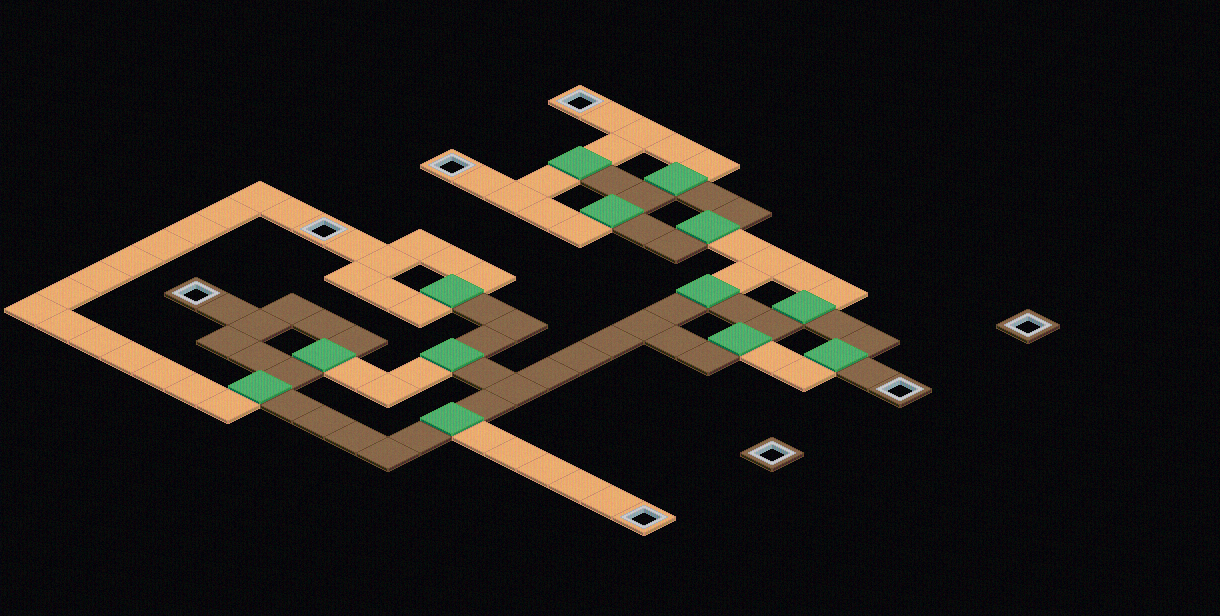
بعد:
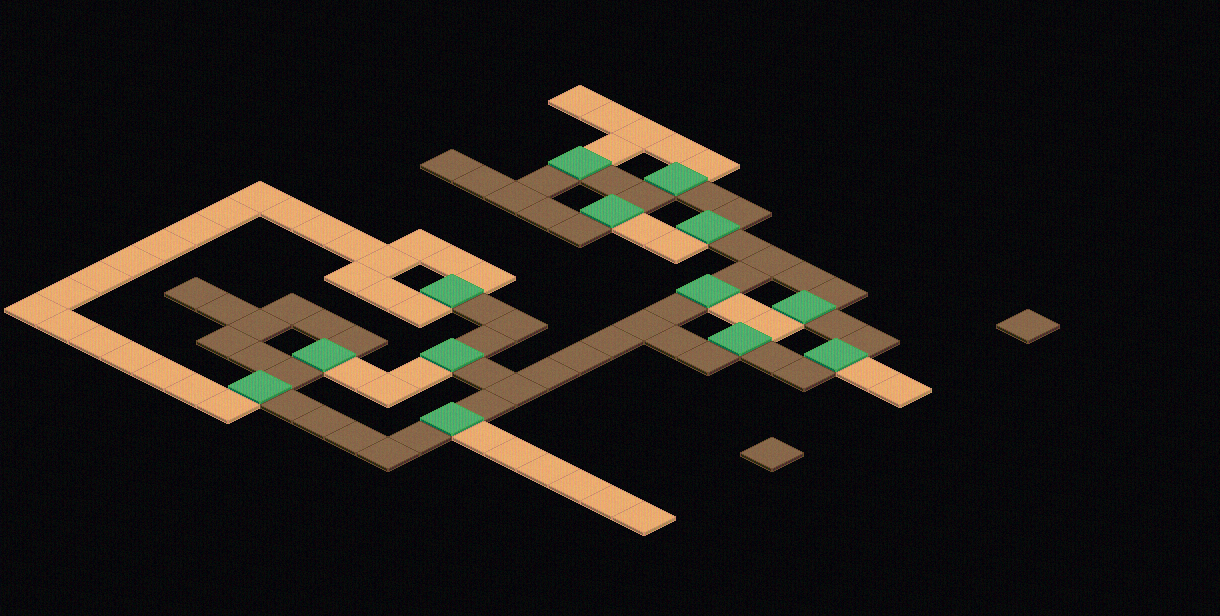
الآن نحن نعرف بالتأكيد أن هذا هو نسيج الفتحة على السبورة ويمكننا إضافته إلى قائمة التعداد عن طريق تحويله في وظيفة منفصلة:
تم تجميع جميع القوام:
#include <X11/Xlib.h>
#include <sys/types.h>
#include <sys/stat.h>
#include <fcntl.h>
#include <unistd.h>

/*    */

/*! \brief     */
#define IMAGE_WIDTH (1220)
/*! \brief     */
#define IMAGE_HEIGHT (616)
/*! \brief        */
#define IMAGE_SHIFTX (580)

/*! \brief   */
#define TEXTURE_COUNT (8)
/*! \brief     */
#define TEXTURE_WIDTH (64)
/*! \brief     */
#define TEXTURE_HEIGHT (40)
/*! \brief      */
#define TEXTURE_TOP_WIDTH (64)
/*! \brief      */
#define TEXTURE_TOP_HEIGHT (32)

/*! \brief    */
#define MAP_WIDTH (19)
/*! \brief    */
#define MAP_HEIGHT (19)
/*! \brief    -.      '\n' */
#define MAP_FILEDATA ((MAP_WIDTH + 1) * MAP_HEIGHT)
/*! \brief      NOR- */
#define MAP_ITERATIONS (20)

/*! \brief    - */
enum map_characters {
    MAPCHAR_WIRE  = '.', /**<             (ASCII = 46) */
    MAPCHAR_PLUS  = '+', /**<  ( ) (ASCII = 43) */
    MAPCHAR_MINUS = '-', /**<  ( ) (ASCII = 45) */
    MAPCHAR_NOR   = '>', /**< NOR-       (ASCII = 62) */
    MAPCHAR_EMPTY = ' ', /**<         (ASCII = 32) */
};

/*! \brief    */
enum textures_indexes {
    TEXINDEX_EMPTY = (0), /**<                    */
    TEXINDEX_MINUS = (1), /**<   " " */
    TEXINDEX_WIRE  = (2), /**<       */
    TEXINDEX_PLUS  = (3), /**<   ""   */
    /**/
    TEXINDEX_NOR   = (6), /**<   NOR-           */
    TEXINDEX_HOLE  = (7)  /**<          */
};

/*! \brief   */
enum program_arguments {
    ARG_PROGRAM,  /**<    */
    ARG_BLUEPRINT /**<  -   */
};

/*! \brief    .
 *   int      */
int pixdata[IMAGE_HEIGHT][IMAGE_WIDTH];
/*! \brief  ,    */
int textures[TEXTURE_COUNT][TEXTURE_HEIGHT][TEXTURE_WIDTH] = { 0 };
/*! \brief   .
 *        '\n' */
char mapdata[MAP_HEIGHT][MAP_WIDTH + 1];

/*! \brief   Xlib */
Display * display;
/*! \brief    Xlib */
Window window;
/*! \brief      */
XImage * image;

static void _texture_draw(int t, int x, int y);

/*! \brief      */
static void _image_create(void) {
    display = XOpenDisplay(0);
    window = XCreateSimpleWindow(display,
                                 RootWindow(display, DefaultScreen(display)),
                                 0, 0, IMAGE_WIDTH, IMAGE_HEIGHT, 1, 0, 0);
    image = XCreateImage(display,
                     DefaultVisual(display, DefaultScreen(display)),
                     DefaultDepth(display, DefaultScreen(display)),
                     2, 0, (char *) pixdata, IMAGE_WIDTH, IMAGE_HEIGHT, 32, 0);
}

/* \brief  ,     */
static void _image_reset(void) {
    for (int y = 0; y < IMAGE_HEIGHT; y++)
        for (int x = 0; x < IMAGE_WIDTH; x++)
            pixdata[y][x] = 0;
}

/*! \brief
 * \param[in] elem
 * \return   */
static int _map2texture(char elem) {
    return ((elem >> 4) & 1) << 2 | (elem & 3);
}

/*! \brief        */
static void _image_compile(void) {
    for (int y = 0; y < MAP_HEIGHT; y++)
        for (int x = 0; x < MAP_WIDTH; x++)
            _texture_draw(_map2texture(mapdata[y][x]), x, y);
}

/*! \brief     */
static void _image_draw(void) {
    XPutImage(display, window,
              DefaultGC(display, DefaultScreen(display)),
              image, 0, 0, 0, 0, IMAGE_WIDTH, IMAGE_HEIGHT);
    XMapWindow(display, window);
    XFlush(display);
}

/*! \brief      */
static void _image_drill(void) {
    for (int y = 0; y < MAP_HEIGHT; y++)
            for (int x = 0; x < MAP_WIDTH; x++)
                if ((x % 14 == 2) && (y % 4 == 3))
                    _texture_draw(TEXINDEX_HOLE, x, y);
}

/*! \brief
 * \param[in] t
 * \param[in] x X
 * \param[in] y Y   */
static void _texture_draw(int t, int x, int y) {
    for (int ty = 0; ty < TEXTURE_HEIGHT; ty++)
        for (int tx = 0; tx < TEXTURE_WIDTH; tx++)
            if (textures[t][ty][tx])
                pixdata[ty +
                        y * (TEXTURE_TOP_HEIGHT / 2) +
                        x * (TEXTURE_TOP_HEIGHT / 2)]
                       [tx +
                        IMAGE_SHIFTX +
                        x * (TEXTURE_TOP_WIDTH / 2) -
                        y * TEXTURE_TOP_HEIGHT] = textures[t][ty][tx];
}

/*! \brief   -
 * \param[in] filename  - */
static void _map_read(const char * filename) {
    int f = open(filename, 0);
    read(f, mapdata, MAP_FILEDATA);
    close(f);
}

/*! \brief     -
 *          */
static void _map_wire_inputs(void) {
    for (int y = 0; y < MAP_HEIGHT; y++)
        for (int x = 0; x < MAP_WIDTH; x++)
            if ((x % 14 == 2) && (y % 4 == 3))
                mapdata[y][x] = MAPCHAR_WIRE;
}

/*! \brief
 * \param[in] t ,
 * \param[in] x X-
 * \param[in] y Y-
 * \param[in] c
 * \param[in] l   */
static void _map_fill(int t, int x, int y, int c, int l) {
    if ((x >= MAP_WIDTH || y >= MAP_HEIGHT ||
         x < 0 || y < 0) || (mapdata[y][x] == l)
        || (mapdata[y][x] != c))
        return;
    mapdata[y][x] = l;
    _map_fill(t, x - 1, y, c, l);
    _map_fill(t, x + 1, y, c, l);
    _map_fill(t, x, y - 1, c, l);
    _map_fill(t, x, y + 1, c, l);
}

/*! \brief
 * .
 * \param[in] counter  */
static void _map_wire_counter(int counter) {
    _map_fill(0, 2, 3,  mapdata[3][2],  counter & 1 ? MAPCHAR_PLUS : MAPCHAR_MINUS);
    _map_fill(0, 2, 7,  mapdata[7][2],  counter & 2 ? MAPCHAR_PLUS : MAPCHAR_MINUS);
    _map_fill(0, 2, 11, mapdata[11][2], counter & 4 ? MAPCHAR_PLUS : MAPCHAR_MINUS);
    _map_fill(0, 2, 15, mapdata[15][2], counter & 8 ? MAPCHAR_PLUS : MAPCHAR_MINUS);
}

/*! \brief    ()   NOR- */
static void _map_process_gates(void) {
    for (int i = 0; i < MAP_ITERATIONS; i++)
        for (int y = 0; y < MAP_HEIGHT; y++)
            for (int x = 0; x < MAP_WIDTH; x++)
                if (mapdata[y][x] == MAPCHAR_NOR)
                    _map_fill(0, x + 1, y, mapdata[y][x + 1],
                        !(mapdata[y - 1][x] == MAPCHAR_PLUS ? 1 : 0
                       || mapdata[y + 1][x] == MAPCHAR_PLUS ? 1 : 0) ?
                            MAPCHAR_PLUS : MAPCHAR_MINUS);
}

/*    */

int _x[] = { 15117427, 8413248, 5878632, 13027014, 1 };
int rn = 2166136261;

void *T;

void e(int t, int x, int y, int c, int l) {
    if ((x >= TEXTURE_WIDTH || y >= TEXTURE_HEIGHT ||
         x < 0 || y < 0) ||
         (textures[t][y][x] == l) ||
         (textures[t][y][x] != c))
        return;
    textures[t][y][x] = l;
    e(t, x - 1, y, c, l);
    e(t, x + 1, y, c, l);
    e(t, x, y - 1, c, l);
    e(t, x, y + 1, c, l);
}

void k(int t, int x, int y, int c, int l) {
    while (c--) {
        textures[t][y][x++] = l;
        textures[t][y++][x++] = l;
    }
}

void r(int t, int x, int y, int c, int l) {
    while (c--) {
        textures[t][y][x--] = l;
        textures[t][y++][x--] = l;
    }
}

void u(int t, int x, int y, int c, int l) {
    while (c--)
        textures[t][y++][x] = l;
}

char *z[8] = {
    (char[]) {4},
    (char[]) {6, 1 * 4 + 1, 0 + 0, 32 - 0, 5 - 0, 16, 0, 0,
              21 + 0 * 3 - 0, 16, 1, 63, 21 + 0 * 3 - 0, 16, 2,
              63 * 0, 21 - 0, 4, 2, 31 + 0, 36 - 0, 4, 0 + 1,
              32 - 1, 5 - 0, 16, 0, 0, 21 + 1 * 3 - 0, 16, 1, 63,
              21 + 1 * 3 - 0, 16, 2, 63 * 1, 21 - 0, 4, 2, 31 + 1,
              36 - 0, 4, 6, 1 * 4 + 0, 3, 31, 8 - 0, 6, 1 * 4 + 2,
              3, 33, 38 - 0, 6, 1 * 4 + 3, 3, 30, 38 - 0, 4},
    (char[]) {5, 1},
    (char[]) {6, 0 * 4 + 1, 0 + 0, 32 - 0, 5 - 0, 16,
              0, 0, 21 + 0 * 3 - 0, 16, 1, 63,
              21 + 0 * 3 - 0, 16, 2, 63 * 0, 21 - 0,
              4, 2, 31 + 0, 36 - 0, 4, 0 + 1, 32 - 1,
              5 - 0, 16, 0, 0, 21 + 1 * 3 - 0, 16, 1,
              63, 21 + 1 * 3 - 0, 16, 2, 63 * 1,
              21 - 0, 4, 2, 31 + 1, 36 - 0, 4, 6,
              0 * 4 + 0, 3, 31, 8 - 0, 6, 0 * 4 + 2,
              3, 33, 38 - 0, 6, 0 * 4 + 3, 3, 30,
              38 - 0,
              4},
    (char[]) {4},
    (char[]) {4},
    (char[]) {6, 2 * 4 + 1, 0 + 0, 32 - 0, 5 - 3, 16, 0, 0,
              21 + 0 * 3 - 3, 16, 1, 63, 21 + 0 * 3 - 3, 16, 2, 63 * 0,
              21 - 3, 4, 2, 31 + 0, 36 - 3, 4, 0 + 1, 32 - 1, 5 - 3,
              16, 0, 0, 21 + 1 * 3 - 3, 16, 1, 63, 21 + 1 * 3 - 3, 16,
              2, 63 * 1, 21 - 3, 4, 2, 31 + 1, 36 - 3, 4, 6, 2 * 4 + 0,
              3, 31, 8 - 3, 6, 2 * 4 + 2, 3, 33, 38 - 3, 6, 2 * 4 + 3,
              3, 30, 38 - 3, 4},
    (char[]) {6, 13, 0, 32, 9 + 0, 12 - 0,
              0, 8 + 0 + 0, 21, 12 - 0, 1,
              31, 9 + 0, 12 - 0, 1,
              55 - 0 - 0, 21, 12 - 0, 0,
              32, 9 + 3, 12 - 3, 0,
              8 + 3 + 3, 21, 12 - 3, 1,
              31, 9 + 3, 12 - 3, 1,
              55 - 3 - 3, 21, 12 - 3, 6,
              14 + 0, 2, 31 + 0, 13, 4,
              1 - 0, 31 + 0, 16, 7, 3,
              30 + 3 * 0, 14, 6,
              12 + 0 * 4, 3, 32 - 0,
              11 + 0 * 8, 6, 14 + 1, 2,
              31 + 1, 13, 4, 1 - 1,
              31 + 1, 16, 7, 3,
              30 + 3 * 1, 14, 6,
              12 + 1 * 4, 3, 32 - 1,
              11 + 1 * 8,
              4}
};

int main(int argc, char * args[]) {
    _image_create();

    for (int i = 0; i < 8; i++) {
        char *p = z[i];
        int c = 0;
        while (*p != 4) {
            switch (*p) {
            case 0:
                k(i, p[1], p[2], p[3], c);
                p += 4;
                break;
            case 1:
                r(i, p[1], p[2], p[3], c);
                p += 4;
                break;
            case 2:
                u(i, p[1], p[2], p[3], c);
                p += 4;
                break;
            case 3:
                e(i, p[1]
                  , p[2], 0, c);
                p += 3;
                break;
            case 5:
                p = z[p[1]];
                break;
            case 6:
                c = _x[p[1] / 4] - 1643277 * (p[1] % 4);
                p += 2;
                break;
            }
        }
    }
    unsigned int counter = 1;
    while (counter++) {
        _map_read(args[ARG_BLUEPRINT]);
        _map_wire_inputs();
        _map_wire_counter(counter);
        _map_process_gates();

        _image_reset();
        _image_compile();
        _image_drill();

        for (int y = 0; y < IMAGE_HEIGHT; y++)
            for (int x = 0; x < IMAGE_WIDTH; x++) {
                pixdata[y][x] &= 14737632 | (31 << ((x % 3) << 3));
                pixdata[y][x] += 986895 & (rn *= 16777619);
            }

        _image_draw();

        sleep(1);
    }
    return 0;
}
شادر
وعدت القطط من المادة السابقة التظليل. وهم هنا. وأين الكود المسئول عن معالجتها؟
        _image_reset();           //
        _image_compile();       //
        _image_drill();            //

        for (int y = 0; y < IMAGE_HEIGHT; y++)
            for (int x = 0; x < IMAGE_WIDTH; x++) {
                pixdata[y][x] &= 14737632 | (31 << ((x % 3) << 3));
                pixdata[y][x] += 986895 & (rn *= 16777619);
            }

        _image_draw();  //
من خلال طريقة الاستبعاد ، نفهم أن ضوضاء الشاشة وتأثير شاشة LCD تعطي هذين الخطين. كيف يعملون؟
لنبدأ بالآخر:
pixdata[y][x] += 986895 & (rn *= 16777619);تتم إضافة القيمة 986895 إلى كل بكسل (والتي تبدو في الإصدارات السداسية عشرية مثل 0x0f0f0f) ، والتي كانت في السابق عن طريق عملية bit-AND المدمجة مع نتيجة ضرب rn في 16777619. إذا كان rn مولد أرقام عشوائي ، فسيؤدي ذلك إلى إنشاء "ضوضاء" محببة على الشاشة ضمن 16 تدرجًا لكل قناة. ونظرًا لظهور الضوضاء ، فإن rn هو مولد الأرقام العشوائي. لكن كيف يتم تحقيق ذلك؟
int rn = 2166136261;في بداية البرنامج ، تتم تهيئة المتغير rn بالرقم 2166136261. وفي كل تكرار ، يتم ضرب البكسل في 16777619. هذا ليس أكثر من مولد أرقام شبه عشوائي. ولكن بدلاً من المولد الخطي المدروس جيدًا ، يتم استخدام خوارزمية التجزئة FNV بدون خطوة XOR ، نظرًا لأننا لا نحتاج إلى النتيجة النهائية.
يبقى أن نرى كيف يعمل السطر السابق:
pixdata[y][x] &= 14737632 | (31 << ((x % 3) << 3));لنحول الرقم 14737632 إلى تنسيق سداسي عشري ، لأننا نعمل مع قنوات ضوئية أحادية البايت: 0xe0e0e0. والآن ، بأخذ x يساوي من 0 إلى 3 ، نجري الحسابات المقابلة:
0xe0e0e0 | (31 << ((0 % 3) << 3)) = e0e0ff
0xe0e0e0 | (31 << ((1 % 3) << 3)) = e0ffe0
0xe0e0e0 | (31 << ((2 % 3) << 3)) = ffe0e0
إذا طبقنا هذه الأقنعة الآن باستخدام العملية "&" على لون البكسل ، فسنحصل ، على التوالي ، على قنوات R و G و R و B و G و B ، والتي ستبدو مثل تأثير شاشة LCD:

دعنا نفصلهم إلى وظائف منفصلة:
#include <X11/Xlib.h>
#include <sys/types.h>
#include <sys/stat.h>
#include <fcntl.h>
#include <unistd.h>

/*    */

/*! \brief     */
#define IMAGE_WIDTH (1220)
/*! \brief     */
#define IMAGE_HEIGHT (616)
/*! \brief        */
#define IMAGE_SHIFTX (580)

/*! \brief   */
#define TEXTURE_COUNT (8)
/*! \brief     */
#define TEXTURE_WIDTH (64)
/*! \brief     */
#define TEXTURE_HEIGHT (40)
/*! \brief      */
#define TEXTURE_TOP_WIDTH (64)
/*! \brief      */
#define TEXTURE_TOP_HEIGHT (32)

/*! \brief    */
#define MAP_WIDTH (19)
/*! \brief    */
#define MAP_HEIGHT (19)
/*! \brief    -.      '\n' */
#define MAP_FILEDATA ((MAP_WIDTH + 1) * MAP_HEIGHT)
/*! \brief      NOR- */
#define MAP_ITERATIONS (20)

/*! \brief    - */
enum map_characters {
    MAPCHAR_WIRE  = '.', /**<             (ASCII = 46) */
    MAPCHAR_PLUS  = '+', /**<  ( ) (ASCII = 43) */
    MAPCHAR_MINUS = '-', /**<  ( ) (ASCII = 45) */
    MAPCHAR_NOR   = '>', /**< NOR-       (ASCII = 62) */
    MAPCHAR_EMPTY = ' ', /**<         (ASCII = 32) */
};

/*! \brief    */
enum textures_indexes {
    TEXINDEX_EMPTY = (0), /**<                    */
    TEXINDEX_MINUS = (1), /**<   " " */
    TEXINDEX_WIRE  = (2), /**<       */
    TEXINDEX_PLUS  = (3), /**<   ""   */
    /**/
    TEXINDEX_NOR   = (6), /**<   NOR-           */
    TEXINDEX_HOLE  = (7)  /**<          */
};

/*! \brief   */
enum program_arguments {
    ARG_PROGRAM,  /**<    */
    ARG_BLUEPRINT /**<  -   */
};

/*! \brief    .
 *   int      */
int pixdata[IMAGE_HEIGHT][IMAGE_WIDTH];
/*! \brief  ,    */
int textures[TEXTURE_COUNT][TEXTURE_HEIGHT][TEXTURE_WIDTH] = { 0 };
/*! \brief   .
 *        '\n' */
char mapdata[MAP_HEIGHT][MAP_WIDTH + 1];
/*! \brief     */
int random = 2166136261;

/*! \brief   Xlib */
Display * display;
/*! \brief    Xlib */
Window window;
/*! \brief      */
XImage * image;

static void _texture_draw(int t, int x, int y);

/*! \brief      */
static void _image_create(void) {
    display = XOpenDisplay(0);
    window = XCreateSimpleWindow(display,
                                 RootWindow(display, DefaultScreen(display)),
                                 0, 0, IMAGE_WIDTH, IMAGE_HEIGHT, 1, 0, 0);
    image = XCreateImage(display,
                     DefaultVisual(display, DefaultScreen(display)),
                     DefaultDepth(display, DefaultScreen(display)),
                     2, 0, (char *) pixdata, IMAGE_WIDTH, IMAGE_HEIGHT, 32, 0);
}

/* \brief  ,     */
static void _image_reset(void) {
    for (int y = 0; y < IMAGE_HEIGHT; y++)
        for (int x = 0; x < IMAGE_WIDTH; x++)
            pixdata[y][x] = 0;
}

/*! \brief
 * \param[in] elem
 * \return   */
static int _map2texture(char elem) {
    return ((elem >> 4) & 1) << 2 | (elem & 3);
}

/*! \brief        */
static void _image_compile(void) {
    for (int y = 0; y < MAP_HEIGHT; y++)
        for (int x = 0; x < MAP_WIDTH; x++)
            _texture_draw(_map2texture(mapdata[y][x]), x, y);
}

/*! \brief     */
static void _image_draw(void) {
    XPutImage(display, window,
              DefaultGC(display, DefaultScreen(display)),
              image, 0, 0, 0, 0, IMAGE_WIDTH, IMAGE_HEIGHT);
    XMapWindow(display, window);
    XFlush(display);
}

/*! \brief      */
static void _image_drill(void) {
    for (int y = 0; y < MAP_HEIGHT; y++)
            for (int x = 0; x < MAP_WIDTH; x++)
                if ((x % 14 == 2) && (y % 4 == 3))
                    _texture_draw(TEXINDEX_HOLE, x, y);
}

/*! \brief   LCD-
 * \param[in] x X-
 * \param[in] y Y-  */
static void _shader_lcd(int x, int y) {
    pixdata[y][x] &= 0xe0e0e0 | (31 << ((x % 3) << 3));
}

/*! \brief
 * \param[in] x X-
 * \param[in] y Y-  */
static void _shader_noise(int x, int y) {
    pixdata[y][x] += 0x0f0f0f & (random *= 16777619);
}

/*! \brief      */
static void _image_postprocess(void) {
    for (int y = 0; y < IMAGE_HEIGHT; y++)
        for (int x = 0; x < IMAGE_WIDTH; x++) {
            _shader_lcd(x, y);
            _shader_noise(x, y);
        }
}

/*! \brief
 * \param[in] t
 * \param[in] x X
 * \param[in] y Y   */
static void _texture_draw(int t, int x, int y) {
    for (int ty = 0; ty < TEXTURE_HEIGHT; ty++)
        for (int tx = 0; tx < TEXTURE_WIDTH; tx++)
            if (textures[t][ty][tx])
                pixdata[ty +
                        y * (TEXTURE_TOP_HEIGHT / 2) +
                        x * (TEXTURE_TOP_HEIGHT / 2)]
                       [tx +
                        IMAGE_SHIFTX +
                        x * (TEXTURE_TOP_WIDTH / 2) -
                        y * TEXTURE_TOP_HEIGHT] = textures[t][ty][tx];
}

/*! \brief   -
 * \param[in] filename  - */
static void _map_read(const char * filename) {
    int f = open(filename, 0);
    read(f, mapdata, MAP_FILEDATA);
    close(f);
}

/*! \brief     -
 *          */
static void _map_wire_inputs(void) {
    for (int y = 0; y < MAP_HEIGHT; y++)
        for (int x = 0; x < MAP_WIDTH; x++)
            if ((x % 14 == 2) && (y % 4 == 3))
                mapdata[y][x] = MAPCHAR_WIRE;
}

/*! \brief
 * \param[in] t ,
 * \param[in] x X-
 * \param[in] y Y-
 * \param[in] c
 * \param[in] l   */
static void _map_fill(int t, int x, int y, int c, int l) {
    if ((x >= MAP_WIDTH || y >= MAP_HEIGHT ||
         x < 0 || y < 0) || (mapdata[y][x] == l)
        || (mapdata[y][x] != c))
        return;
    mapdata[y][x] = l;
    _map_fill(t, x - 1, y, c, l);
    _map_fill(t, x + 1, y, c, l);
    _map_fill(t, x, y - 1, c, l);
    _map_fill(t, x, y + 1, c, l);
}

/*! \brief
 * .
 * \param[in] counter  */
static void _map_wire_counter(int counter) {
    _map_fill(0, 2, 3,  mapdata[3][2],  counter & 1 ? MAPCHAR_PLUS : MAPCHAR_MINUS);
    _map_fill(0, 2, 7,  mapdata[7][2],  counter & 2 ? MAPCHAR_PLUS : MAPCHAR_MINUS);
    _map_fill(0, 2, 11, mapdata[11][2], counter & 4 ? MAPCHAR_PLUS : MAPCHAR_MINUS);
    _map_fill(0, 2, 15, mapdata[15][2], counter & 8 ? MAPCHAR_PLUS : MAPCHAR_MINUS);
}

/*! \brief    ()   NOR- */
static void _map_process_gates(void) {
    for (int i = 0; i < MAP_ITERATIONS; i++)
        for (int y = 0; y < MAP_HEIGHT; y++)
            for (int x = 0; x < MAP_WIDTH; x++)
                if (mapdata[y][x] == MAPCHAR_NOR)
                    _map_fill(0, x + 1, y, mapdata[y][x + 1],
                        !(mapdata[y - 1][x] == MAPCHAR_PLUS ? 1 : 0
                       || mapdata[y + 1][x] == MAPCHAR_PLUS ? 1 : 0) ?
                            MAPCHAR_PLUS : MAPCHAR_MINUS);
}

/*    */

int _x[] = { 15117427, 8413248, 5878632, 13027014, 1 };

void e(int t, int x, int y, int c, int l) {
    if ((x >= TEXTURE_WIDTH || y >= TEXTURE_HEIGHT ||
         x < 0 || y < 0) ||
         (textures[t][y][x] == l) ||
         (textures[t][y][x] != c))
        return;
    textures[t][y][x] = l;
    e(t, x - 1, y, c, l);
    e(t, x + 1, y, c, l);
    e(t, x, y - 1, c, l);
    e(t, x, y + 1, c, l);
}

void k(int t, int x, int y, int c, int l) {
    while (c--) {
        textures[t][y][x++] = l;
        textures[t][y++][x++] = l;
    }
}

void r(int t, int x, int y, int c, int l) {
    while (c--) {
        textures[t][y][x--] = l;
        textures[t][y++][x--] = l;
    }
}

void u(int t, int x, int y, int c, int l) {
    while (c--)
        textures[t][y++][x] = l;
}

char *z[8] = {
    (char[]) {4},
    (char[]) {6, 1 * 4 + 1, 0 + 0, 32 - 0, 5 - 0, 16, 0, 0,
              21 + 0 * 3 - 0, 16, 1, 63, 21 + 0 * 3 - 0, 16, 2,
              63 * 0, 21 - 0, 4, 2, 31 + 0, 36 - 0, 4, 0 + 1,
              32 - 1, 5 - 0, 16, 0, 0, 21 + 1 * 3 - 0, 16, 1, 63,
              21 + 1 * 3 - 0, 16, 2, 63 * 1, 21 - 0, 4, 2, 31 + 1,
              36 - 0, 4, 6, 1 * 4 + 0, 3, 31, 8 - 0, 6, 1 * 4 + 2,
              3, 33, 38 - 0, 6, 1 * 4 + 3, 3, 30, 38 - 0, 4},
    (char[]) {5, 1},
    (char[]) {6, 0 * 4 + 1, 0 + 0, 32 - 0, 5 - 0, 16,
              0, 0, 21 + 0 * 3 - 0, 16, 1, 63,
              21 + 0 * 3 - 0, 16, 2, 63 * 0, 21 - 0,
              4, 2, 31 + 0, 36 - 0, 4, 0 + 1, 32 - 1,
              5 - 0, 16, 0, 0, 21 + 1 * 3 - 0, 16, 1,
              63, 21 + 1 * 3 - 0, 16, 2, 63 * 1,
              21 - 0, 4, 2, 31 + 1, 36 - 0, 4, 6,
              0 * 4 + 0, 3, 31, 8 - 0, 6, 0 * 4 + 2,
              3, 33, 38 - 0, 6, 0 * 4 + 3, 3, 30,
              38 - 0,
              4},
    (char[]) {4},
    (char[]) {4},
    (char[]) {6, 2 * 4 + 1, 0 + 0, 32 - 0, 5 - 3, 16, 0, 0,
              21 + 0 * 3 - 3, 16, 1, 63, 21 + 0 * 3 - 3, 16, 2, 63 * 0,
              21 - 3, 4, 2, 31 + 0, 36 - 3, 4, 0 + 1, 32 - 1, 5 - 3,
              16, 0, 0, 21 + 1 * 3 - 3, 16, 1, 63, 21 + 1 * 3 - 3, 16,
              2, 63 * 1, 21 - 3, 4, 2, 31 + 1, 36 - 3, 4, 6, 2 * 4 + 0,
              3, 31, 8 - 3, 6, 2 * 4 + 2, 3, 33, 38 - 3, 6, 2 * 4 + 3,
              3, 30, 38 - 3, 4},
    (char[]) {6, 13, 0, 32, 9 + 0, 12 - 0,
              0, 8 + 0 + 0, 21, 12 - 0, 1,
              31, 9 + 0, 12 - 0, 1,
              55 - 0 - 0, 21, 12 - 0, 0,
              32, 9 + 3, 12 - 3, 0,
              8 + 3 + 3, 21, 12 - 3, 1,
              31, 9 + 3, 12 - 3, 1,
              55 - 3 - 3, 21, 12 - 3, 6,
              14 + 0, 2, 31 + 0, 13, 4,
              1 - 0, 31 + 0, 16, 7, 3,
              30 + 3 * 0, 14, 6,
              12 + 0 * 4, 3, 32 - 0,
              11 + 0 * 8, 6, 14 + 1, 2,
              31 + 1, 13, 4, 1 - 1,
              31 + 1, 16, 7, 3,
              30 + 3 * 1, 14, 6,
              12 + 1 * 4, 3, 32 - 1,
              11 + 1 * 8,
              4}
};

int main(int argc, char * args[]) {
    _image_create();

    for (int i = 0; i < 8; i++) {
        char *p = z[i];
        int c = 0;
        while (*p != 4) {
            switch (*p) {
            case 0:
                k(i, p[1], p[2], p[3], c);
                p += 4;
                break;
            case 1:
                r(i, p[1], p[2], p[3], c);
                p += 4;
                break;
            case 2:
                u(i, p[1], p[2], p[3], c);
                p += 4;
                break;
            case 3:
                e(i, p[1]
                  , p[2], 0, c);
                p += 3;
                break;
            case 5:
                p = z[p[1]];
                break;
            case 6:
                c = _x[p[1] / 4] - 1643277 * (p[1] % 4);
                p += 2;
                break;
            }
        }
    }
    unsigned int counter = 1;
    while (counter++) {
        _map_read(args[ARG_BLUEPRINT]);
        _map_wire_inputs();
        _map_wire_counter(counter);
        _map_process_gates();

        _image_reset();
        _image_compile();
        _image_drill();
        _image_postprocess();
        _image_draw();

        sleep(1);
    }
    return 0;
}
"E" ، "k" ، "r" ، "u"
لا تزال هناك 4 وظائف لم نتحرى عنها أو نعيد تسميتها - وهي "e" و "k" و "r" و "u". دعنا نحاول فحصهم دون البحث عن الأماكن التي تم الاتصال بهم منها:
void e(int t, int x, int y, int c, int l) {
    if ((x >= TEXTURE_WIDTH || y >= TEXTURE_HEIGHT ||
         x < 0 || y < 0) ||
         (textures[t][y][x] == l) ||
         (textures[t][y][x] != c))
        return;
    textures[t][y][x] = l;
    e(t, x - 1, y, c, l);
    e(t, x + 1, y, c, l);
    e(t, x, y - 1, c, l);
    e(t, x, y + 1, c, l);
}
من الواضح أن هذه الوظيفة تبدو وتعمل مثل flow_fill ، فقط لمصفوفة القوام ، دعنا نعيد تسميتها إلى _texture_fill.
void k(int t, int x, int y, int c, int l) {
    while (c--) {
        textures[t][y][x++] = l;
        textures[t][y++][x++] = l;
    }
}

void r(int t, int x, int y, int c, int l) {
    while (c--) {
        textures[t][y][x--] = l;
        textures[t][y++][x--] = l;
    }
}
الدالتان "k" و "r" لكل وحدة معطاة c ارسم بكسلين بقيمة l وانتقل إلى اليمين أو اليسار بمقدار 2 بكسل ولأسفل بمقدار بكسل واحد - وهذا يعني أن هذه وظائف لرسم خطوط متساوية القياس SW و SE. دعنا نعيد تسميتها إلى _texture_linesw و _texture_linese.
في هذه المرحلة ، يمكنك بالفعل تخمين أن الوظيفة الأخيرة "u" ترسم خطًا رأسيًا لأسفل:
void u(int t, int x, int y, int c, int l) {
    while (c--)
        textures[t][y++][x] = l;
}
دعونا نعيد تسميته إلى _texture_linedown.
تم إعادة هيكلة جميع الوظائف الفردية:
#include <X11/Xlib.h>
#include <sys/types.h>
#include <sys/stat.h>
#include <fcntl.h>
#include <unistd.h>

/*    */

/*! \brief     */
#define IMAGE_WIDTH (1220)
/*! \brief     */
#define IMAGE_HEIGHT (616)
/*! \brief        */
#define IMAGE_SHIFTX (580)

/*! \brief   */
#define TEXTURE_COUNT (8)
/*! \brief     */
#define TEXTURE_WIDTH (64)
/*! \brief     */
#define TEXTURE_HEIGHT (40)
/*! \brief      */
#define TEXTURE_TOP_WIDTH (64)
/*! \brief      */
#define TEXTURE_TOP_HEIGHT (32)

/*! \brief    */
#define MAP_WIDTH (19)
/*! \brief    */
#define MAP_HEIGHT (19)
/*! \brief    -.      '\n' */
#define MAP_FILEDATA ((MAP_WIDTH + 1) * MAP_HEIGHT)
/*! \brief      NOR- */
#define MAP_ITERATIONS (20)

/*! \brief    - */
enum map_characters {
    MAPCHAR_WIRE  = '.', /**<             (ASCII = 46) */
    MAPCHAR_PLUS  = '+', /**<  ( ) (ASCII = 43) */
    MAPCHAR_MINUS = '-', /**<  ( ) (ASCII = 45) */
    MAPCHAR_NOR   = '>', /**< NOR-       (ASCII = 62) */
    MAPCHAR_EMPTY = ' ', /**<         (ASCII = 32) */
};

/*! \brief    */
enum textures_indexes {
    TEXINDEX_EMPTY = (0), /**<                    */
    TEXINDEX_MINUS = (1), /**<   " " */
    TEXINDEX_WIRE  = (2), /**<       */
    TEXINDEX_PLUS  = (3), /**<   ""   */
    /**/
    TEXINDEX_NOR   = (6), /**<   NOR-           */
    TEXINDEX_HOLE  = (7)  /**<          */
};

/*! \brief   */
enum program_arguments {
    ARG_PROGRAM,  /**<    */
    ARG_BLUEPRINT /**<  -   */
};

/*! \brief    .
 *   int      */
int pixdata[IMAGE_HEIGHT][IMAGE_WIDTH];
/*! \brief  ,    */
int textures[TEXTURE_COUNT][TEXTURE_HEIGHT][TEXTURE_WIDTH] = { 0 };
/*! \brief   .
 *        '\n' */
char mapdata[MAP_HEIGHT][MAP_WIDTH + 1];
/*! \brief     */
int random = 2166136261;

/*! \brief   Xlib */
Display * display;
/*! \brief    Xlib */
Window window;
/*! \brief      */
XImage * image;

static void _texture_draw(int t, int x, int y);

/*! \brief      */
static void _image_create(void) {
    display = XOpenDisplay(0);
    window = XCreateSimpleWindow(display,
                                 RootWindow(display, DefaultScreen(display)),
                                 0, 0, IMAGE_WIDTH, IMAGE_HEIGHT, 1, 0, 0);
    image = XCreateImage(display,
                     DefaultVisual(display, DefaultScreen(display)),
                     DefaultDepth(display, DefaultScreen(display)),
                     2, 0, (char *) pixdata, IMAGE_WIDTH, IMAGE_HEIGHT, 32, 0);
}

/* \brief  ,     */
static void _image_reset(void) {
    for (int y = 0; y < IMAGE_HEIGHT; y++)
        for (int x = 0; x < IMAGE_WIDTH; x++)
            pixdata[y][x] = 0;
}

/*! \brief
 * \param[in] elem
 * \return   */
static int _map2texture(char elem) {
    return ((elem >> 4) & 1) << 2 | (elem & 3);
}

/*! \brief        */
static void _image_compile(void) {
    for (int y = 0; y < MAP_HEIGHT; y++)
        for (int x = 0; x < MAP_WIDTH; x++)
            _texture_draw(_map2texture(mapdata[y][x]), x, y);
}

/*! \brief     */
static void _image_draw(void) {
    XPutImage(display, window,
              DefaultGC(display, DefaultScreen(display)),
              image, 0, 0, 0, 0, IMAGE_WIDTH, IMAGE_HEIGHT);
    XMapWindow(display, window);
    XFlush(display);
}

/*! \brief      */
static void _image_drill(void) {
    for (int y = 0; y < MAP_HEIGHT; y++)
            for (int x = 0; x < MAP_WIDTH; x++)
                if ((x % 14 == 2) && (y % 4 == 3))
                    _texture_draw(TEXINDEX_HOLE, x, y);
}

/*! \brief   LCD-
 * \param[in] x X-
 * \param[in] y Y-  */
static void _shader_lcd(int x, int y) {
    pixdata[y][x] &= 0xe0e0e0 | (31 << ((x % 3) << 3));
}

/*! \brief
 * \param[in] x X-
 * \param[in] y Y-  */
static void _shader_noise(int x, int y) {
    pixdata[y][x] += 0x0f0f0f & (random *= 16777619);
}

/*! \brief      */
static void _image_postprocess(void) {
    for (int y = 0; y < IMAGE_HEIGHT; y++)
        for (int x = 0; x < IMAGE_WIDTH; x++) {
            _shader_lcd(x, y);
            _shader_noise(x, y);
        }
}

/*! \brief
 * \param[in] t
 * \param[in] x X
 * \param[in] y Y   */
static void _texture_draw(int t, int x, int y) {
    for (int ty = 0; ty < TEXTURE_HEIGHT; ty++)
        for (int tx = 0; tx < TEXTURE_WIDTH; tx++)
            if (textures[t][ty][tx])
                pixdata[ty +
                        y * (TEXTURE_TOP_HEIGHT / 2) +
                        x * (TEXTURE_TOP_HEIGHT / 2)]
                       [tx +
                        IMAGE_SHIFTX +
                        x * (TEXTURE_TOP_WIDTH / 2) -
                        y * TEXTURE_TOP_HEIGHT] = textures[t][ty][tx];
}

/*! \brief
 * \param[in] t
 * \param[in] x X-
 * \param[in] y Y-
 * \param[in] source
 * \param[in] target   */
static void _texture_fill(int t, int x, int y, int source, int target) {
    if ((x >= TEXTURE_WIDTH || y >= TEXTURE_HEIGHT ||
         x < 0 || y < 0) ||
         (textures[t][y][x] == target) ||
         (textures[t][y][x] != source))
        return;
    textures[t][y][x] = target;
    _texture_fill(t, x - 1, y, source, target);
    _texture_fill(t, x + 1, y, source, target);
    _texture_fill(t, x, y - 1, source, target);
    _texture_fill(t, x, y + 1, source, target);
}

/*! \brief      SE
 * \param[in] t
 * \param[in] x X-
 * \param[in] y Y-
 * \param[in] c
 * \param[in] color   */
static void _texture_linese(int t, int x, int y, int c, int color) {
    while (c--) {
        textures[t][y][x++] = color;
        textures[t][y++][x++] = color;
    }
}

/*! \brief      SW
 * \param[in] t
 * \param[in] x X-
 * \param[in] y Y-
 * \param[in] c
 * \param[in] color   */
static void _texture_linesw(int t, int x, int y, int c, int color) {
    while (c--) {
        textures[t][y][x--] = color;
        textures[t][y++][x--] = color;
    }
}

/*! \brief
 * \param[in] t
 * \param[in] x X-
 * \param[in] y Y-
 * \param[in] c
 * \param[in] color   */
static void _texture_linedown(int t, int x, int y, int c, int color) {
    while (c--)
        textures[t][y++][x] = color;
}

/*! \brief   -
 * \param[in] filename  - */
static void _map_read(const char * filename) {
    int f = open(filename, 0);
    read(f, mapdata, MAP_FILEDATA);
    close(f);
}

/*! \brief     -
 *          */
static void _map_wire_inputs(void) {
    for (int y = 0; y < MAP_HEIGHT; y++)
        for (int x = 0; x < MAP_WIDTH; x++)
            if ((x % 14 == 2) && (y % 4 == 3))
                mapdata[y][x] = MAPCHAR_WIRE;
}

/*! \brief
 * \param[in] t ,
 * \param[in] x X-
 * \param[in] y Y-
 * \param[in] c
 * \param[in] l   */
static void _map_fill(int t, int x, int y, int c, int l) {
    if ((x >= MAP_WIDTH || y >= MAP_HEIGHT ||
         x < 0 || y < 0) || (mapdata[y][x] == l)
        || (mapdata[y][x] != c))
        return;
    mapdata[y][x] = l;
    _map_fill(t, x - 1, y, c, l);
    _map_fill(t, x + 1, y, c, l);
    _map_fill(t, x, y - 1, c, l);
    _map_fill(t, x, y + 1, c, l);
}

/*! \brief
 * .
 * \param[in] counter  */
static void _map_wire_counter(int counter) {
    _map_fill(0, 2, 3,  mapdata[3][2],  counter & 1 ? MAPCHAR_PLUS : MAPCHAR_MINUS);
    _map_fill(0, 2, 7,  mapdata[7][2],  counter & 2 ? MAPCHAR_PLUS : MAPCHAR_MINUS);
    _map_fill(0, 2, 11, mapdata[11][2], counter & 4 ? MAPCHAR_PLUS : MAPCHAR_MINUS);
    _map_fill(0, 2, 15, mapdata[15][2], counter & 8 ? MAPCHAR_PLUS : MAPCHAR_MINUS);
}

/*! \brief    ()   NOR- */
static void _map_process_gates(void) {
    for (int i = 0; i < MAP_ITERATIONS; i++)
        for (int y = 0; y < MAP_HEIGHT; y++)
            for (int x = 0; x < MAP_WIDTH; x++)
                if (mapdata[y][x] == MAPCHAR_NOR)
                    _map_fill(0, x + 1, y, mapdata[y][x + 1],
                        !(mapdata[y - 1][x] == MAPCHAR_PLUS ? 1 : 0
                       || mapdata[y + 1][x] == MAPCHAR_PLUS ? 1 : 0) ?
                            MAPCHAR_PLUS : MAPCHAR_MINUS);
}

/*    */

int _x[] = { 15117427, 8413248, 5878632, 13027014, 1 };

char *z[8] = {
    (char[]) {4},
    (char[]) {6, 1 * 4 + 1, 0 + 0, 32 - 0, 5 - 0, 16, 0, 0,
              21 + 0 * 3 - 0, 16, 1, 63, 21 + 0 * 3 - 0, 16, 2,
              63 * 0, 21 - 0, 4, 2, 31 + 0, 36 - 0, 4, 0 + 1,
              32 - 1, 5 - 0, 16, 0, 0, 21 + 1 * 3 - 0, 16, 1, 63,
              21 + 1 * 3 - 0, 16, 2, 63 * 1, 21 - 0, 4, 2, 31 + 1,
              36 - 0, 4, 6, 1 * 4 + 0, 3, 31, 8 - 0, 6, 1 * 4 + 2,
              3, 33, 38 - 0, 6, 1 * 4 + 3, 3, 30, 38 - 0, 4},
    (char[]) {5, 1},
    (char[]) {6, 0 * 4 + 1, 0 + 0, 32 - 0, 5 - 0, 16,
              0, 0, 21 + 0 * 3 - 0, 16, 1, 63,
              21 + 0 * 3 - 0, 16, 2, 63 * 0, 21 - 0,
              4, 2, 31 + 0, 36 - 0, 4, 0 + 1, 32 - 1,
              5 - 0, 16, 0, 0, 21 + 1 * 3 - 0, 16, 1,
              63, 21 + 1 * 3 - 0, 16, 2, 63 * 1,
              21 - 0, 4, 2, 31 + 1, 36 - 0, 4, 6,
              0 * 4 + 0, 3, 31, 8 - 0, 6, 0 * 4 + 2,
              3, 33, 38 - 0, 6, 0 * 4 + 3, 3, 30,
              38 - 0,
              4},
    (char[]) {4},
    (char[]) {4},
    (char[]) {6, 2 * 4 + 1, 0 + 0, 32 - 0, 5 - 3, 16, 0, 0,
              21 + 0 * 3 - 3, 16, 1, 63, 21 + 0 * 3 - 3, 16, 2, 63 * 0,
              21 - 3, 4, 2, 31 + 0, 36 - 3, 4, 0 + 1, 32 - 1, 5 - 3,
              16, 0, 0, 21 + 1 * 3 - 3, 16, 1, 63, 21 + 1 * 3 - 3, 16,
              2, 63 * 1, 21 - 3, 4, 2, 31 + 1, 36 - 3, 4, 6, 2 * 4 + 0,
              3, 31, 8 - 3, 6, 2 * 4 + 2, 3, 33, 38 - 3, 6, 2 * 4 + 3,
              3, 30, 38 - 3, 4},
    (char[]) {6, 13, 0, 32, 9 + 0, 12 - 0,
              0, 8 + 0 + 0, 21, 12 - 0, 1,
              31, 9 + 0, 12 - 0, 1,
              55 - 0 - 0, 21, 12 - 0, 0,
              32, 9 + 3, 12 - 3, 0,
              8 + 3 + 3, 21, 12 - 3, 1,
              31, 9 + 3, 12 - 3, 1,
              55 - 3 - 3, 21, 12 - 3, 6,
              14 + 0, 2, 31 + 0, 13, 4,
              1 - 0, 31 + 0, 16, 7, 3,
              30 + 3 * 0, 14, 6,
              12 + 0 * 4, 3, 32 - 0,
              11 + 0 * 8, 6, 14 + 1, 2,
              31 + 1, 13, 4, 1 - 1,
              31 + 1, 16, 7, 3,
              30 + 3 * 1, 14, 6,
              12 + 1 * 4, 3, 32 - 1,
              11 + 1 * 8,
              4}
};

int main(int argc, char * args[]) {
    _image_create();

    for (int i = 0; i < 8; i++) {
        char *p = z[i];
        int c = 0;
        while (*p != 4) {
            switch (*p) {
            case 0:
                _texture_linese(i, p[1], p[2], p[3], c);
                p += 4;
                break;
            case 1:
                _texture_linesw(i, p[1], p[2], p[3], c);
                p += 4;
                break;
            case 2:
                _texture_linedown(i, p[1], p[2], p[3], c);
                p += 4;
                break;
            case 3:
                _texture_fill(i, p[1], p[2], 0, c);
                p += 3;
                break;
            case 5:
                p = z[p[1]];
                break;
            case 6:
                c = _x[p[1] / 4] - 1643277 * (p[1] % 4);
                p += 2;
                break;
            }
        }
    }
    unsigned int counter = 1;
    while (counter++) {
        _map_read(args[ARG_BLUEPRINT]);
        _map_wire_inputs();
        _map_wire_counter(counter);
        _map_process_gates();

        _image_reset();
        _image_compile();
        _image_drill();
        _image_postprocess();
        _image_draw();

        sleep(1);
    }
    return 0;
}
رسومات فيكتور
تبقى الخطوة الأخيرة - لمعرفة ما يحدث في حالة التبديل الأخيرة ، تُركت لوقت لاحق:
    for (int i = 0; i < 8; i++) {
        char *p = z[i];
        int c = 0;
        while (*p != 4) {
            switch (*p) {
            case 0:
                _texture_linese(i, p[1], p[2], p[3], c);
                p += 4;
                break;
            case 1:
                _texture_linesw(i, p[1], p[2], p[3], c);
                p += 4;
                break;
            case 2:
                _texture_linedown(i, p[1], p[2], p[3], c);
                p += 4;
                break;
            case 3:
                _texture_fill(i, p[1], p[2], 0, c);
                p += 3;
                break;
            case 5:
                p = z[p[1]];
                break;
            case 6:
                c = _x[p[1] / 4] - 1643277 * (p[1] % 4);
                p += 2;
                break;
            }
        }
    }
الآن بعد أن أصبح للوظائف أسماء جديدة ومفهومة ، يمكننا القول أن كتلة الكود هذه تفسر البيانات من المصفوفة "z" ، ووفقًا للتعليمات الواردة فيها (على سبيل المثال ، 0 ، 5 ، 5 ، 8 ، 2 - "ارسم الخط الجنوبي- الشرق ، من [5،5] 8 بكسل طويلة على الجانب القصير مع اللون رقم 2 ") يرسم مجموعة كاملة من الأنسجة.
يبدو أن كل شيء واضح ، ولكن لم تتم ملاحظة إشارة واحدة للون في البرنامج.
c = _x[p[1] / 4] - 1643277 * (p[1] % 4);نعم ، لذا فإن المصفوفة _x عبارة عن لوح ألوان ، ولكن بتنسيق "مضغوط" غريب جدًا.
int _x[] = { 15117427, 8413248, 5878632, 13027014, 1 };نظرًا لأننا لا نعرف حتى الآن عدد الألوان المستخدمة في اللوحة (عند تعيين اللون ، يكون الفهرس قابلاً للقسمة على الأقل على 4) ، نقوم بإعادة تنسيق جدول البيانات لرسم وتجميع الأرقام حسب الفئات ، مع استبدال تواقيع التعليمات بالثوابت:
إعادة هيكلة جدول تعليمات المتجه
#include <X11/Xlib.h>
#include <sys/types.h>
#include <sys/stat.h>
#include <fcntl.h>
#include <unistd.h>

/*    */

/*! \brief     */
#define IMAGE_WIDTH (1220)
/*! \brief     */
#define IMAGE_HEIGHT (616)
/*! \brief        */
#define IMAGE_SHIFTX (580)

/*! \brief   */
#define TEXTURE_COUNT (8)
/*! \brief     */
#define TEXTURE_WIDTH (64)
/*! \brief     */
#define TEXTURE_HEIGHT (40)
/*! \brief      */
#define TEXTURE_TOP_WIDTH (64)
/*! \brief      */
#define TEXTURE_TOP_HEIGHT (32)

/*! \brief    */
#define MAP_WIDTH (19)
/*! \brief    */
#define MAP_HEIGHT (19)
/*! \brief    -.      '\n' */
#define MAP_FILEDATA ((MAP_WIDTH + 1) * MAP_HEIGHT)
/*! \brief      NOR- */
#define MAP_ITERATIONS (20)

/*! \brief    - */
enum map_characters {
    MAPCHAR_WIRE  = '.', /**<             (ASCII = 46) */
    MAPCHAR_PLUS  = '+', /**<  ( ) (ASCII = 43) */
    MAPCHAR_MINUS = '-', /**<  ( ) (ASCII = 45) */
    MAPCHAR_NOR   = '>', /**< NOR-       (ASCII = 62) */
    MAPCHAR_EMPTY = ' ', /**<         (ASCII = 32) */
};

/*! \brief    */
enum textures_indexes {
    TEXINDEX_EMPTY = (0), /**<                    */
    TEXINDEX_MINUS = (1), /**<   " " */
    TEXINDEX_WIRE  = (2), /**<       */
    TEXINDEX_PLUS  = (3), /**<   ""   */
    /**/
    TEXINDEX_NOR   = (6), /**<   NOR-           */
    TEXINDEX_HOLE  = (7)  /**<          */
};

/*! \brief     */
enum textures_instructions {
    TEXVEC_LINESE = (0), /**<  SE                          */
    TEXVEC_LINESW = (1), /**<  SW                          */
    TEXVEC_LINEDW = (2), /**<                          */
    TEXVEC_FILL   = (3), /**<                            */
    TEXVEC_EXIT   = (4), /**<              */
    TEXVEC_REPEAT = (5), /**<     */
    TEXVEC_COLOR  = (6)  /**<                         */
};

/*! \brief   */
enum program_arguments {
    ARG_PROGRAM,  /**<    */
    ARG_BLUEPRINT /**<  -   */
};

/*! \brief    .
 *   int      */
int pixdata[IMAGE_HEIGHT][IMAGE_WIDTH];
/*! \brief  ,    */
int textures[TEXTURE_COUNT][TEXTURE_HEIGHT][TEXTURE_WIDTH] = { 0 };
/*! \brief   .
 *        '\n' */
char mapdata[MAP_HEIGHT][MAP_WIDTH + 1];
/*! \brief     */
int random = 2166136261;

/*! \brief   Xlib */
Display * display;
/*! \brief    Xlib */
Window window;
/*! \brief      */
XImage * image;

/*! \brief      */
static const char * vecdata[TEXTURE_COUNT] = {
    /* TEXINDEX_EMPTY */
    (char[]) { TEXVEC_EXIT },
    /* TEXINDEX_MINUS */
    (char[]) { TEXVEC_COLOR,   5,            TEXVEC_LINESE, 32,  5, 16,
               TEXVEC_LINESE,  0, 21, 16,    TEXVEC_LINESW, 63, 21, 16,
               TEXVEC_LINEDW,  0, 21,  4,    TEXVEC_LINEDW, 31, 36,  4,
               TEXVEC_LINESW, 31,  5, 16,    TEXVEC_LINESE,  0, 24, 16,
               TEXVEC_LINESW, 63, 24, 16,    TEXVEC_LINEDW, 63, 21,  4,
               TEXVEC_LINEDW, 32, 36,  4,    TEXVEC_COLOR,   4,
               TEXVEC_FILL,   31, 8,         TEXVEC_COLOR,   6,
               TEXVEC_FILL,   33, 38,        TEXVEC_COLOR,   7,
               TEXVEC_FILL,   30, 38,        TEXVEC_EXIT },
    /* TEXINDEX_WIRE */
    (char[]) { TEXVEC_REPEAT,  1 },
    /* TEXINDEX_PLUS */
    (char[]) { TEXVEC_COLOR,   1,            TEXVEC_LINESE, 32,  5, 16,
               TEXVEC_LINESE,  0, 21, 16,    TEXVEC_LINESW, 63, 21, 16,
               TEXVEC_LINEDW, 63, 21,  4,    TEXVEC_LINEDW, 31, 36,  4,
               TEXVEC_LINESW, 31,  5, 16,    TEXVEC_LINESE,  0, 24, 16,
               TEXVEC_LINESW, 63, 24, 16,    TEXVEC_LINEDW, 63, 21,  4,
               TEXVEC_LINEDW, 32, 36,  4,    TEXVEC_COLOR,   0,
               TEXVEC_FILL,   31,  8,        TEXVEC_COLOR,   2,
               TEXVEC_FILL,   33, 38,        TEXVEC_COLOR,   3,
               TEXVEC_FILL,   30, 38,        TEXVEC_EXIT },
    /*   */
    (char[]) { TEXVEC_EXIT },
    /*   */
    (char[]) { TEXVEC_EXIT },
    /* TEXINDEX_NOR */
    (char[]) { TEXVEC_COLOR,   9,            TEXVEC_LINESE, 32,  2, 16,
               TEXVEC_LINESE,  0, 18, 16,    TEXVEC_LINESW, 63, 18, 16,
               TEXVEC_LINEDW,  0, 18,  4,    TEXVEC_LINEDW, 31, 33,  4,
               TEXVEC_LINESW, 31,  2, 16,    TEXVEC_LINESE,  0, 21, 16,
               TEXVEC_LINESW, 63, 21, 16,    TEXVEC_LINEDW, 63, 18,  4,
               TEXVEC_LINEDW, 32, 33,  4,    TEXVEC_COLOR,   8,
               TEXVEC_FILL,   31,  5,        TEXVEC_COLOR,  10,
               TEXVEC_FILL,   33, 35,        TEXVEC_COLOR,  11,
               TEXVEC_FILL,   30, 35,        TEXVEC_EXIT },
    /* TEXINDEX_HOLE */
    (char[]) { TEXVEC_COLOR,  13,            TEXVEC_LINESE, 32, 9, 12,
               TEXVEC_LINESE,  8, 21, 12,    TEXVEC_LINESW, 31, 9, 12,
               TEXVEC_LINESW, 55, 21, 12,    TEXVEC_LINESE, 32, 12, 9,
               TEXVEC_LINESE, 14, 21,  9,    TEXVEC_LINESW, 31, 12, 9,
               TEXVEC_LINESW, 49, 21,  9,    TEXVEC_COLOR,  14,
               TEXVEC_LINEDW, 31, 13,  4,    TEXVEC_LINESW, 31, 16, 7,
               TEXVEC_FILL,   30, 14,        TEXVEC_COLOR,  12,
               TEXVEC_FILL,   32, 11,        TEXVEC_COLOR,  15,
               TEXVEC_LINEDW, 32, 13,  4,    TEXVEC_LINESE, 32, 16, 7,
               TEXVEC_FILL,   33, 14,        TEXVEC_COLOR,  16,
               TEXVEC_FILL,   31, 19,        TEXVEC_EXIT }
};

static void _texture_draw(int t, int x, int y);

/*! \brief      */
static void _image_create(void) {
    display = XOpenDisplay(0);
    window = XCreateSimpleWindow(display,
                                 RootWindow(display, DefaultScreen(display)),
                                 0, 0, IMAGE_WIDTH, IMAGE_HEIGHT, 1, 0, 0);
    image = XCreateImage(display,
                     DefaultVisual(display, DefaultScreen(display)),
                     DefaultDepth(display, DefaultScreen(display)),
                     2, 0, (char *) pixdata, IMAGE_WIDTH, IMAGE_HEIGHT, 32, 0);
}

/* \brief  ,     */
static void _image_reset(void) {
    for (int y = 0; y < IMAGE_HEIGHT; y++)
        for (int x = 0; x < IMAGE_WIDTH; x++)
            pixdata[y][x] = 0;
}

/*! \brief
 * \param[in] elem
 * \return   */
static int _map2texture(char elem) {
    return ((elem >> 4) & 1) << 2 | (elem & 3);
}

/*! \brief        */
static void _image_compile(void) {
    for (int y = 0; y < MAP_HEIGHT; y++)
        for (int x = 0; x < MAP_WIDTH; x++)
            _texture_draw(_map2texture(mapdata[y][x]), x, y);
}

/*! \brief     */
static void _image_draw(void) {
    XPutImage(display, window,
              DefaultGC(display, DefaultScreen(display)),
              image, 0, 0, 0, 0, IMAGE_WIDTH, IMAGE_HEIGHT);
    XMapWindow(display, window);
    XFlush(display);
}

/*! \brief      */
static void _image_drill(void) {
    for (int y = 0; y < MAP_HEIGHT; y++)
            for (int x = 0; x < MAP_WIDTH; x++)
                if ((x % 14 == 2) && (y % 4 == 3))
                    _texture_draw(TEXINDEX_HOLE, x, y);
}

/*! \brief   LCD-
 * \param[in] x X-
 * \param[in] y Y-  */
static void _shader_lcd(int x, int y) {
    pixdata[y][x] &= 0xe0e0e0 | (31 << ((x % 3) << 3));
}

/*! \brief
 * \param[in] x X-
 * \param[in] y Y-  */
static void _shader_noise(int x, int y) {
    pixdata[y][x] += 0x0f0f0f & (random *= 16777619);
}

/*! \brief      */
static void _image_postprocess(void) {
    for (int y = 0; y < IMAGE_HEIGHT; y++)
        for (int x = 0; x < IMAGE_WIDTH; x++) {
            _shader_lcd(x, y);
            _shader_noise(x, y);
        }
}

/*! \brief
 * \param[in] t
 * \param[in] x X
 * \param[in] y Y   */
static void _texture_draw(int t, int x, int y) {
    for (int ty = 0; ty < TEXTURE_HEIGHT; ty++)
        for (int tx = 0; tx < TEXTURE_WIDTH; tx++)
            if (textures[t][ty][tx])
                pixdata[ty +
                        y * (TEXTURE_TOP_HEIGHT / 2) +
                        x * (TEXTURE_TOP_HEIGHT / 2)]
                       [tx +
                        IMAGE_SHIFTX +
                        x * (TEXTURE_TOP_WIDTH / 2) -
                        y * TEXTURE_TOP_HEIGHT] = textures[t][ty][tx];
}

/*! \brief
 * \param[in] t
 * \param[in] x X-
 * \param[in] y Y-
 * \param[in] source
 * \param[in] target   */
static void _texture_fill(int t, int x, int y, int source, int target) {
    if ((x >= TEXTURE_WIDTH || y >= TEXTURE_HEIGHT ||
         x < 0 || y < 0) ||
         (textures[t][y][x] == target) ||
         (textures[t][y][x] != source))
        return;
    textures[t][y][x] = target;
    _texture_fill(t, x - 1, y, source, target);
    _texture_fill(t, x + 1, y, source, target);
    _texture_fill(t, x, y - 1, source, target);
    _texture_fill(t, x, y + 1, source, target);
}

/*! \brief      SE
 * \param[in] t
 * \param[in] x X-
 * \param[in] y Y-
 * \param[in] c
 * \param[in] color   */
static void _texture_linese(int t, int x, int y, int c, int color) {
    while (c--) {
        textures[t][y][x++] = color;
        textures[t][y++][x++] = color;
    }
}

/*! \brief      SW
 * \param[in] t
 * \param[in] x X-
 * \param[in] y Y-
 * \param[in] c
 * \param[in] color   */
static void _texture_linesw(int t, int x, int y, int c, int color) {
    while (c--) {
        textures[t][y][x--] = color;
        textures[t][y++][x--] = color;
    }
}

/*! \brief
 * \param[in] t
 * \param[in] x X-
 * \param[in] y Y-
 * \param[in] c
 * \param[in] color   */
static void _texture_linedown(int t, int x, int y, int c, int color) {
    while (c--)
        textures[t][y++][x] = color;
}

/*! \brief   -
 * \param[in] filename  - */
static void _map_read(const char * filename) {
    int f = open(filename, 0);
    read(f, mapdata, MAP_FILEDATA);
    close(f);
}

/*! \brief     -
 *          */
static void _map_wire_inputs(void) {
    for (int y = 0; y < MAP_HEIGHT; y++)
        for (int x = 0; x < MAP_WIDTH; x++)
            if ((x % 14 == 2) && (y % 4 == 3))
                mapdata[y][x] = MAPCHAR_WIRE;
}

/*! \brief
 * \param[in] t ,
 * \param[in] x X-
 * \param[in] y Y-
 * \param[in] c
 * \param[in] l   */
static void _map_fill(int t, int x, int y, int c, int l) {
    if ((x >= MAP_WIDTH || y >= MAP_HEIGHT ||
         x < 0 || y < 0) || (mapdata[y][x] == l)
        || (mapdata[y][x] != c))
        return;
    mapdata[y][x] = l;
    _map_fill(t, x - 1, y, c, l);
    _map_fill(t, x + 1, y, c, l);
    _map_fill(t, x, y - 1, c, l);
    _map_fill(t, x, y + 1, c, l);
}

/*! \brief
 * .
 * \param[in] counter  */
static void _map_wire_counter(int counter) {
    _map_fill(0, 2, 3,  mapdata[3][2],  counter & 1 ? MAPCHAR_PLUS : MAPCHAR_MINUS);
    _map_fill(0, 2, 7,  mapdata[7][2],  counter & 2 ? MAPCHAR_PLUS : MAPCHAR_MINUS);
    _map_fill(0, 2, 11, mapdata[11][2], counter & 4 ? MAPCHAR_PLUS : MAPCHAR_MINUS);
    _map_fill(0, 2, 15, mapdata[15][2], counter & 8 ? MAPCHAR_PLUS : MAPCHAR_MINUS);
}

/*! \brief    ()   NOR- */
static void _map_process_gates(void) {
    for (int i = 0; i < MAP_ITERATIONS; i++)
        for (int y = 0; y < MAP_HEIGHT; y++)
            for (int x = 0; x < MAP_WIDTH; x++)
                if (mapdata[y][x] == MAPCHAR_NOR)
                    _map_fill(0, x + 1, y, mapdata[y][x + 1],
                        !(mapdata[y - 1][x] == MAPCHAR_PLUS ? 1 : 0
                       || mapdata[y + 1][x] == MAPCHAR_PLUS ? 1 : 0) ?
                            MAPCHAR_PLUS : MAPCHAR_MINUS);
}

/*    */

int _x[] = { 15117427, 8413248, 5878632, 13027014, 1 };

int main(int argc, char * args[]) {
    _image_create();

    for (int tex = 0; tex < TEXTURE_COUNT; tex++) {
        char * ptr = vecdata[tex];
        int c = 0;
        while (*ptr != TEXVEC_EXIT) {
            switch (*ptr) {
            case TEXVEC_LINESE:
                _texture_linese(tex, ptr[1], ptr[2], ptr[3], c);
                ptr += 4;
                break;
            case TEXVEC_LINESW:
                _texture_linesw(tex, ptr[1], ptr[2], ptr[3], c);
                ptr += 4;
                break;
            case TEXVEC_LINEDW:
                _texture_linedown(tex, ptr[1], ptr[2], ptr[3], c);
                ptr += 4;
                break;
            case TEXVEC_FILL:
                _texture_fill(tex, ptr[1], ptr[2], 0, c);
                ptr += 3;
                break;
            case TEXVEC_REPEAT:
                ptr = vecdata[ptr[1]];
                break;
            case TEXVEC_COLOR:
                c = _x[ptr[1] / 4] - 1643277 * (ptr[1] % 4);
                ptr += 2;
                break;
            }
        }
    }
    unsigned int counter = 1;
    while (counter++) {
        _map_read(args[ARG_BLUEPRINT]);
        _map_wire_inputs();
        _map_wire_counter(counter);
        _map_process_gates();

        _image_reset();
        _image_compile();
        _image_drill();
        _image_postprocess();
        _image_draw();

        sleep(1);
    }
    return 0;
}
الحد الأقصى للعدد الذي يقف بعد التعليمة "TEXVEC_COLOR" هو 16. لنكتب أبسط رمز للحصول على الجدول بأكمله:
الآن ، بعد أن أصبحت اللوحة التي تم فك تشفيرها في أيدينا ، يمكننا استبدال وظيفة استخدامها وكتابة فك تشفير الألوان في الجدول الثابت ، وفي نفس الوقت تسليط الضوء على وظيفة إنشاء القوام:
أكمل الكود بعد إعادة البناء:
#include <X11/Xlib.h>
#include <sys/types.h>
#include <sys/stat.h>
#include <fcntl.h>
#include <unistd.h>

/*    */

/*! \brief     */
#define IMAGE_WIDTH (1220)
/*! \brief     */
#define IMAGE_HEIGHT (616)
/*! \brief        */
#define IMAGE_SHIFTX (580)

/*! \brief   */
#define TEXTURE_COUNT (8)
/*! \brief     */
#define TEXTURE_WIDTH (64)
/*! \brief     */
#define TEXTURE_HEIGHT (40)
/*! \brief      */
#define TEXTURE_TOP_WIDTH (64)
/*! \brief      */
#define TEXTURE_TOP_HEIGHT (32)

/*! \brief    */
#define MAP_WIDTH (19)
/*! \brief    */
#define MAP_HEIGHT (19)
/*! \brief    -.      '\n' */
#define MAP_FILEDATA ((MAP_WIDTH + 1) * MAP_HEIGHT)
/*! \brief      NOR- */
#define MAP_ITERATIONS (20)

/*! \brief    - */
enum map_characters {
    MAPCHAR_WIRE  = '.', /**<             (ASCII = 46) */
    MAPCHAR_PLUS  = '+', /**<  ( ) (ASCII = 43) */
    MAPCHAR_MINUS = '-', /**<  ( ) (ASCII = 45) */
    MAPCHAR_NOR   = '>', /**< NOR-       (ASCII = 62) */
    MAPCHAR_EMPTY = ' ', /**<         (ASCII = 32) */
};

/*! \brief    */
enum textures_indexes {
    TEXINDEX_EMPTY = (0), /**<                    */
    TEXINDEX_MINUS = (1), /**<   " " */
    TEXINDEX_WIRE  = (2), /**<       */
    TEXINDEX_PLUS  = (3), /**<   ""   */
    /**/
    TEXINDEX_NOR   = (6), /**<   NOR-           */
    TEXINDEX_HOLE  = (7)  /**<          */
};

/*! \brief     */
enum textures_instructions {
    TEXVEC_LINESE = (0), /**<  SE                          */
    TEXVEC_LINESW = (1), /**<  SW                          */
    TEXVEC_LINEDW = (2), /**<                          */
    TEXVEC_FILL   = (3), /**<                            */
    TEXVEC_EXIT   = (4), /**<              */
    TEXVEC_REPEAT = (5), /**<     */
    TEXVEC_COLOR  = (6)  /**<                         */
};

/*! \brief   */
enum program_arguments {
    ARG_PROGRAM,  /**<    */
    ARG_BLUEPRINT /**<  -   */
};

/*! \brief    .
 *   int      */
int pixdata[IMAGE_HEIGHT][IMAGE_WIDTH];
/*! \brief  ,    */
int textures[TEXTURE_COUNT][TEXTURE_HEIGHT][TEXTURE_WIDTH] = { 0 };
/*! \brief   .
 *        '\n' */
char mapdata[MAP_HEIGHT][MAP_WIDTH + 1];
/*! \brief     */
int random = 2166136261;

/*! \brief   Xlib */
Display * display;
/*! \brief    Xlib */
Window window;
/*! \brief      */
XImage * image;

/*! \brief
 * \note    {001}    ""  {000} */
static const int texturepalette[] = {
                         /*     ▁▁▂▂▃▃▄▄▅▅▆▆▇▇██    */
    /* - */ 0xe6ac73, 0xcd9966, 0xb48659, 0x9b734c,
    /* -  */ 0x806040, 0x674d33, 0x4e3a26, 0x352719,
    /*            */ 0x59b368, 0x40a05b, 0x278d4e, 0x0e7a41,
    /*              */ 0xc6c6c6, 0xadb3b9, 0x94a0ac, 0x7b8d9f,
    /*             */ 0x000001
};

/*! \brief      */
static const char * vecdata[TEXTURE_COUNT] = {
    /* TEXINDEX_EMPTY */
    (char[]) { TEXVEC_EXIT },
    /* TEXINDEX_MINUS */
    (char[]) { TEXVEC_COLOR,   5,            TEXVEC_LINESE, 32,  5, 16,
               TEXVEC_LINESE,  0, 21, 16,    TEXVEC_LINESW, 63, 21, 16,
               TEXVEC_LINEDW,  0, 21,  4,    TEXVEC_LINEDW, 31, 36,  4,
               TEXVEC_LINESW, 31,  5, 16,    TEXVEC_LINESE,  0, 24, 16,
               TEXVEC_LINESW, 63, 24, 16,    TEXVEC_LINEDW, 63, 21,  4,
               TEXVEC_LINEDW, 32, 36,  4,    TEXVEC_COLOR,   4,
               TEXVEC_FILL,   31, 8,         TEXVEC_COLOR,   6,
               TEXVEC_FILL,   33, 38,        TEXVEC_COLOR,   7,
               TEXVEC_FILL,   30, 38,        TEXVEC_EXIT },
    /* TEXINDEX_WIRE */
    (char[]) { TEXVEC_REPEAT,  1 },
    /* TEXINDEX_PLUS */
    (char[]) { TEXVEC_COLOR,   1,            TEXVEC_LINESE, 32,  5, 16,
               TEXVEC_LINESE,  0, 21, 16,    TEXVEC_LINESW, 63, 21, 16,
               TEXVEC_LINEDW, 63, 21,  4,    TEXVEC_LINEDW, 31, 36,  4,
               TEXVEC_LINESW, 31,  5, 16,    TEXVEC_LINESE,  0, 24, 16,
               TEXVEC_LINESW, 63, 24, 16,    TEXVEC_LINEDW, 63, 21,  4,
               TEXVEC_LINEDW, 32, 36,  4,    TEXVEC_COLOR,   0,
               TEXVEC_FILL,   31,  8,        TEXVEC_COLOR,   2,
               TEXVEC_FILL,   33, 38,        TEXVEC_COLOR,   3,
               TEXVEC_FILL,   30, 38,        TEXVEC_EXIT },
    /*   */
    (char[]) { TEXVEC_EXIT },
    /*   */
    (char[]) { TEXVEC_EXIT },
    /* TEXINDEX_NOR */
    (char[]) { TEXVEC_COLOR,   9,            TEXVEC_LINESE, 32,  2, 16,
               TEXVEC_LINESE,  0, 18, 16,    TEXVEC_LINESW, 63, 18, 16,
               TEXVEC_LINEDW,  0, 18,  4,    TEXVEC_LINEDW, 31, 33,  4,
               TEXVEC_LINESW, 31,  2, 16,    TEXVEC_LINESE,  0, 21, 16,
               TEXVEC_LINESW, 63, 21, 16,    TEXVEC_LINEDW, 63, 18,  4,
               TEXVEC_LINEDW, 32, 33,  4,    TEXVEC_COLOR,   8,
               TEXVEC_FILL,   31,  5,        TEXVEC_COLOR,  10,
               TEXVEC_FILL,   33, 35,        TEXVEC_COLOR,  11,
               TEXVEC_FILL,   30, 35,        TEXVEC_EXIT },
    /* TEXINDEX_HOLE */
    (char[]) { TEXVEC_COLOR,  13,            TEXVEC_LINESE, 32, 9, 12,
               TEXVEC_LINESE,  8, 21, 12,    TEXVEC_LINESW, 31, 9, 12,
               TEXVEC_LINESW, 55, 21, 12,    TEXVEC_LINESE, 32, 12, 9,
               TEXVEC_LINESE, 14, 21,  9,    TEXVEC_LINESW, 31, 12, 9,
               TEXVEC_LINESW, 49, 21,  9,    TEXVEC_COLOR,  14,
               TEXVEC_LINEDW, 31, 13,  4,    TEXVEC_LINESW, 31, 16, 7,
               TEXVEC_FILL,   30, 14,        TEXVEC_COLOR,  12,
               TEXVEC_FILL,   32, 11,        TEXVEC_COLOR,  15,
               TEXVEC_LINEDW, 32, 13,  4,    TEXVEC_LINESE, 32, 16, 7,
               TEXVEC_FILL,   33, 14,        TEXVEC_COLOR,  16,
               TEXVEC_FILL,   31, 19,        TEXVEC_EXIT }
};

static void _texture_draw(int t, int x, int y);

/*! \brief      */
static void _image_create(void) {
    display = XOpenDisplay(0);
    window = XCreateSimpleWindow(display,
                                 RootWindow(display, DefaultScreen(display)),
                                 0, 0, IMAGE_WIDTH, IMAGE_HEIGHT, 1, 0, 0);
    image = XCreateImage(display,
                     DefaultVisual(display, DefaultScreen(display)),
                     DefaultDepth(display, DefaultScreen(display)),
                     2, 0, (char *) pixdata, IMAGE_WIDTH, IMAGE_HEIGHT, 32, 0);
}

/* \brief  ,     */
static void _image_reset(void) {
    for (int y = 0; y < IMAGE_HEIGHT; y++)
        for (int x = 0; x < IMAGE_WIDTH; x++)
            pixdata[y][x] = 0;
}

/*! \brief
 * \param[in] elem
 * \return   */
static int _map2texture(char elem) {
    return ((elem >> 4) & 1) << 2 | (elem & 3);
}

/*! \brief        */
static void _image_compile(void) {
    for (int y = 0; y < MAP_HEIGHT; y++)
        for (int x = 0; x < MAP_WIDTH; x++)
            _texture_draw(_map2texture(mapdata[y][x]), x, y);
}

/*! \brief     */
static void _image_draw(void) {
    XPutImage(display, window,
              DefaultGC(display, DefaultScreen(display)),
              image, 0, 0, 0, 0, IMAGE_WIDTH, IMAGE_HEIGHT);
    XMapWindow(display, window);
    XFlush(display);
}

/*! \brief      */
static void _image_drill(void) {
    for (int y = 0; y < MAP_HEIGHT; y++)
            for (int x = 0; x < MAP_WIDTH; x++)
                if ((x % 14 == 2) && (y % 4 == 3))
                    _texture_draw(TEXINDEX_HOLE, x, y);
}

/*! \brief   LCD-
 * \param[in] x X-
 * \param[in] y Y-  */
static void _shader_lcd(int x, int y) {
    pixdata[y][x] &= 0xe0e0e0 | (31 << ((x % 3) << 3));
}

/*! \brief
 * \param[in] x X-
 * \param[in] y Y-  */
static void _shader_noise(int x, int y) {
    pixdata[y][x] += 0x0f0f0f & (random *= 16777619);
}

/*! \brief      */
static void _image_postprocess(void) {
    for (int y = 0; y < IMAGE_HEIGHT; y++)
        for (int x = 0; x < IMAGE_WIDTH; x++) {
            _shader_lcd(x, y);
            _shader_noise(x, y);
        }
}

/*! \brief
 * \param[in] t
 * \param[in] x X
 * \param[in] y Y   */
static void _texture_draw(int t, int x, int y) {
    for (int ty = 0; ty < TEXTURE_HEIGHT; ty++)
        for (int tx = 0; tx < TEXTURE_WIDTH; tx++)
            if (textures[t][ty][tx])
                pixdata[ty +
                        y * (TEXTURE_TOP_HEIGHT / 2) +
                        x * (TEXTURE_TOP_HEIGHT / 2)]
                       [tx +
                        IMAGE_SHIFTX +
                        x * (TEXTURE_TOP_WIDTH / 2) -
                        y * TEXTURE_TOP_HEIGHT] = textures[t][ty][tx];
}

/*! \brief
 * \param[in] t
 * \param[in] x X-
 * \param[in] y Y-
 * \param[in] source
 * \param[in] target   */
static void _texture_fill(int t, int x, int y, int source, int target) {
    if ((x >= TEXTURE_WIDTH || y >= TEXTURE_HEIGHT ||
         x < 0 || y < 0) ||
         (textures[t][y][x] == target) ||
         (textures[t][y][x] != source))
        return;
    textures[t][y][x] = target;
    _texture_fill(t, x - 1, y, source, target);
    _texture_fill(t, x + 1, y, source, target);
    _texture_fill(t, x, y - 1, source, target);
    _texture_fill(t, x, y + 1, source, target);
}

/*! \brief      SE
 * \param[in] t
 * \param[in] x X-
 * \param[in] y Y-
 * \param[in] c
 * \param[in] color   */
static void _texture_linese(int t, int x, int y, int c, int color) {
    while (c--) {
        textures[t][y][x++] = color;
        textures[t][y++][x++] = color;
    }
}

/*! \brief      SW
 * \param[in] t
 * \param[in] x X-
 * \param[in] y Y-
 * \param[in] c
 * \param[in] color   */
static void _texture_linesw(int t, int x, int y, int c, int color) {
    while (c--) {
        textures[t][y][x--] = color;
        textures[t][y++][x--] = color;
    }
}

/*! \brief
 * \param[in] t
 * \param[in] x X-
 * \param[in] y Y-
 * \param[in] c
 * \param[in] color   */
static void _texture_linedown(int t, int x, int y, int c, int color) {
    while (c--)
        textures[t][y++][x] = color;
}

/*! \brief   ,    */
static void _textures_create(void) {
    for (int tex = 0; tex < TEXTURE_COUNT; tex++) {
        const char * ptr = vecdata[tex];
        int c = 0;
        while (*ptr != TEXVEC_EXIT) {
            switch (*ptr) {
            case TEXVEC_LINESE:
                _texture_linese(tex, ptr[1], ptr[2], ptr[3], c);
                ptr += 4;
                break;

            case TEXVEC_LINESW:
                _texture_linesw(tex, ptr[1], ptr[2], ptr[3], c);
                ptr += 4;
                break;

            case TEXVEC_LINEDW:
                _texture_linedown(tex, ptr[1], ptr[2], ptr[3], c);
                ptr += 4;
                break;

            case TEXVEC_FILL:
                _texture_fill(tex, ptr[1], ptr[2], 0, c);
                ptr += 3;
                break;

            case TEXVEC_REPEAT:
                ptr = vecdata[ptr[1]];
                break;

            case TEXVEC_COLOR:
                c = texturepalette[ptr[1]];
                ptr += 2;
                break;
            }
        }
    }
}

/*! \brief   -
 * \param[in] filename  - */
static void _map_read(const char * filename) {
    int f = open(filename, 0);
    read(f, mapdata, MAP_FILEDATA);
    close(f);
}

/*! \brief     -
 *          */
static void _map_wire_inputs(void) {
    for (int y = 0; y < MAP_HEIGHT; y++)
        for (int x = 0; x < MAP_WIDTH; x++)
            if ((x % 14 == 2) && (y % 4 == 3))
                mapdata[y][x] = MAPCHAR_WIRE;
}

/*! \brief
 * \param[in] t ,
 * \param[in] x X-
 * \param[in] y Y-
 * \param[in] c
 * \param[in] l   */
static void _map_fill(int t, int x, int y, int c, int l) {
    if ((x >= MAP_WIDTH || y >= MAP_HEIGHT ||
         x < 0 || y < 0) || (mapdata[y][x] == l)
        || (mapdata[y][x] != c))
        return;
    mapdata[y][x] = l;
    _map_fill(t, x - 1, y, c, l);
    _map_fill(t, x + 1, y, c, l);
    _map_fill(t, x, y - 1, c, l);
    _map_fill(t, x, y + 1, c, l);
}

/*! \brief
 * .
 * \param[in] counter  */
static void _map_wire_counter(int counter) {
    _map_fill(0, 2, 3,  mapdata[3][2],  counter & 1 ? MAPCHAR_PLUS : MAPCHAR_MINUS);
    _map_fill(0, 2, 7,  mapdata[7][2],  counter & 2 ? MAPCHAR_PLUS : MAPCHAR_MINUS);
    _map_fill(0, 2, 11, mapdata[11][2], counter & 4 ? MAPCHAR_PLUS : MAPCHAR_MINUS);
    _map_fill(0, 2, 15, mapdata[15][2], counter & 8 ? MAPCHAR_PLUS : MAPCHAR_MINUS);
}

/*! \brief    ()   NOR- */
static void _map_process_gates(void) {
    for (int i = 0; i < MAP_ITERATIONS; i++)
        for (int y = 0; y < MAP_HEIGHT; y++)
            for (int x = 0; x < MAP_WIDTH; x++)
                if (mapdata[y][x] == MAPCHAR_NOR)
                    _map_fill(0, x + 1, y, mapdata[y][x + 1],
                        !(mapdata[y - 1][x] == MAPCHAR_PLUS ? 1 : 0
                       || mapdata[y + 1][x] == MAPCHAR_PLUS ? 1 : 0) ?
                            MAPCHAR_PLUS : MAPCHAR_MINUS);
}

int main(int argc, char * args[]) {
    _image_create();
    _textures_create();

    unsigned int counter = 1;
    while (counter++) {
        _map_read(args[ARG_BLUEPRINT]);
        _map_wire_inputs();
        _map_wire_counter(counter);
        _map_process_gates();

        _image_reset();
        _image_compile();
        _image_drill();
        _image_postprocess();
        _image_draw();

        sleep(1);
    }
    return 0;
}
الخاتمة
هذا كل شئ.على الرغم من حقيقة أنني لم أفز بأي جوائز ، إلا أنها كانت تجربة غريبة إلى حد ما (ساهم في ذلك HDD الذي توفي قبل يومين من بدء قبول العمل). كان هناك خطأ ما في كتابة الكود غير المقروء قدر الإمكان وفي نفس الوقت صالح تمامًا من وجهة نظر اللغة. ومع ذلك ، لا يمكن القول أنه لم يكن مثيرا للاهتمام. عندما تقول الأداة المساعدة التي تحسب الرموز المميزة أن الكود يكسر القواعد من خلال تجاوز الحد بمقدار 2000+ رمز ، ولا تعرف كيفية تقصيرها ، فهذا يمثل تحديًا. عندما يتجاوز حجم الملف الحدود ، وتريد إضافة نوع من المؤثرات الرسومية ، فهذا يعد تحديًا. كان من الصعب استيعاب الكثير من الوظائف ، وكان من الأجمل قراءة ناتج الأداة ، والتي قالت أخيرًا ، بعد عدة مئات من التصحيحات ، أنه يمكن إلغاء تحميل الكود. أوصي القراء بالمشاركة في المسابقة ، إذا كان ذلك فقطللانضمام واختبار قوتك.
نعم ، لا يمنح أي جوائز أو جوائز ، لكنك ستعرف أنك تختبئ تحت الاسم المستعار zhestokyshveller على موقع IOCCC.